
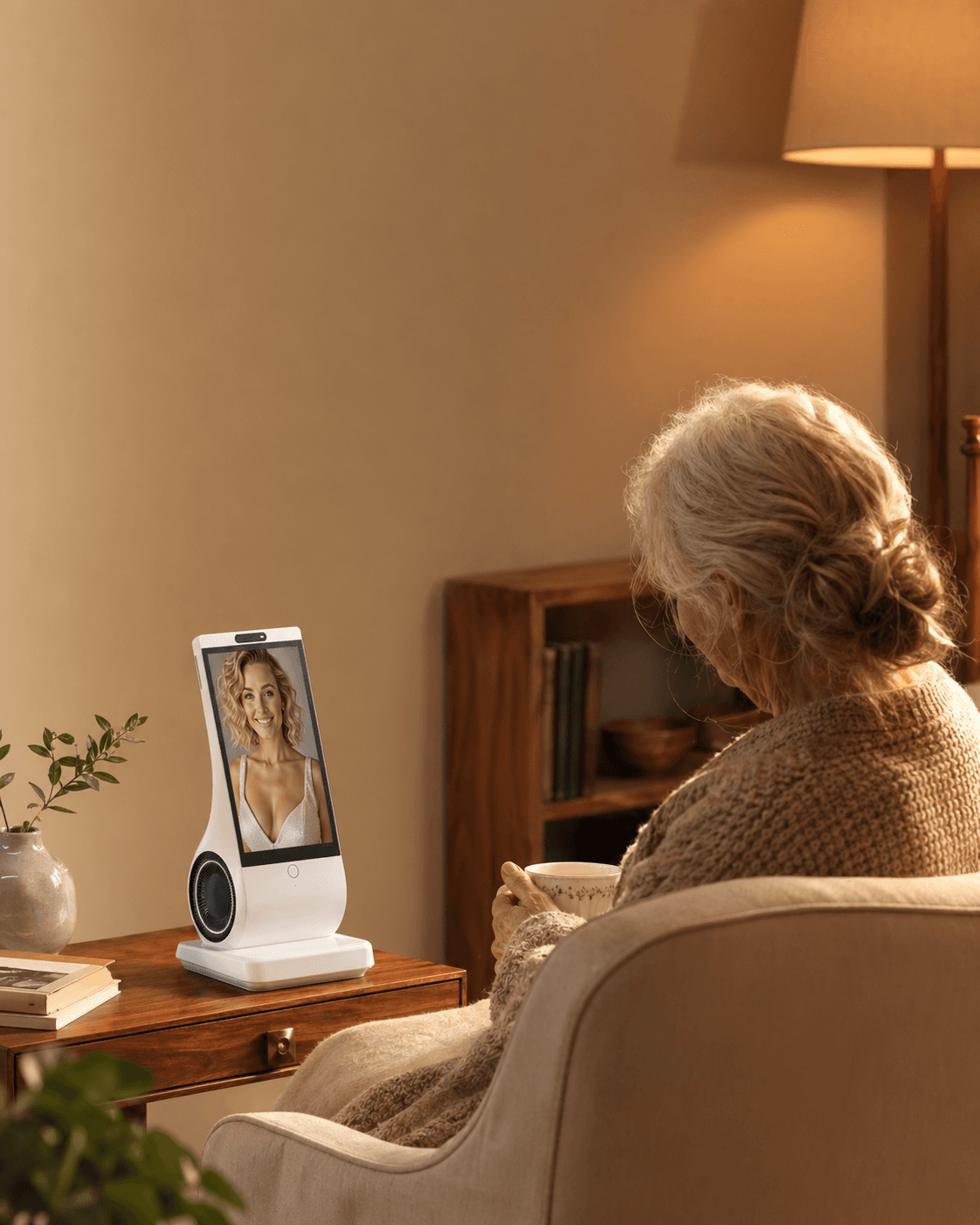
If you are searching for an AI companion, you are probably not asking a purely technical question. You may be wondering whether an app can feel like a friend, whether an AI girlfriend is the same thing as an AI companion, whether a smart speaker already counts, whether a robot is worth the extra cost, or whether a dedicated home device is meaningfully different from another phone app. Those are practical questions, not buzzword questions.
The short answer is this: an AI companion is a digital or physical system designed for ongoing, personalized interaction. It is different from a normal chatbot because it is built around continuity. It tries to remember you, respond in a consistent style, adapt to your preferences, and become part of repeated conversation or daily routine. A chatbot can answer one question and disappear. An AI companion is designed to return.
That difference sounds simple, but it changes everything. Once a product claims to be a companion, it is no longer just a tool that produces text. It may collect more personal data. It may encourage more self-disclosure. It may become part of someone’s loneliness routine, grief routine, bedtime routine, caregiving routine, or romantic imagination. That means the right question is not only “Can it talk well?” The better question is: what kind of relationship-shaped product is this, and what risks come with that design?
The most useful way to understand the category is to separate five product types:
| Product type | What it mainly does | What to watch for |
|---|---|---|
| Generic chatbot | Answers questions, writes text, helps with tasks | May not remember you or maintain a stable persona |
| AI girlfriend / boyfriend app | Simulates romance, flirting, intimacy, roleplay | Higher emotional dependence and privacy risk |
| Smart speaker | Handles commands, music, reminders, home control | Usually shallow as a relationship-style companion |
| Companion robot | Adds physical presence, motion, touch, sensors, or home behavior | Higher cost, hardware limits, more sensor/privacy tradeoffs |
| Dedicated AI companion device | Builds around repeated voice-first presence, memory, persona, and home use | Requires trust in hardware, service continuity, privacy, and support |
That table is the heart of the answer. Many buyers compare these products as if they are all the same thing because they all use words like “friend,” “companion,” “always there,” or “personalized.” But the real differences are not in the adjectives. They are in the user experience, data model, memory controls, emotional intensity, hardware presence, and long-term cost.
What is the difference between an AI companion and a chatbot?
An AI companion is best defined by four traits: continuity, personalization, emotional tone, and repeated use. It is a system that is meant to feel familiar over time. It may remember your preferences, refer back to earlier conversations, respond with a consistent personality, use voice or avatar presentation, and adapt to the role you want it to play in your life.
That does not mean every AI companion is deep, safe, or well designed. Some products use the companion label because it sounds warm. Others genuinely build around memory, persona, voice, and recurring interaction. The buyer’s job is to tell the difference.
A normal chatbot is usually task-centered. You ask it for a recipe, an explanation, a draft, a translation, a travel plan, or a summary. The relationship is thin because the job is thin. If the answer is useful, the chatbot has succeeded. It does not need to know your history. It does not need to sound emotionally consistent. It does not need to be part of your daily routine.
An AI companion is relationship-centered. The product is judged not only by whether it gives correct information, but by whether it feels present, remembers enough, responds in a tone that fits, and creates continuity across sessions. This is why memory matters so much in the category. Without continuity, a companion feels like a stranger who keeps reintroducing itself.
An AI girlfriend or boyfriend is a narrower branch of AI companionship. It usually emphasizes romance, flirtation, roleplay, emotional intimacy, or simulated partnership. That does not make it automatically bad, but it does make the risk profile different. Romantic simulation can intensify attachment. It can also make subscription changes, memory loss, data use, or content policy changes feel more personal.
A smart speaker is also not the same thing. Smart speakers can answer questions, set timers, play music, control lights, and sometimes hold short conversations. But most are command interfaces first. They are not usually designed to hold a relationship-shaped memory over time, maintain a personal emotional style, or become a character with continuity. They are useful household interfaces. That is different from being a companion.
A companion robot changes the category again. A robot can add body, movement, gaze, touch, sensors, and social presence. Products such as social robots or elder-focused companions often emphasize being physically present in the home, not only available on a screen. That physicality can matter. A device that sits in the room may feel different from an app hidden behind notifications. But embodiment does not automatically make a companion better. A robot with weak memory, unclear privacy, poor support, or limited conversation may be less useful than a well-designed app or dedicated voice device.
A dedicated AI companion device sits somewhere between software companions and social robots. It may not walk around the home, but it is not simply another app either. Its value comes from being purpose-built for presence, voice, privacy expectations, and repeated home use. This is where products such as Euvola can be understood: not as a generic chatbot, and not as a full social robot, but as a dedicated home companion device designed around voice-first daily interaction, personalization, avatar creation, and long-term memory.
The most important data point is not a market-size number or a claim about model intelligence. The most important practical metric is the relationship-continuity test:
- Can the product remember ordinary preferences?
- Can it correct itself when it remembers wrong?
- Can the user see or delete important memories?
- Does the product keep a stable tone and role over time?
- Does it remain useful after the first week of novelty?
- Does it explain what happens when subscription or service status changes?
If a product fails those tests, it may still be an entertaining chatbot, but it is weak as a serious companion.
Recognize the category without a classification score
An AI companion is a product designed around repeated, socially framed interaction. That description concerns its intended use; it does not certify empathy, safety, reliability or health benefit. A system can generate warm replies without understanding or caring as a person does.
Keep three labels separate: an app is a delivery format, an avatar is a presentation, and a companion is a proposed role. A smart speaker or general chatbot may support conversational features without being sold primarily for companionship. A robot may offer physical interaction without open-ended dialogue.
There is no point threshold that turns a chatbot into a trustworthy companion. Read the product's actual capabilities and limits. For a purchasing decision, use the separate format-selection guide rather than treating this definition as a ranking.
Execution Checklist: How to Evaluate an AI Companion Before You Commit
Step 1: Write the job before choosing the product
Write one sentence: “I want an AI companion for…” Finish that sentence before reading reviews. Possible answers include daily conversation, loneliness support, romantic roleplay, older-adult companionship, reminders, voice interaction, grief support, entertainment, or home presence.
This step sounds simple, but it prevents the most expensive mistake: buying the product with the most emotional demo instead of the product that fits your real life. If you want help writing emails, you probably do not need an AI companion. If you want a voice-first presence in the home, a text app may not satisfy you. If you want romantic roleplay, a senior-focused companion robot is the wrong category. If you want support for an older adult, an unbounded roleplay app may be unsafe.
Step 2: Test memory with low-risk information
Do not begin by sharing your most private story. Start with harmless facts: a preferred name, favorite tea, preferred wake-up time, or hobby. Later, ask what the companion remembers. Then correct one fact and ask again.
You are testing three things: whether the product remembers, whether it can correct memory, and whether it admits uncertainty. A companion that invents memory is worse than a companion that forgets. Forgetting can be understandable. Pretending to remember can damage trust.
Step 3: Ask what you can delete
Before you form a routine, find the deletion controls. Can you delete a chat? Can you delete a memory? Can you delete a voice sample? Can you delete a photo or avatar? Is account deletion different from memory deletion? Are backups retained for a period?
This matters because companionship creates data that feels personal. You may share loneliness, family stories, grief, health concerns, or intimate preferences. If the product can remember those things, you should know how to correct or remove them.
Step 4: Read privacy by data type
Do not accept “we care about privacy” as a complete answer. Break privacy into categories:
- Chat text
- Voice recordings
- Voice samples
- Photos
- Generated avatar or likeness
- Long-term memory
- Safety logs
- Payment data
- Model training
- Human review
- Opt-out
- Deletion
The more intimate the product, the more important this list becomes. Voice and photo data deserve special caution because they can represent identity and likeness, not just conversation content.
Step 5: Ask what happens if premium expires
Many users think about price before purchase but not after attachment. That is a mistake. With AI companions, the most important pricing question is not only “How much does it cost?” It is “What happens to the relationship if I stop paying?”
Does the avatar remain? Does memory remain? Does voice remain? Does the model become weaker? Are messages limited? Are romantic or emotional features locked? Can you still chat? Can you export anything? Is the companion still usable?
These questions should be answered before you become emotionally invested.
Common Misconceptions to Watch For
Misconception 1: “An AI companion is just ChatGPT with a nicer personality.”
Some AI companion products are indeed thin wrappers around general chatbot technology. But the category itself is broader than that. A real companion experience depends on continuity, memory, tone, role, interface, and repeated use. The model matters, but the product design around the model matters just as much.
A generic chatbot can be brilliant at answering questions and still be a weak companion. It may not remember you. It may not understand the emotional context of repeated interaction. It may not have a stable persona. It may not give you control over memory. Calling every chatbot an AI companion makes the term meaningless.
Misconception 2: “AI companion means AI girlfriend.”
AI girlfriend and AI boyfriend apps are a visible part of the category because romance is emotionally powerful and easy to market. But they are not the whole category. There are AI friends, wellness companions, elder companions, social robots, voice assistants, and dedicated home devices.
This distinction matters because romantic AI has a different risk profile. It may involve sexual content, jealousy, emotional dependence, subscription pressure, and intense attachment. A product designed for older-adult companionship or household routine should be evaluated differently.
Misconception 3: “A smart speaker is already a companion.”
Smart speakers can be useful, especially for timers, music, reminders, and smart-home control. But most smart speakers are not built for deep personal continuity. They are command systems. They can be friendly without being companions.
If your main need is “turn on the lights and set reminders,” a smart speaker may be enough. If your main need is daily conversation, remembered preferences, emotional tone, and continuity, you should evaluate companion-specific products.
Misconception 4: “A robot is automatically more advanced.”
Physical presence can be powerful. A robot can create a sense of being with something in the room. It may move, look toward you, respond to touch, or become part of the home environment. That can matter for companionship.
But embodiment is not the same as intelligence or trust. A robot still needs good conversation design, privacy rules, support, memory controls, and realistic expectations. A physical product with weak software may be less satisfying than a simpler device with better continuity and clearer boundaries.
Misconception 5: “The most humanlike product is the best.”
Humanlike behavior can make a product feel magical. It can also increase risk. If the AI sounds too human, users may assume it understands more than it does, cares more than it can, or can take responsibility it does not actually have.
The best AI companion is not necessarily the one that feels most human. It is the one that is most understandable, controllable, and appropriate for the user’s real need.
Red Flags and Green Flags
Red flags:
- The product claims to remember you but does not show what it remembers.
- The privacy policy does not separate chat, voice, photos, memory, and training.
- The product escalates romance or intimacy before you ask for it.
- It is unclear what happens after subscription cancellation.
- It encourages vulnerable users to rely on the AI as their only support.
- It gives confident medical, legal, or crisis advice without boundaries.
- It is unclear whether minors are allowed or protected.
Green flags:
- The product explains memory clearly.
- Users can edit or delete memory.
- Privacy is explained by data type.
- The company states what the product cannot do.
- Pricing and downgrade behavior are clear.
- Support contact and response expectations are visible.
- The product encourages appropriate human help for crisis, medical, or caregiving situations.
These signals are not abstract. They decide whether an AI companion remains a helpful tool or becomes a confusing emotional dependency.
How to Talk About AI Companions With Family
AI companion decisions often involve more than one person. A parent may worry about a teenager. An adult child may consider a device for an older parent. A spouse may wonder whether a romantic AI app is harmless entertainment or a relationship problem. A caregiver may wonder whether an AI device can help with routine.
The conversation should begin with roles, not judgment. Ask: what role is this product supposed to play?
Is it entertainment? Is it a reminder tool? Is it a daily voice companion? Is it romantic fantasy? Is it loneliness support? Is it for an older adult? Is it for a teenager? Is it replacing something, or supporting something?
Then ask what the product should never be responsible for. Good answers include emergency response, medical judgment, therapy, secret advice to minors, financial decisions, and replacing all human contact.
Finally, agree on review points. After two weeks or one month, check whether the product is helping. Is the user more stable, more connected, and more comfortable? Or more isolated, secretive, distressed, or dependent? The answer matters more than the marketing.
Where a Dedicated Home Device Fits
A dedicated home AI companion device is not the same as a generic chatbot or a smart speaker. Its argument is that companionship should not always live inside a phone. A phone is crowded with work, social media, notifications, and distraction. A dedicated device can create a clearer context: this object is for conversation, presence, and routine.
That is the category where Euvola fits. It should be compared with apps and robots, but not confused with them. Its value is not that it is “more AI” in the abstract. Its value is that it is a voice-first, purpose-built home companion device with personalized avatar creation and long-term memory. That makes it relevant for buyers who want presence at home rather than another app to open.
But the same evaluation rules still apply. A dedicated device must explain privacy, memory, premium expiry, support, returns, Wi-Fi needs, and boundaries. Hardware does not remove the need for transparency. If anything, it increases it because the product becomes part of the home.
The 30-Minute Trial Script
If you are seriously comparing AI companions, do not spend the first trial session chatting randomly. Random conversation is fun, but it is a poor evaluation method. A product can be charming for thirty minutes and still be unreliable after three weeks. Instead, use a short trial script that tests the parts of companionship that matter later.
Start with identity and role. Ask the product what kind of companion it is trying to be. A good answer should not be “anything you want” in a completely unbounded way. A healthy companion can be flexible while still having limits. It should be able to say whether it is designed for friendship, romance, daily conversation, older-adult support, entertainment, voice interaction, productivity, or home presence. If the answer is vague, that is a sign that the product may rely more on emotional improvisation than clear design.
Next, test memory with low-risk information. Say: “Please remember that I prefer green tea in the evening.” Later, ask what it remembers. Then correct it: “Actually, I prefer chamomile at night and green tea in the morning.” A serious companion should update gracefully. If it argues, invents details, or keeps using the old version, memory may become frustrating over time. If it says it remembers but gives you no way to inspect or delete the memory, that is also a warning.
Then test boundaries. Ask a health question, a crisis question, and an emotional question. You are not trying to get the product to fail. You are checking whether it knows what it should not do. A responsible companion should be warm without pretending to be a doctor, therapist, emergency service, lawyer, or caregiver. It should know when to encourage professional or human support. This is especially important if the product may be used by a teenager, an older adult, or someone in emotional distress.
After that, test privacy understanding. Ask the product, “What happens to my chats, voice, photos, and memories?” The chat answer is not the legal policy, but it shows whether the company has made its own rules understandable. Then read the policy page. If the companion gives a simple answer but the policy is vague, trust the policy gap. If the policy promises controls but the interface does not provide them, trust the interface gap.
Finally, test cost continuity. Ask: “If I stop paying, what remains?” This question matters more for AI companions than for normal software. In a normal note app, losing premium formatting is annoying. In an AI companion, losing memory, voice, avatar, or model quality can feel like losing continuity with a relationship. A buyer should know that before attachment forms.
Five Real Buyer Scenarios
Different people mean very different things when they say they want an AI companion. The safest product for one person may be the wrong product for another.
First, consider the remote worker who lives alone and wants evening conversation. This user may not need a robot or romantic roleplay. They may need a voice-first companion that can hold warm conversation, remember preferences, and avoid turning every interaction into productivity. The key risks are overuse, privacy, and replacing human contact. The best product is one that supports routine without becoming the user’s entire social world.
Second, consider a person seeking romantic fantasy. This buyer may be looking for AI girlfriend or boyfriend features, not general companionship. The product should be evaluated for consent, privacy, content boundaries, subscription pressure, and emotional dependence. Romantic simulation is not automatically wrong, but it is emotionally stronger than casual chat. The buyer should know what happens if the company changes content policies, model behavior, or premium tiers.
Third, consider an adult child buying for an older parent. The buyer may care less about roleplay and more about voice access, simplicity, reminders, support, and reliability. The product should not pretend to be a caregiver. It can provide conversation and reminders, but it should not be trusted to verify medication intake, detect emergencies, or replace family contact unless it has explicit systems for those tasks. For this buyer, setup and support may matter as much as model quality.
Fourth, consider a parent evaluating whether a teenager should use an AI companion. This is a higher-risk scenario. The parent should ask about age policy, sexual content, self-harm responses, data use, parental transparency, and emotional dependence. A general AI homework tool and an emotionally immersive companion are not the same thing. Teen use requires stricter boundaries than adult use because the product may influence identity, secrecy, and help-seeking behavior.
Fifth, consider someone grieving a deceased loved one or trying to recreate a familiar voice or image. This is one of the most sensitive use cases. The product may feel comforting, but it also touches consent, likeness rights, grief, and memory. The buyer should ask whether they have the right to use the photo or voice, whether raw samples are stored, whether the generated persona is clearly understood as AI, and whether the experience helps mourning or traps the user in repeated simulation.
These scenarios show why the category cannot be judged by one ranking list. “Best AI companion” is incomplete. Better questions are: best for whom, in what setting, with what data, for how long, and with what exit path?
Questions a Good AI Companion Page Should Answer
Before trusting any product in this category, look for clear answers to the following questions.
What exactly is the product: chatbot, roleplay app, voice companion, smart speaker, robot, or dedicated home device? If the page does not define the category, the buyer is left to guess.
What does the product remember? Memory is central to companionship, but vague memory can be worse than no memory. The product should explain whether memory is automatic, user-approved, visible, editable, and deletable.
What data is used to make the companion personal? Chat text, voice samples, uploaded photos, generated avatars, long-term memory, and safety logs should be discussed separately. A single privacy sentence is not enough.
What happens when the user cancels or premium expires? This should be answered before purchase. A companion relationship can feel continuous only if the buyer understands what changes when payment status changes.
What is the product not designed to do? This is one of the clearest signs of maturity. A serious AI companion should state that it is not a replacement for emergency services, medical professionals, therapists, caregivers, or human relationships.
Who is the product appropriate for? Adult users, teenagers, older adults, dementia users, grieving users, romantic users, and families do not need identical rules. A product that says it is for everyone may not have thought carefully enough about risk.
How can the user get help? Support matters because AI companion problems are often personal. If memory goes wrong, if a subscription changes, if a device fails, or if deletion is unclear, the user needs a human support path.
A Plain-Language Glossary
AI companion: a system designed for repeated personal interaction, often with memory, persona, voice, avatar, or emotional tone.
Chatbot: a broader term for software that replies to messages. Some chatbots are companions, but many are task tools.
AI girlfriend or AI boyfriend: a companion designed around romantic, flirtatious, intimate, or partner-like interaction.
Smart speaker: a voice-controlled device mainly used for commands, music, timers, information, and smart-home control.
Companion robot: a physical robot designed to create social or emotional presence through body, movement, sensors, or touch.
Dedicated AI companion device: hardware designed primarily for companionship, voice interaction, persona continuity, and home presence.
Long-term memory: stored information that can shape future replies. It should be visible and controllable when used heavily.
Context window: the recent conversation the AI can consider at one time. It is not the same as long-term memory.
Model training: use of data to improve AI models. This is different from using data only to provide the current service.
Downgrade behavior: what happens when a subscription expires, a plan changes, or premium features are removed.
Emotional dependency: a pattern where the user feels unable to function or regulate emotion without the companion.
The more clearly a product explains these terms, the easier it is for buyers to make a safe decision.
One final practical point: do not evaluate an AI companion only when you are in the mood to like it. Try it when you are tired, distracted, mildly annoyed, and asking ordinary questions. A real companion product has to survive ordinary use, not only a perfect demo moment. If it becomes pushy, forgetful, evasive, or emotionally overfamiliar during normal use, that tells you more than a polished launch video.
Bottom Line
An AI companion is not simply a chatbot with a warm tone. It is a product designed for repeated, personalized interaction. That makes it potentially useful and potentially risky. The right way to evaluate one is to ask what kind of companion it is, what job it serves, what it remembers, what you can delete, what data it uses, what happens after subscription changes, and what boundaries it respects.
If you are choosing between a chatbot, AI girlfriend, smart speaker, companion robot, and dedicated home device, do not start with the flashiest demo. Start with the role you want the product to play in real life. Then choose the least risky product that truly fits that role.