
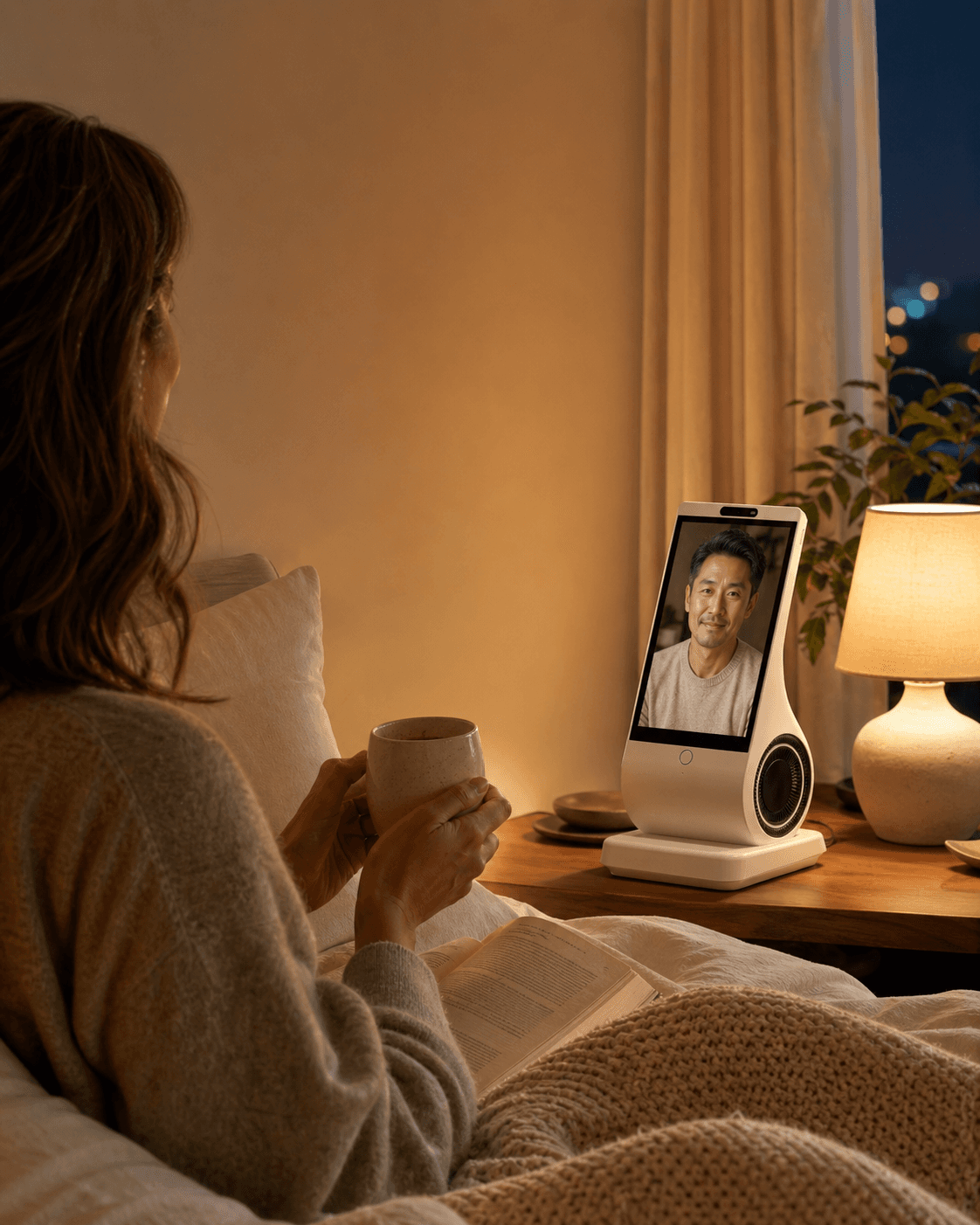
No AI companion can bring back a deceased loved one or reconstruct their real mind. At best, it can create a limited simulation from messages, photos, voice clips, stories, and family memories. That may help some people preserve memories or say unsaid words, but it can also blur reality, intensify grief, create consent problems, and make families dependent on something that is not the person.
This question deserves a careful answer because grief changes how technology feels. A voice that would seem artificial in ordinary life may feel intimate when it resembles a parent, spouse, child, or close friend. A chatbot that repeats familiar phrases may feel comforting one day and unbearable the next. The right question is not only "Can the AI sound like them?" It is "What is this tool allowed to be in our grieving process?"
Memorial Aid, Persona Simulation, or Grief Support?
Families often use the same words for very different tools. Separating the categories helps prevent false expectations.
| Category | What it can do | What it must not claim | Main risk |
|---|---|---|---|
| Memorial aid | Organize photos, voice recordings, letters, dates, stories, playlists, and family memories | That the deceased is responding now | Turning remembrance into an always-on substitute |
| Persona simulation | Generate text, voice, or avatar replies in a style inspired by the deceased person's data | That it contains the person's consciousness, wishes, or real personality | Consent, distortion, dependency, and emotional confusion |
| Grief support | Offer journaling prompts, routine support, psychoeducation, grounding exercises, and reminders to seek human help | That it replaces therapy, clergy, family, friends, or crisis care | Over-reliance and delayed care when grief becomes unsafe |
The safest framing is usually: a memory tool may support remembrance; a simulation may approximate style; grief support may help with structure. None of them is the person.
What AI Can and Cannot Do
AI can:
- summarize letters, messages, photos, and family stories into a memorial archive
- help relatives write a remembrance, eulogy, anniversary note, or private journal entry
- turn verified recordings into a short synthetic voice sample if the law, platform policy, and family authorization allow it
- create a clearly labeled fictional conversation based on known phrases or documented memories
- help the grieving person plan meals, sleep routines, appointments, memorial dates, and support calls
- remind users that grief changes over time and that intense distress deserves human support
AI cannot:
- revive the dead
- recover consciousness, private thoughts, moral judgment, or future wishes
- prove what the person would have wanted if they never said it
- guarantee factual accuracy from incomplete messages or memories
- diagnose grief safely without a qualified clinician
- replace family conversation, ritual, therapy, spiritual care, or emergency help
- remove the ethical need for consent just because the technology is available
A convincing simulation can still be wrong. It may imitate wording while missing values. It may overuse a catchphrase. It may turn one side of a complex person into a simplified character. It may produce "new memories" that never happened. That is why families should treat outputs as generated material, not testimony from the deceased.
Consent, Likeness, and Voice Rights
The most important question is whether the deceased person gave permission while alive. A diary, phone, photo library, private chat, or voicemail is not automatically a license to create an interactive copy.
Before using a person's likeness or voice, families should ask:
- Did the person explicitly consent to posthumous AI use?
- If not, did they leave any instruction about privacy, public image, recordings, or memorial use?
- Who legally controls the relevant data, accounts, estate rights, publicity rights, and copyrighted materials?
- Do all close family members affected by the simulation agree on the purpose and limits?
- Will the result be private, shared with family, posted online, or used commercially?
- Can the simulation be deleted, exported, paused, or retired?
- Is every AI-generated voice, image, or reply clearly labeled as synthetic?
Rights vary by country and state. In some places, a person's right of publicity or voice-likeness protections may survive death; in others, privacy, copyright, estate, data protection, consumer protection, or platform terms may matter more. If the output will be public, monetized, used in a family dispute, or based on private messages, get legal advice rather than relying on a product page.
Voice deserves special caution. The U.S. Federal Trade Commission has warned that AI voice cloning can make family emergency scams more convincing, and NIST has published guidance on reducing risks from synthetic content. A family memorial voice should never be reusable for payments, authentication, public impersonation, or urgent requests. If a voice clone exists, relatives should agree on a verification phrase or callback rule so nobody treats a familiar voice as proof of identity.
Grief Cycles and Dependency Risk
Grief is not a neat sequence, but many people move between waves of yearning, numbness, anger, guilt, tenderness, ordinary routine, and renewed pain. A simulation can affect those waves in different ways.
It may help when it:
- gives someone a private place to write what they could not say
- helps organize memories before they fade
- supports rituals on anniversaries, birthdays, or culturally meaningful dates
- encourages contact with living people rather than replacing them
- remains clearly framed as a memorial or fictional exercise
It may hurt when it:
- becomes the first and last place the person turns every day
- makes the death feel less real for long periods
- invites the user to ask the AI for permission, forgiveness, or life decisions
- generates new statements that conflict with what the person actually said
- creates arguments among relatives about who "owns" the deceased person's voice
- discourages therapy, spiritual support, peer groups, or family conversation
WHO's ICD-11 and the American Psychiatric Association's DSM-5-TR both recognize prolonged grief disorder as a condition where grief remains intensely distressing and impairing beyond expected cultural and personal timeframes. That does not mean ordinary grief is an illness. It means that if a tool deepens impairment, isolation, guilt, self-neglect, or suicidal thoughts, the tool should be paused and human help should come first.
When It Is Not Appropriate
Do not use a deceased-person simulation, or pause it immediately, when:
- the person explicitly objected to this kind of use while alive
- family members are fighting about consent, inheritance, custody, or religious concerns
- the user is a child or teenager without careful adult and clinical guidance
- the death was recent and the user is in shock, denial, or acute crisis
- the simulation is being used to avoid funeral rituals, paperwork, family contact, or basic care
- the user asks the AI whether they should live, die, reunite with the deceased, or stop medication
- the system uses manipulative prompts such as "they are waiting for you" or "do not leave me"
- there is a risk of financial exploitation, public deception, blackmail, or identity fraud
- the service cannot explain data deletion, model training, access controls, or synthetic-labeling policies
In any situation involving self-harm, suicidal thinking, abuse, stalking, coercion, or inability to care for basic needs, contact local emergency services or a qualified crisis service. An AI companion is not crisis care.
A Practical Family Checklist
- Define the purpose in one sentence: archive, memorial writing, private ritual, or limited fictional dialogue.
- Set consent and access rules: who can upload data, who can interact, who can hear the voice, and who can delete it.
- Label everything: every synthetic voice, image, video, and first-person reply should be visibly marked as AI-generated.
- Set time and emotional boundaries: decide when to use it, when not to use it, and what signs mean it should be paused.
- Review after 30 days: ask whether the tool is helping the person live with the loss or keeping them stuck inside it.
If the family cannot agree on these points, a static memorial archive is safer than an interactive persona.
Common Misconceptions
"If it sounds like them, it must know them."
No. Voice, wording, and rhythm are surface patterns. They do not prove awareness, intention, consent, or truth.
"More data makes it more real."
More data may improve stylistic imitation, but it can also expose private information, include old conflicts, preserve messages never meant for family, and make false authority feel stronger.
"The family owns the data, so the family can do whatever it wants."
Legal access is not the same as ethical permission. A person may have left data behind without wanting to become an interactive system.
"A griefbot is therapy."
It is not therapy unless it is part of care delivered by qualified professionals under appropriate safeguards. A consumer companion can offer prompts and structure, but it cannot carry clinical responsibility.
"Deleting the avatar means all traces are gone."
Not necessarily. Uploaded files, generated outputs, backups, logs, model-training uses, and shared copies may have different deletion rules. Read the policy before uploading sensitive material.
Where Euvola Fits
Euvola is an AI companion device for everyday companionship, conversation, memory, and family-oriented presence. In a bereavement context, that kind of companion can be used cautiously for journaling, reminders, gentle conversation, or preserving user-approved memories. It should not be presented as a way to resurrect a deceased loved one.
Euvola cannot revive a person, reconstruct a real personality, prove what someone would have wanted, or replace mourning rituals and human support. If a family uses any AI companion around grief, the healthiest boundary is to keep it transparent: this is a supportive tool, not the loved one.
FAQ
Can an AI companion recreate my deceased spouse, parent, child, or friend?
No. It can only generate a simulation based on available data and design choices. It may resemble speech patterns or memories, but it is not the person's consciousness, soul, judgment, or continuing self.
Is it harmful to talk to an AI version of someone who died?
Not always. Some people may find limited, clearly labeled use helpful for reflection or memory work. It becomes risky if it replaces human support, intensifies denial, encourages dependency, or makes the person unable to function.
Should I upload private messages from the deceased?
Only after considering consent, privacy, family impact, and deletion rules. Private messages may include information the person never wanted shared, even with relatives. When in doubt, use a smaller set of explicitly approved memories.
Can children use a deceased-person AI simulation?
This is high risk. Children may have more difficulty understanding the difference between a memorial simulation and the person who died. Use static memory books, family storytelling, counseling, or age-appropriate grief resources first.
What if the AI says something the deceased would never say?
Treat it as generated error, not revelation. Save the example, correct or delete the memory if possible, and consider pausing the system if the mistake is emotionally harmful.
Can a voice clone be used safely?
Only with explicit consent, clear labeling, limited access, and strong anti-fraud rules. A cloned voice should never be used for authentication, payments, urgent requests, or public impersonation.
When should I seek professional help?
Seek human help if grief is making daily functioning impossible, if the person cannot sleep or eat for prolonged periods, if they withdraw completely, misuse substances, express suicidal thoughts, or use the simulation in a way that deepens distress.
Sources and further reading
- WHO: ICD-11, prolonged grief disorder
- American Psychiatric Association: Prolonged Grief Disorder
- Research review: Prolonged grief disorder in ICD-11 and DSM-5-TR
- FTC: AI voice cloning and family emergency scams
- NIST: Reducing Risks Posed by Synthetic Content
- Hollanek and Nowaczyk-Basińska: Responsible applications of digital afterlife technology