
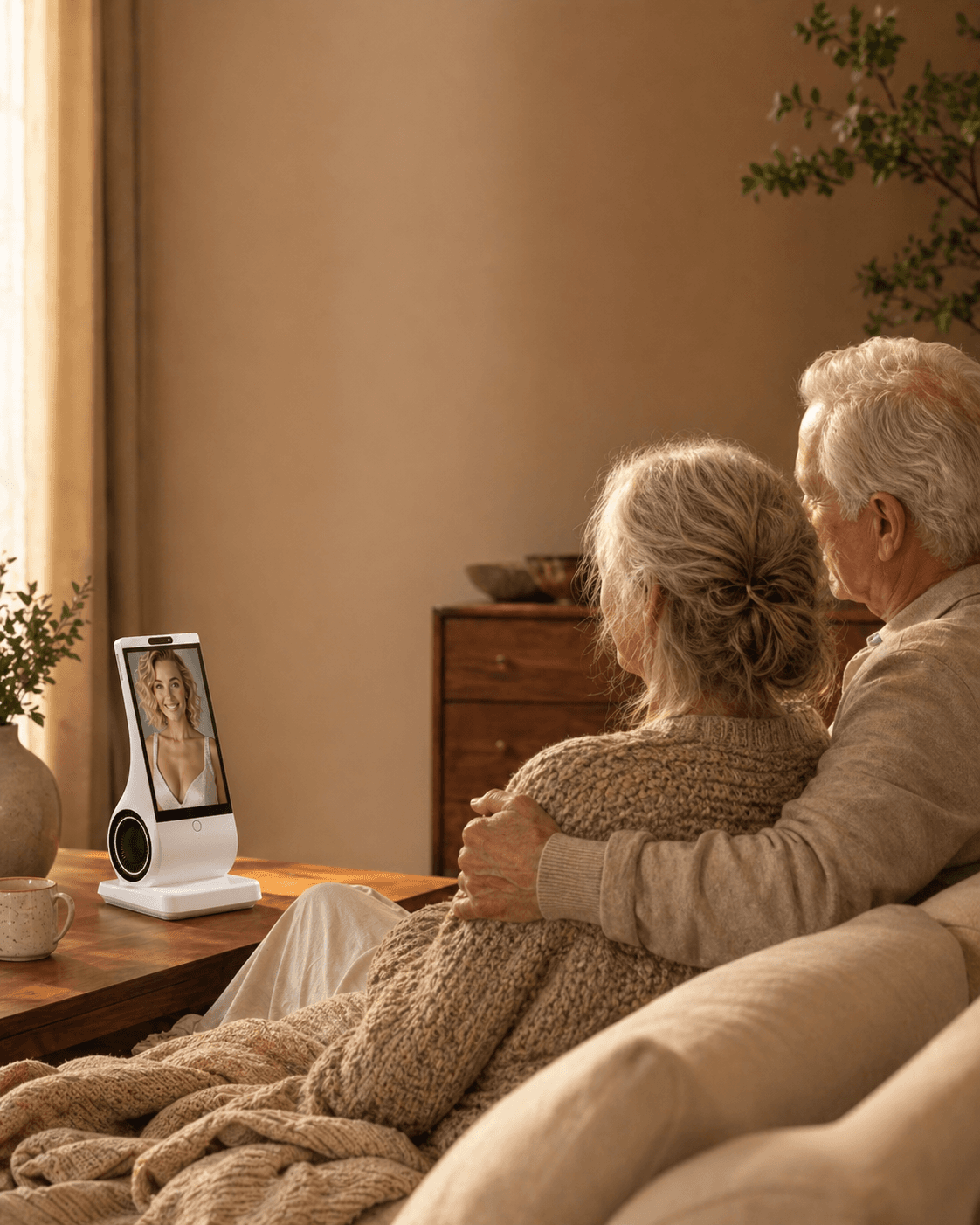
Choose the form of company your parent actually wants and can sustain. A live pet offers touch, reciprocity, and a real relationship, but only when daily care and lifetime backup are secure. A robotic pet can provide tactile, predictable interaction without animal-welfare duties. A conversational AI can offer open-ended speech but not touch, pet care, human friendship, or emergency help. Ask your parent first, compare an ordinary bad day—not an ideal day—and trial reversible options before buying.
Reviewed and updated: September 15, 2026
The Sunday-afternoon decision
Your mother’s house has been quiet since the cat died. She still manages her own meals and bills, but she no longer drives at night. On the phone she says she misses “another heartbeat in the room.” You start looking at rescue cats. Your brother asks who will clean the litter box after her next operation. A friend suggests a robotic cat. An advertisement offers an AI companion that talks. By Sunday afternoon, the family group chat has turned one sentence—“Mum is lonely”—into three shopping carts.
The carts hide three promises. A living animal’s needs do not pause when the owner is tired, ill, hospitalized, or moving. A robotic pet offers shape, sound, movement, and touch without animal-welfare duties. Conversational AI offers words and continuity, but cannot curl against a hand, ask to be walked, or love as an animal loves. None creates a dependable human network.
The best answer may be one of those options, a combination, or no purchase at all. The honest decision begins with two people: the older adult who will live with the choice, and the person who will inherit its work when a difficult week arrives. If those are not the same person, the second person needs a voice before a living animal comes home.
Do not use one word for four kinds of company
Families often say “companionship” as if a dog, a plush robot, a voice device, and a neighbour provide interchangeable units of it. They do not. Ask which experience is missing.
Touch and bodily presence
Somebody wants warmth on a lap, fur under a hand, a reason to sit in the garden, or the small domestic noises of another creature moving through a room. A living cat or dog can provide this. A tactile robotic pet may provide a narrower version: weight, softness, purring, movement, or a response to stroking. A tabletop conversational device generally cannot.
If touch is the need, an eloquent voice may still feel like the wrong answer. Do not call that resistance to technology. It is a correct description of the job.
Reciprocal care
Feeding an animal, changing water, grooming, arranging a walk, and noticing that something is wrong can create purpose. That purpose comes from real dependence: the animal needs its person. It also creates an ethical obligation. When family members praise the routine a pet might bring, they must also ask whether the animal will receive reliable care on the owner’s worst ordinary day.
A robotic pet can invite nurturing gestures, but it does not depend on them for welfare. An AI companion may remember preferences and respond to conversation, but its apparent need is designed behavior, not the vulnerability of a living creature. That difference should be stated, not blurred.
Open-ended conversation
A person may want to tell a story, ask a question, complain about the weather, hear a response, or pick up a topic from yesterday. A conversational AI is built for this form of interaction. A smart speaker may handle shorter commands. Some advanced robot pets also accept speech, although the depth, reliability, and privacy model vary widely. A simple therapeutic-style robotic cat may purr or meow but will not discuss a grandchild’s visit.
When conversation is the missing job, compare actual turn-taking, recognition of the parent’s voice, repair after a misunderstanding, volume, language, memory controls, and what happens when the service or Wi-Fi fails. A demonstration in a quiet shop is not a home trial.
Human belonging and practical backup
A friend remembers a shared past. A neighbour can knock on the door. A visiting volunteer can notice that the heating is broken. A relative can drive to an appointment. A qualified caregiver can perform assigned care. A crisis service can respond to danger. Pets and companion technologies may enrich a day, but they do not collectively become that network.
The World Health Organization describes social connection through the structure, function, and quality of relationships. A household can gain more sound and interaction while still lacking nearby people, transport, mutual support, or someone able to act. Keep “company in the room” and “people who can show up” as separate lines in the family plan.
A comparison for an ordinary bad day
Do not compare an affectionate rescue profile with a glossy robot video and an AI demo. Compare what happens on a rainy Tuesday when the parent slept badly, the floor needs cleaning, the internet drops, and the usual helper is away.
| Question | Live pet | Tactile robotic pet | Conversational AI companion | No-purchase human or animal contact |
|---|---|---|---|---|
| What does it offer best? | Living relationship, touch, reciprocal care, and sometimes outdoor routine | Predictable touch, sound, and pet-like response | Open-ended voice interaction, stories, questions, and remembered context where supported | Reciprocal human contact, real-world help, or contact with animals without ownership |
| What does it require every day? | Food, water, hygiene, exercise or enrichment, supervision, money, and veterinary access | Batteries or charging, cleaning, storage, and willingness to engage | Power, internet where required, account/setup help, updates, privacy choices, and troubleshooting | Scheduling, transport, reliable people or programmes, and often fees or volunteer availability |
| What happens on a bad day? | The animal still needs full care | It can be switched off without harming a living being | It can be paused, though service dependence and frustration remain | A visit can be cancelled, but dependable contact requires rescheduling and backup |
| What can go wrong? | Falls, bites or scratches, allergies, waste, neglected needs, vet bills, housing conflict, or emergency rehoming | Rejection, infantilizing presentation, repetitive behavior, mechanical failure, or novelty fading | Misunderstanding, inaccurate answers, privacy loss, dependence, subscription/service change, or reduced human contact | Poor match, safeguarding concern, inconsistency, transport barrier, or unwanted intrusion |
| Is the choice easily reversible? | Usually no; a living creature cannot be treated as a trial object | Usually yes if a return or lending option exists | Usually yes if return, deletion, and cancellation terms are clear | Often yes when the first meeting or visit is explicitly a trial |
| Can it respond to an emergency? | No reliable emergency response | No | Not unless a specific, independently verified emergency function exists; a companion label proves nothing | Only if a real person is present, reachable, and assigned that responsibility |
This table does not rank affection. It exposes obligations. A live pet is not “high maintenance technology.” It is a life. A robot is not “the same without vet bills.” An AI voice is not “a patient family member.” Each option earns its place by matching a specific need without borrowing abilities from another category.
What the evidence says—and refuses to say
Pet and robot marketing tends to begin with benefits. Family decisions are safer when they begin with uncertainty.
A 2026 umbrella review of human-animal interaction in adults aged 60 and over synthesized earlier reviews. It reported signals including social interaction in facilities, walking among dog owners, and older adults’ descriptions of emotional support, sensory engagement, and reciprocity. It also recorded burdens such as concern for an animal’s health and pet-related expense. The type of contact, setting, and study design varied. “Animals can matter deeply” is supported; “buying a pet will solve this parent’s loneliness” is not.
A 2022 systematic review of pet ownership, loneliness, and social isolation found that only part of the included observational literature detected the hoped-for association. Results differed across outcomes and periods. Ownership is also not the same exposure as a structured visit from a trained animal. A family should not turn an association into a prescription.
The newest useful caution is a 2026 systematic review and meta-analysis of live and robotic animal-assisted interventions. Across its pooled results, it did not find a significant effect on loneliness, and it rated certainty for loneliness low to very low. It reported other outcome signals, but those do not justify relabeling a pet or robot as treatment for a lonely individual. This is why this article speaks about a voluntary companionship trial, not therapy.
Research on social robots is not a single verdict either. A 2024 meta-analysis of randomized trials in long-term-care settings and a 2025 meta-analysis of AI-enabled social robots reported potential. Setting matters: facilitated residence sessions are not equivalent to shipping a consumer device to a parent living alone.
Older adults are not a uniform “user group.” A study of robotic-pet use among community-dwelling older adults and research on dignity, autonomy, and preferred styles of robot company show why a person’s own response belongs at the centre. Some enjoy a clearly artificial pet. Some find pet-like behaviour warm and undemanding. Others find the same object childish, uncanny, noisy, or irrelevant. The ethical response is not to persuade harder. It is to offer an honest description and an easy refusal.
Evidence can help set expectations. It cannot choose on behalf of the person who will share the room.
The PAWS fit test: fifteen points before a living animal
Use PAWS to slow the family down. It is a decision aid, not a medical or capacity assessment. Score each statement only when it is true on a normal week and reasonably true on a bad week. A low result does not mean the parent does not deserve companionship. It means a living animal should not be the first experiment.
P — Preference, 0 to 4
Give one point for each statement:
- The parent—not only the children—has repeatedly asked for this species or individual animal.
- The parent understands the daily work and still wants it.
- The animal’s likely noise, touch, activity, and temperament fit the parent’s preferences.
- Everyone living in the home freely agrees, including anyone with allergies, fear, religious or cultural concerns, or an existing pet.
A nostalgic memory of a calm dog twenty years ago is not consent to today’s puppy. “She used to love cats” is not the same as “She wants to care for this cat now.” If family members are planning a surprise, the score is zero until the parent sees the real proposal and can say no without spoiling a gift.
A — Ability on a bad day, 0 to 4
Give one point for each statement:
- Food, water, toileting, cleaning, grooming, exercise, and supervision can happen reliably.
- The parent can move safely around the animal, bowls, litter, leads, toys, and gates in the actual home.
- Veterinary visits, routine transport, medications, and urgent transport have a named route.
- Expected and unexpected costs can be paid without sacrificing the parent’s essentials or the animal’s care.
Do not score from the parent’s strongest morning. Use the day after a poor night, during bad weather, and the week after a minor procedure. If ability depends on an adult child “probably helping,” move that help into the next section and name it.
The historical CDC analysis of pet-related fall injuries used United States emergency-department data from 2001–2006. In that old dataset, injury rates associated with cats and dogs increased with age, and tripping, being pushed or pulled, walking dogs, and pet items appeared in the circumstances. The data are dated and incomplete; they cannot calculate a parent’s current personal risk. They do justify walking through the home, lead, bowls, litter, lighting, stairs, and animal behaviour instead of assuming that a smaller animal is automatically safe.
W — Welfare backup, 0 to 4
Give one point for each statement:
- A primary backup person has explicitly agreed to daily animal care during illness or travel.
- A second route—paid walker/sitter, boarding, neighbour, rescue, foster, or family—is available if the first fails.
- The family has a written plan for hospitalization, relocation, loss of capacity, or death.
- The backup plan protects the animal for its likely lifetime, not only for the next six months.
The ASPCA’s planning guidance recommends naming emergency and permanent caregivers, keeping the animal’s habits and medical information available, checking that caregivers remain willing, and considering future costs. That standard does not become optional because the intended owner is lonely.
The backup person must say yes. Do not write “daughter will take the dog” when the daughter has not agreed, has incompatible animals, rents a no-pet home, travels, or cannot absorb veterinary costs. An assumed heir is not a plan.
S — Social fit, 0 to 3
Give one point for each statement:
- The option adds something the parent specifically misses: touch, purposeful care, outdoor routine, or animal company.
- It complements rather than replaces a minimum schedule of human contact.
- There is at least one outward link, such as a walking neighbour, veterinarian, groomer, pet visitor, training class, or family routine.
A pet can open a social door; it can also make leaving home harder. A cat may make a quiet house warmer while doing nothing about transport or nearby help. A dog may create walks, yet a parent who cannot manage the lead may become more housebound. Score the routine you can see, not the story the family hopes to tell.
How to read the score
- 13–15: Continue to species, temperament, age, housing, and veterinary discussions. The score permits further evaluation; it does not approve an animal.
- 9–12: Solve every zero before proceeding. A foster arrangement, regular visiting animal, shared-care plan, or older well-matched animal may reveal a safer route.
- 0–8: Do not use a living animal as the first loneliness experiment. Try reversible human contact, animal visits, a tactile robot, or a conversational option that matches the missing job.
A single zero in welfare backup should block an adoption even when the total looks high. Arithmetic must not hide a living creature’s unmet need.
Four lanes, including the option not to buy
Lane 1: a living animal
A live pet is the strongest match when the parent wants a particular animal relationship and the household can care for that animal for life. The reward is mutual unpredictability: the animal chooses, needs, ages, and asks the person to adapt.
That reciprocity can be meaningful. It can also become work silently transferred to family. Before adopting, list the boring tasks by time: first thing in the morning, midday, evening, weekly cleaning, preventive care, grooming, supplies, and transport. Then list the unpleasant exceptions: diarrhea at night, a frightened animal at the vet, a torn lead, a missed walker, a housing inspection, or the parent’s unexpected hospital stay.
Do not solve the question by saying “get an older dog” or “cats are easy.” An older animal may be calmer but can have medical needs. A cat still needs clean litter, enrichment, observation, transport, and a plan. A small dog can still pull, bark, need training, or live for years. Ask a veterinarian and a reputable shelter or rescue about the actual animal, not a stereotype.
Sometimes the best animal answer is borrowed contact: fostering with a genuine return arrangement, pet-sitting for a familiar neighbour, visiting a relative’s animal, a therapy-animal programme, or helping at an appropriate shelter activity. These options still require safety and suitability checks, but they do not automatically create a lifetime custody transfer.
Lane 2: a tactile robotic pet
A robotic pet is a better match when the missing experience is touch, soothing repetition, or pet-like response, while live-animal care is unavailable or unwise. Simpler models may react to stroking with movement or sound. More complex models may roam, recognize voices, use cameras, connect to apps, or depend on cloud services. “Robot pet” describes a shape, not a consistent privacy or capability standard.
Present it truthfully. “This is a soft robotic cat that purrs when stroked” preserves choice. Pretending it is alive to force acceptance can damage trust. A person may knowingly enjoy make-believe, just as an adult enjoys a film, doll, game, or model railway. Knowledge that something is artificial does not cancel pleasure.
Do not assume that a pet-shaped object is more dignified than a screen. Some people adore animal form; others dislike toys or find repetitive sounds irritating. Let the user handle a demonstration or loan unit. Watch whether they choose it without prompting.
Check practical details: weight, texture, cleanability, volume, moving parts, battery type, charging steps, buttons, repair or replacement, return policy, and whether the device can move into a walking path. If it has microphones, cameras, an app, Wi-Fi, accounts, or cloud AI, apply the same privacy review as any connected device.
Lane 3: a conversational AI companion
A conversational AI is a better match when the parent wants speech: questions, stories, reflection, games, information, or a thread that continues across days. It can sit in the quiet part of the schedule without requiring a living animal’s care. It cannot reproduce the touch, smell, warmth, autonomy, or mutual dependence of a pet.
The word “conversation” hides variation. Products may wait or prompt, remember or reset, live in an app or dedicated hardware, use cameras or remain camera-free, and charge once or require a subscription. Recognition may change with accent, language, voice, hearing, noise, and network quality.
Test the parent’s ordinary speech. Can they begin, interrupt, correct a name, ask it to repeat, change the volume, and end the interaction? Can they tell when it is listening? If it gives a wrong answer, does the experience remain harmless, or will the parent rely on it for medicine, money, transport, or safety? The more consequential the use, the less appropriate an unverified conversational response becomes.
Connected companions deserve a continuity audit. Ask what data enters the service, how long it is stored, who can access it, whether it is used for model improvement, how deletion works, which functions stop without payment, how long security updates are promised, and what happens if the company or cloud service changes. The FTC’s connected-device advice recommends changing default credentials where applicable, using available security features, installing updates, and disabling unused functions. The agency also warns consumers to ask how long smart-device software support will last.
Lane 4: no purchase
No purchase is not neglect. If the parent misses animals but not ownership, arrange a visit with a known animal, investigate a reputable visiting-animal programme, or ask a shelter about safe volunteer roles. If the parent misses being expected somewhere, a weekly class may do more than an object. If the house feels silent, radio, audiobooks, music, a shared programme, or calls may be enough.
The money not spent on a device might fund a dog walker for an existing pet, transport to an activity, hearing support, a cleaner who makes hosting possible, or a regular human companion. Start with the bottleneck. Buying “company” while leaving the bottleneck untouched is how well-meant gifts become clutter.
A fourteen-day trial for a robot or AI companion
Use the same trial discipline for a tactile robot or conversational device, but judge each by its assigned job.
Before day one
Write one sentence: “We are trying this because you said you miss [what] at [time].” Record who owns the device and account, what it costs now and later, what data it uses, who can access anything, how to mute or switch it off, how to return it, and which human contacts will remain unchanged.
For an AI device, configure privacy choices with the parent present. Do not secretly enable family access, recording, model improvement, or monitoring. For a robotic pet, agree on where it will sit and whether sounds or movement should be off at night.
Days 1–3: one job in one room
Test ten or fifteen minutes at the difficult time of day. Do not spend the whole session demonstrating features. Let the parent initiate or respond. For a tactile pet, notice whether touch is inviting and whether sound or movement startles. For AI, test ordinary voice, interruption, correction, repeat, volume, and ending.
Days 4–7: allow imperfection
Use the real room with television noise, ordinary light, visitors, and the usual internet. Let a day pass without family prompting. A device that works only while an adult child operates it has not yet become the parent’s option.
Record friction, not only delight. Was it hard to charge? Did it block a path? Did speech recognition fail? Did the parent worry about being watched? Did a repetitive sound become irritating? Did an inaccurate answer matter?
Days 8–12: connect outward
Give the option one bridge to the wider world. A robotic pet might sit during a real visitor’s call and prompt conversation. An AI companion might help the parent prepare a question for a grandchild, choose music for a shared listening time, or plan a call. The device need not perform these tasks autonomously; the test is whether its use supports a human activity rather than displacing one.
Days 13–14: ask privately, then decide
Ask the parent when the buyer is not defending the purchase: “Would you miss this, keep it if it cost your money, move it to another room, use it differently, or prefer it gone?” Accept indifference as data.
Keep it only if the parent freely chooses it, the assigned job is visible, friction is manageable, privacy is understood, and human contact is stable or improving. Return, donate appropriately, or switch it off when those conditions fail. A clean stop is a feature of the trial, not a defeat.
Dignity is not a product category
A robotic pet is not automatically childish, and a human-faced AI is not automatically respectful. Dignity comes from truth, consent, control, and believing a person who dislikes something. Do not film a reaction without permission, declare a device a “new best friend,” or tease attachment or rejection. Cognitive change does not erase assent: turning away, switching it off, agitation, or pushing it aside are meaningful. A calmer family alone is not evidence that the parent benefits.
Where EUVOLA fits—and where it does not
EUVOLA is in the conversational-AI lane, not the live-pet or tactile robotic-pet lane. The current EUVOLA official FAQ describes a dedicated voice-first home device with a personalized on-screen avatar. It has no camera; it does include a human presence sensor. It requires Wi-Fi for chatting and service access and does not currently work offline.
For this decision, EUVOLA may fit when an older adult personally wants open-ended voice conversation during a predictable quiet period, prefers dedicated hardware to opening an app, and has help for initial setup and ordinary troubleshooting. Its screen and room speakers provide visual and voice presence. They do not provide fur, weight, animal movement, outdoor routine, or a creature that needs care. A parent asking for a cat should not be told that a talking screen is “basically the same.”
Current core chat, personalized voice, and long-term memory do not require an active subscription after the included Premium period, according to the FAQ. Buyers should still verify the current checkout, service, return, and support terms at the time of purchase rather than rely on an old article.
EUVOLA is not a medical, therapy, caregiving, animal-welfare, or emergency product. It cannot diagnose or treat a condition, give medical advice, confirm whether medication was taken, notify family about a missed dose, detect a fall, call emergency services, or prove that somebody is safe. It cannot feed, walk, observe, or protect a pet.
Family messaging, photo sending, conversation viewing, conversation summaries, family accounts, and permission management are not currently available. Remote setup is planned, not current. If the buyer’s real requirement is to monitor a parent or receive a daily report, EUVOLA is not the promised route.
The service may process a photo, short voice sample, conversation audio and text, and long-term memory. The FAQ says original photos and voice samples are deleted after generation, original conversation audio and text after model processing, and long-term memory remains until the user deletes it. When model improvement is enabled, photo, voice, and conversation data may be used to improve models; users can turn it off. Long-term memory is not used for training. Review these choices with the person who will speak, not only the person who pays.
Mistakes that turn care into a purchase shortcut
“A pet will give Mum a reason to get up”
That hope makes the animal responsible for the parent’s functioning. Reverse the sentence: can Mum reliably get up because the animal already needs food, toileting, movement, and attention? If not, arrange human support first. Purpose is a possible benefit, not an animal-care plan.
“A robotic pet has all the benefits and none of the work”
It has different possible benefits. It cannot offer a living relationship, and it still creates charging, cleaning, noise, repair, and acceptance questions. Evidence from facilitated programmes does not guarantee that a purchased robot will be used at home.
“AI is better because it can talk”
Better for which need? Speech is useful when conversation is wanted. It does not replace touch, reciprocity, outdoor activity, or human belonging. A highly verbal product can be exhausting for someone who wants quiet physical comfort.
“The smallest pet is the easiest”
Size alone does not determine exercise, behavior, lifespan, veterinary needs, noise, biting, toileting, or safe handling. Ask about the actual species and individual animal, and obtain qualified veterinary or rescue guidance.
“The children will help if something happens”
Something will happen: travel, illness, bad weather, a late appointment, or a service cancellation. Replace “the children” with names, tasks, dates, keys, money, and a second route. Anyone expected to take permanent custody must agree in advance.
“If Dad likes it on day one, the problem is solved”
Novelty is not durable fit. Review after two weeks, three months, and every health or housing change. For a device, watch voluntary use and outward connection. For an animal, watch welfare and transferred labor as closely as affection.
“At least the device cannot hurt anyone”
A nonliving companion removes animal-welfare risk, not every risk. It can still collect sensitive data, give a wrong answer, create financial or emotional dependence, block a walkway, fail without updates, or displace contact. Match safeguards to the actual product.
When none of these should be the next step
Pause the shopping decision when there is sudden confusion, rapid withdrawal, untreated pain, a major hearing or vision change, inability to manage food or hygiene, suspected animal neglect, a dangerous home, financial exploitation, or immediate safety concern. Those are reasons to involve a qualified person who can assess the actual situation.
If a current pet is missing food, water, hygiene, exercise, medication, or veterinary care, protect the animal now. Contact a veterinarian, trusted family member, local animal-welfare organization, or appropriate authority according to the urgency and local rules. Do not introduce a robot as camouflage while a living animal remains at risk.
Statements about wanting to die, self-harm, or having no reason to live require human response. Ask directly, remain present, and contact local crisis or emergency help. In the United States, the NIMH five action steps include asking directly, being present, helping the person connect, and using 988. Outside the United States, use the relevant local service. A pet may matter enormously and a device may offer a voice, but neither is a crisis plan.
Five actions before anyone checks out
- Finish the sentence. Ask the parent: “In the quiet part of the day, do you miss touch, caring for something, conversation, going out, or a particular person?” Record their words, not the family’s interpretation.
- Run PAWS. If considering a living animal, score Preference, Ability, Welfare backup, and Social fit. Treat any zero in welfare backup as a stop.
- Test the no-purchase lane. Arrange one animal visit, borrowed contact, human visit, or shared routine. It may meet the need or reveal what a product must do.
- Make technology reversible. For a robotic pet or AI companion, confirm a demonstration or return path, privacy and account terms, ongoing cost, updates, deletion, and a fourteen-day review.
- Protect the human floor. Put dependable calls, visits, neighbours, services, and emergency contacts on a separate plan. Do not reduce them because a new object is engaging.
The checklist is short because the decision should lead to observable commitments. If the family cannot name who cleans litter during a hospital stay, another hour of product comparison will not solve the missing plan.
Questions families ask at the end of the search
Is a cat better than a dog for an older parent who lives alone?
Not automatically. A cat may not require outdoor walks, but litter, feeding, enrichment, scratching, lifting supplies, veterinary transport, cost, and lifetime backup remain. A dog may add an outdoor routine but also lead, training, toileting, and fall considerations. Start with the parent’s preference and the actual animal’s needs. Ask a veterinarian or reputable shelter about the individual fit.
Are robotic pets only for people with dementia?
No. A person without cognitive impairment may enjoy a tactile, responsive object and fully understand that it is artificial. The relevant questions are preference, dignity, sensory fit, and voluntary use. Do not market it to the parent as treatment, hide what it is, or assume that a model designed for memory care suits every older adult.
Could a robotic pet be less lonely than a conversational AI?
“Less lonely” is not a product property. A tactile pet may better match someone who misses touch and quiet pet-like presence. Conversational AI may better match someone who wants words and open-ended exchange. Either can be irrelevant or irritating. Neither substitutes for a human network, and research does not guarantee an individual result.
Can an AI companion take care of a real pet when my parent forgets?
No. A conversational system might provide a reminder if that function is supported, but it cannot verify feeding, inspect water, walk an animal, clean waste, notice illness reliably, arrange veterinary care, or intervene. A real person must own the welfare plan.
Does pet ownership prevent loneliness?
Not reliably for everyone. Reviews report meaningful experiences and some positive associations or intervention findings, but results vary and the 2026 live/robotic animal-assisted meta-analysis found no significant pooled loneliness effect with low to very low certainty. Treat companionship as a possible lived benefit, not a guaranteed outcome.
Can any companion option replace family calls or a caregiver?
No. A pet or device may add to quiet hours. It cannot carry the shared history and reciprocal responsibility of family, and it cannot perform a caregiver’s assigned physical or professional tasks. Set a sustainable human-contact floor and a separate care and emergency plan.
Let the obligation reveal the answer
A family can love the idea of a pet, admire the gentleness of a robotic cat, and be impressed by an AI conversation. The decisive question is still plain: what will this choice ask of the parent and everyone around them on an ordinary bad day?
For a living animal, the obligation flows both ways and lasts for life. If that care cannot be guaranteed, affection is not enough. For a robot or AI, the obligation is to tell the truth, protect privacy, preserve choice, and stop when the product narrows rather than enlarges the person’s world. For every lane, human relationships and real-world response remain outside the box.
Buy only after the parent’s answer is audible, the hidden labor has names, and the exit or lifetime plan is real. Sometimes that leads to a rescue cat. Sometimes to a purring robot, a voice at the kitchen table, a weekly dog visit, or no new object at all. Those are not weaker versions of the same solution. They are different answers to different kinds of quiet.
Sources and further reading
- World Health Organization: Social connection, 30 June 2025
- BMC Geriatrics: Human-animal interactions and health and well-being of older adults, 2026 umbrella review
- Social Psychiatry and Psychiatric Epidemiology: Pet ownership, loneliness, and social isolation, 2022 systematic review
- JAMDA: Live and robotic animal-assisted interventions in older adults, 2026 systematic review and meta-analysis
- JAMDA: Social robots, depression, and loneliness in long-term-care residents, 2024 meta-analysis
- The Gerontologist: Wired for companionship, 2025 meta-analysis of AI-enabled social robots
- The Journals of Gerontology: Robotic pet use among community-dwelling older adults
- International Journal of Social Robotics: Dignity, autonomy, and styles of robot company
- CDC: Nonfatal fall-related injuries associated with dogs and cats, historical 2001–2006 data
- ASPCA: Making a plan for your pet
- FTC Consumer Advice: Securing internet-connected devices at home
- National Institute of Mental Health: Five action steps to help someone having thoughts of suicide
- EUVOLA: Official FAQ and current product boundaries