
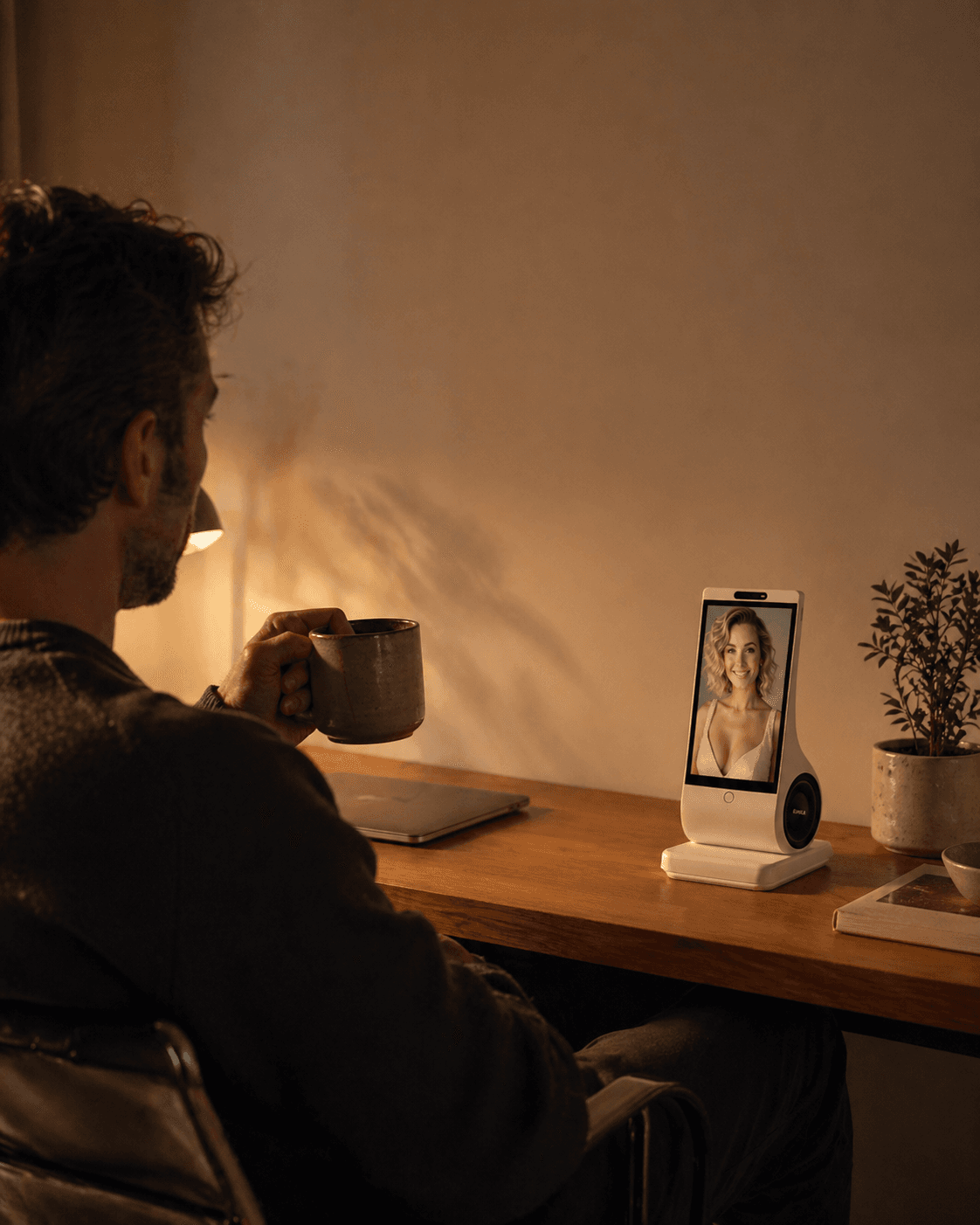
You can use voice AI to rehearse questions after a presentation if you keep your own evidence in charge. Give it a short, nonconfidential outline, practise answering a challenge aloud, then check whether your answer stays within what you can support. A useful rehearsal reveals a claim to clarify or a fact to check. It does not establish that your argument is correct or predict what the audience will ask.
This guide is for adults preparing a work, community or academic presentation. EUVOLA sells a home voice companion and publishes this guide. The exercise and fictional example are editorial suggestions, not a tested training programme or a treatment for speaking anxiety.
Start with the claim you need to defend
Before opening the microphone, make a private note with four entries: your main claim; the evidence you can actually show; the people, setting and period that evidence covers; and what remains unknown. Keep the original report or calculation available on your side. If a slide says more than the evidence supports, change the slide before practising a more persuasive answer.
For an invented example, a community centre tried one evening opening with six volunteers. Four said they would attend again. This can support describing those volunteers' responses after that event. It cannot establish demand across the neighbourhood, future attendance or whether a permanent opening would cover its costs. These numbers illustrate a reasoning problem; they are not research or a customer result.
Share only a stripped-down outline and facts you are allowed to disclose. Omit participant identities, unpublished findings, customer records and confidential budgets. Check the service's data controls first; the voice and conversation privacy guide explains what to inspect. Use a fictional example if the real material cannot be shared safely.
Give every important number a source you can find
Choose the claim that matters to the decision the audience will make. If you are proposing a second trial, the central claim might be that you have a reason to test again without yet knowing whether to approve a permanent schedule. Write the sentence you intend to say. Then put the original document and the relevant page, row, slide or calculation beside it. A note that says “survey” is hard to use during questions. A note that says which question was asked, who answered and which entry records the answer gives you somewhere to look.
For each number, try saying the numerator and denominator out loud. In the centre example, “four of six volunteers said they would come again” tells the audience more than “two-thirds want it.” The second phrasing hides who answered and what they were actually asked. If someone asks how many people returned, explain that the exercise contains a statement of intention and no observation of a return visit. If someone asks how many people the centre might serve, that calls for separate evidence about capacity, access and expected attendance. It is a different question from whether six people liked the event.
Turn this into a small set of notes you can actually find. Give each claim a short label such as “attendee feedback” or “staffing cost.” Put the corresponding source or calculation on a backup slide only if you are entitled to display it. Keep raw identifiable responses off the screen. The MIT presentation guide suggests preparing backup slides for specific technical points. If public disclosure is limited, prepare a short description of the method and its boundaries. Sometimes the right preparation is to narrow a slide or ask a colleague what can be disclosed, before putting anything into an AI tool.
Prepare two lengths for a claim the audience is likely to challenge. A short answer gives the conclusion, one source and the limitation that changes how it should be read. A longer answer explains the sample, method or comparison only if the listener needs that detail. Practise who was invited rather than memorizing an entire dataset. These notes organize an answer without turning readiness into a score.
Give the simulated audience different jobs
In its doctoral-exam guidance, MIT's CEE Communication Lab distinguishes clarification, justification and extension questions. They offer useful practice directions; they do not predict your audience.
For the community-centre example, try questions that require different reasoning:
- Clarification: “What do you mean by demand: stated interest or actual attendance?”
- Justification: “Why would those volunteers' responses support another opening?”
- Extension: “What would you need to know before opening every week?”
If the tool supports voice conversation, you could say:
> I am rehearsing questions after a presentation. Use only the outline and facts I provide. Ask one question about a claim, wait for my complete answer, then ask a relevant follow-up. Vary clarification, evidence and limits. Do not invent results or answer for me. When I say “review,” identify the claim in my answer and any detail that needs checking. Do not award a readiness score or predict the real audience.
If it ignores the outline or repeatedly cuts you off, use one written question at a time or rehearse with a willing person. A prompt cannot guarantee the behaviour of a particular product. For interface problems, see the guide to interruptions during thinking pauses.
Run one round without a script and one with the evidence at hand
In the first round, look only at your slide or keyword. Hear a question, pause and make the best brief answer you can. Listen for whether you answered the thing that was asked. A prompt such as “Why did you choose those volunteers?” concerns the recruitment method. “How many want to come back?” concerns the recorded responses. A confident answer to the second question does not repair a missing answer to the first.
In the second round, open the source and ask for a question phrased differently about the same claim. If your words were confusing but the slide and evidence were sound, change the words. If you could answer only after locating a number, improve your notes or prepare a permissible backup slide. If the source has no answer, mark that gap and practise saying where the evidence ends. Each outcome leads to a different revision. There is no need to award a score or to keep rehearsing the same exchange until the tool approves.
For a group talk, assign who can answer questions about each source. One person might explain attendance and another might be authorized to discuss the budget. Practise a handoff that names the part of the question the other person can answer, then give them the floor. If neither person has the evidence, record the gap. An AI playing the audience cannot decide on behalf of your team who may share information.
Check what kind of mistake happened before you change the answer
Compare the exact question with what you heard and what made it into the response. If the question means “why this location?” and you answered “why this schedule?”, the first repair is to check the meaning. If a transcript is available and it turned “four” into “forty,” correct the recognition error. If you said “forty” yourself, correct the spoken number. If the AI claims that someone else measured “forty,” go back to the original record. These situations can sound similar when you listen back, but each calls for a different action.
With a question in another language, prepare a few short ways to ask for the question to be repeated or narrowed. Use phrases you can say comfortably. For example, “Could you ask the last part again?” works when you missed the ending. “Are you asking about that evening or about weekly opening?” works when two time periods are possible. A repeat of the question in your words gives the listener a chance to correct the scope. You can use a short pause to locate a number or select a source. A live answer does not have to arrive as quickly as a voice tool can reply.
When there are two questions in one turn, say which part you are taking first. If the person asks whether visitors liked the evening and whether the centre can fund it weekly, give the recorded response to the first part and mark the funding question as open. Asking for clarification only helps if you then respond to the clarified version. Write down that version during rehearsal so you can compare it to your answer.
Practise correcting the question's premise
Suppose the AI asks, “Since residents overwhelmingly want this, why haven't you expanded?” Do not accept its invented consensus just to keep the rehearsal moving. An answer might be: “We have responses from six volunteers after one event. We do not yet know wider demand. Are you asking what further evidence we would need?”
Then answer the clarified question using your own plan, distinguishing a proposed next step from an approved commitment. If the AI supplies a cost estimate or a citation, check the original before adding it to your notes. NIST's generative AI risk profile, section 2.2, describes confidently presented false content. Fluent feedback cannot verify a source for you.
Practise correcting the record in the room
If you notice you overstated the result, make the correction specific. For example, “I said four residents came back. I should have said four of the six volunteers told us they would come back. We did not track return visits.” The correction describes the exact difference and what it changes. If a moderator has moved on, ask to return briefly to that point at an appropriate moment. If slides or notes will be shared later, correct the relevant line there as well and use the organizer's agreed channel to pass on the corrected wording.
A challenge may expose a judgment you could reasonably discuss even with incomplete evidence. You might say “I think a second trial would help us learn whether anyone actually returns. I cannot infer from one evening that weekly opening will be viable.” That keeps the proposal and the observation distinct. If you would recommend the same action even after an assumption changes, explain your reason. If the recommendation depends on a number you do not have, pause the recommendation and name the missing number. Taking a narrower position is an available outcome of rehearsal.
If a listener challenges the method, check whether they are questioning the sample, the way a result was measured or the decision you drew from it. You may be able to explain why volunteers were invited and still agree that their replies do not represent the whole neighbourhood. If a listener brings evidence you have not seen, ask where it comes from. Follow the event's rules about checking and replying later. Answer the part whose evidence you can explain.
Rehearse the answer you cannot give yet
The MIT CEE Communication Lab's presentation guide recommends clarifying questions and admitting when you do not know. Try answering an unexpected question without filling the gap with a guess.
In the fictional example: “We have not estimated weekly staffing costs. I can explain the trial's attendance, but I cannot yet say whether weekly opening is affordable.” If follow-up is appropriate, identify what you would check and who can provide it. Promise a date only if you can meet it. If you did not understand the question, ask for a rephrasing before answering; this is also useful when presenting in another language.
After the rehearsal, keep the question, the answer you actually gave, the evidence it relies on and any unresolved check. Ask a willing colleague or listener to challenge a different claim. Their own questions can reveal gaps your simulated audience missed. Use the organiser's rules for the real event; rehearsal does not authorise live AI assistance.
Finish with a question another person actually chose
A willing listener offers something different from the simulated audience. Give them the main slide and ask what they think you are claiming. Let them ask one question they chose themselves before sharing your practice questions. If they heard a broader claim than you meant, ask which phrase led them there. If their question exposes a source you cannot find, mark that as a preparation task. MIT's CEE Communication Lab recommends practising with colleagues and asking them to pose questions. That is teaching advice for presenters. It gives no prediction of your own audience or assurance that a certain practice routine improves results.
When the slides are confidential, practise with an authorized colleague or use a fictional version that preserves the type of evidence and question. If nobody is available, write a few questions on separate notes, shuffle them and answer one aloud without looking at your prepared answer. Then check your words against the original evidence. This preserves the part of the exercise about choosing a response from evidence. It gives you no observation of how an audience understands the response.
End by deciding which change belongs on the slide, which belongs in your backup notes, and which belongs on a list of open questions. For example, replace “demand is clear” with the sentence about four volunteers, note the wording of the question and number of respondents on a backup slide, and confirm staffing costs before discussing a weekly schedule. If the practice exposed a factual gap, track the source, the person who can check it and any agreed deadline. If useful questions and boundaries are clear, stop polishing the simulation and rehearse with your actual slides. Use the event's rules for recordings and tools, including accommodations agreed with the organizer. Keep private materials out of a service you are not authorized to use.
What does this mean for EUVOLA?
The current EUVOLA FAQ describes a Wi-Fi-dependent home voice companion. Dedicated presentation coaching, slide import and validated Q&A assessment have not been verified for this guide. No result here establishes improved presentation performance. A companion cannot replace human relationships, caregiving, clinical judgment, crisis support or emergency services.