
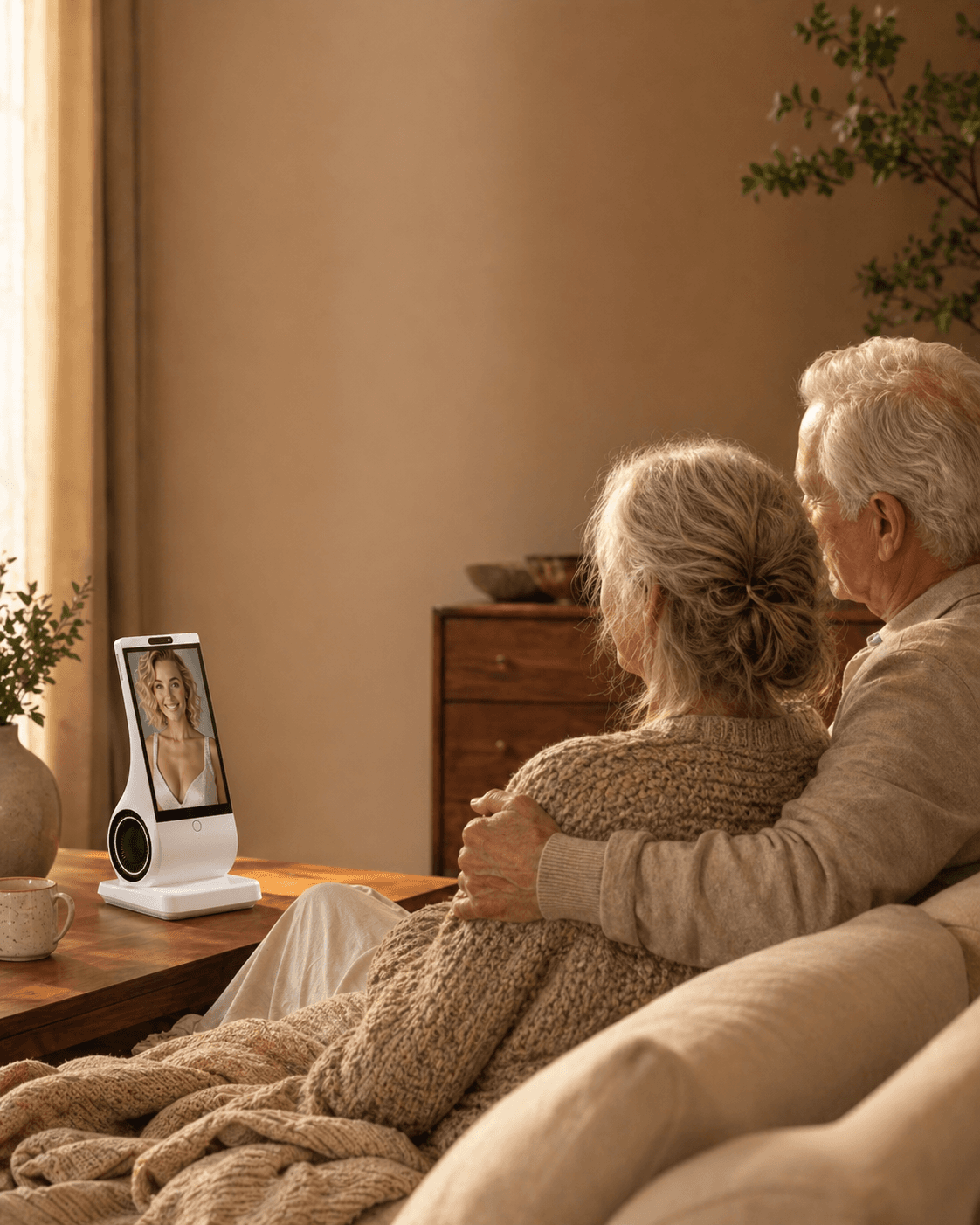
An AI companion may offer an optional place to talk when caregiving leaves little room for your own life. It cannot give you time off, share responsibility, or replace people who know you. Before buying, separate three needs: someone to hear you, someone who understands, and someone who can take over. A device might help with the first; the others require human support and, sometimes, professional care.
Reviewed and updated: 30 September 2026. The household examples below are illustrations, not accounts of identifiable families. This is a consumer decision guide, not a diagnosis or treatment plan.
Being needed all day is not the same as having company
At half past nine, the kitchen is finally quiet. You have spoken to a pharmacy, answered your father's questions, sent your sister an update, and rearranged tomorrow's transport. There has been no shortage of conversation. Yet nobody has asked about the book on your bedside table, the difficult meeting at work, or the person you used to be before every evening acquired a checklist.
That is the particular gap a family caregiver may mean by loneliness. Another person can be nearby while ordinary companionship is missing. You may love the person you support and still want a conversation in which you are not coordinating, reassuring, explaining, or making a decision. Wanting that conversation does not make the care less loving.
The World Health Organization distinguishes loneliness from social isolation: one concerns a felt mismatch in connection, the other the extent of social contact. A busy household does not settle either question. For a buying decision, “How many people did I speak to?” is less useful than “Did any of those conversations let me be myself?”
Public caregiver discussions reviewed for this guide repeatedly raised that distinction. They are a small, self-selected sample, not a survey of all caregivers. The useful signal is the question beneath the complaints: where can someone find company when their time is fragmented and their usual listener is now the person who needs care?
An AI product can look particularly attractive in that moment. It does not require arranging a visit or finding a mutually convenient hour. But ease of access can hide a mismatch. If what you need is another adult to take the evening shift, a longer conversation with a device still leaves you on duty.
Name what is missing before choosing what to buy
Try finishing this sentence without naming a product: “The hardest part of today was that I had nobody to…” The ending matters more than the word loneliness. “Tell something silly” points somewhere different from “share a frightening decision” or “stay with Mum while I leave the house.”
There is no need to choose one need forever. On Monday you may want ordinary conversation; by Thursday you may need sleep and replacement care. The point is to avoid making one purchase carry three different jobs simply because they all feel painful.
Someone to hear you
You want to say that the supermarket was absurdly busy, remember a holiday, discuss a film, or get a thought out of your head. You may not want advice. A friend, a flexible online hobby group, a journal, or an AI conversation might each suit part of that moment, depending on whether you want a response and whether sharing feels comfortable.
An AI can generate a responsive conversation, but it does not become a person with a shared life. If its reply feels useful, that experience need not be dismissed. Equally, if it feels hollow or irritating, you do not owe the product more time to prove that you tried hard enough.
Someone who understands
You want to speak without first explaining why a seemingly small event has exhausted you. Another caregiver may recognize the practical context; a trusted friend may know your family history; a counsellor may help you examine feelings you find difficult to discuss elsewhere. Those are different relationships, and none is guaranteed to be a good fit on the first attempt.
A chatbot's fluent agreement is not evidence that it understands the household accurately. It hears the account you provide and can make mistakes. It should not become the authority that tells you your sibling is selfish, your parent is manipulative, or a professional is wrong after reading one frustrated description.
Someone who can take over
You need another capable person to accept responsibility for an agreed period or task. This might mean an appropriate relative, an arranged care service, or another locally available form of replacement care. Carers UK explains how to plan a break with appropriate support.
An AI conversation is not that handover. Neither is giving the person you care for a companion device and hoping it keeps them occupied. Someone who cannot safely remain alone still needs suitable human care. The question is who is responsible while you rest, not what is playing or talking in the room.
Compare the job, not the friendliness of the reply
The following comparison is an editorial decision framework. It does not rank treatments or promise outcomes. Availability, cost, accessibility, language, and personal preference can change which option is realistic.
A friend or relative: best considered when you want an existing relationship, shared history, or ordinary mutual conversation. The limitation may be timing, emotional capacity, or an unhelpful habit of offering advice. Ask for a small, specific form of contact before assuming the relationship cannot adapt. Friendship does not automatically make someone a suitable replacement caregiver.
A caregiver peer group: worth considering when explaining the role itself is exhausting. Ask about the group's focus, moderation, privacy, meeting format, and whether listening without speaking is welcome. A group may provide understanding without solving the care schedule. An open online forum is not a confidential clinical service, and advice from strangers needs checking.
A counsellor or other qualified professional: relevant when distress, conflict, grief, or persistent difficulty functioning needs more than casual conversation. Ask about qualifications, confidentiality, availability, fees, and whether the professional works with caregivers. An appointment provides a defined professional relationship; it does not arrange all the practical help at home unless that is explicitly part of the service.
Respite or replacement care: relevant when the missing resource is time off responsibility. Establish the person's needs, the substitute's competence, the tasks covered, the hours, the cost, and the fallback if someone cancels. A companion subscription and a respite arrangement are not interchangeable entries in the family budget.
An AI companion: potentially relevant for voluntary, everyday conversation that can fit around a fragmented day. Check privacy, stopping controls, errors, cost, service dependence, and whether it leaves room for human contact. It cannot provide reciprocal friendship, clinical judgment, physical help, safeguarding, or a reliable emergency response.
A hobby or quiet activity without a purchase: sometimes the better fit when you are tired of answering anybody. Reading, music, making something, or an existing interest may suit a period that you want to spend alone. Chosen solitude is not a failed version of conversation. If the barrier is lack of safe time, however, even a free hobby still needs coverage.
One illustrative household might combine a short midweek call with a friend, a monthly peer meeting, and a relative's agreed Saturday shift. Another might use an AI occasionally and prefer no group at all. The purpose is not to fill a calendar. It is to match a particular absence with support that can actually address it.
Do the time calculation that a product demo leaves out
Imagine that a relative offers two hours of replacement care on Saturday. You spend twenty minutes handing over and twenty minutes travelling each way. That leaves sixty minutes for yourself: 120 minus 20 minus 40. These are example numbers, not a recommended care schedule. The calculation reveals why “two hours of help” can feel much smaller in practice.
Now compare an evening with thirty minutes of AI conversation. If you remain responsible for every interruption throughout those thirty minutes, you have received no minutes of transferred care responsibility. You may still have enjoyed the conversation. It is simply a different benefit, and the distinction should survive the sales pitch.
Use two columns on paper: “time when another person is responsible” and “time when I am still responsible but doing something I enjoy.” Put each proposed arrangement in the correct column. Do not count the same minutes twice. A device cannot move time from the second column to the first.
There is a second cost: administration. Setting up an account, sorting out Wi-Fi, managing a subscription, checking privacy controls, and getting support all take attention. If a relative offers a device as a gift, ask who owns those tasks. A gift that creates another help desk for the caregiver may be poorly timed even if the product is otherwise suitable.
Finally, calculate money over the period you expect to use it. Include the device, required services, accessories, connectivity if additional, and possible return postage. Compare that total with the specific alternatives available to you, without assuming a quoted care-service price includes every charge. A low monthly number does not make an unwanted purchase useful.
It is reasonable to decide that no discretionary purchase fits this month. The inability to buy a companion does not mean you have failed to invest in yourself. Practical support, an accessible human conversation, or simply keeping financial breathing room may matter more.
Ask for help that can be accepted, refused, or reassigned
“Let me know if you need anything” leaves the caregiver with another task: deciding what to ask, judging whether it is too much, and managing the answer. A bounded request is easier to discuss. For example: “Could you handle the grocery order every Wednesday for the next month, including checking what is missing and dealing with substitutions?”
That request transfers a complete task, not just the easy final step. Contrast it with asking someone to collect a bag after you have planned, ordered, paid, and resolved every problem. Both can help, but they remove different amounts of work. Say which one you need rather than waiting for the other person to infer it.
For time off, name the interval and the responsibility: “Could you be the person on duty from two until four on Sunday, after we agree what you need to know?” Do not assume willingness equals competence. Some tasks require training or professional help; the person receiving care should be involved as far as appropriate, with their dignity and preferences respected.
If relatives are far away, there may still be a complete administrative job they can own. Researching an available service, making agreed transport arrangements, or managing a recurring household order can be useful when consent and access are clear. Do not share passwords or personal health information casually just to make the delegation easier.
For companionship, make a different request: “Could we talk for fifteen minutes about anything except appointments? I don't need solutions tonight.” A friend may have mistaken your frequent care updates for the kind of conversation you want. Giving them a clearer invitation can reveal whether a different pattern is possible.
These are sample scripts, not a guarantee of cooperation. Some families are unavailable, unsafe, or persistently unwilling. A failed request is information about the support network, not proof that you should become better at asking indefinitely. The ACL caregiver programme describes human support routes; local access and eligibility need checking.
If you try AI, give it a small and honest job
A useful starting purpose might be “talk about the novel I am reading when nobody else is awake.” Another might be “help me find words for a request I will review and send myself.” Those are ordinary conversational uses. “Keep me emotionally stable enough to continue without help” is far too much responsibility to assign a product.
Start with something you would be comfortable saying in a setting whose privacy terms you understand. You need not begin with the most painful event of your life. A conversation about an interest can tell you whether the voice, pace, interruptions, and response style suit you without requiring intimate disclosure as the price of admission.
If the AI offers an interpretation of a family argument, treat it as generated text, not a verdict. Ask what information might be missing, then consider the matter away from the device. A message to a sibling should still sound like you, include only facts you know, and leave room for the sibling's account.
Do not use a chatbot to decide medication changes, assess whether someone can be left alone, settle legal authority, or handle an urgent safety concern. Those questions require the relevant qualified person or service. A persuasive answer is especially risky when exhaustion makes checking it feel impossible.
Some people prefer speaking; others want text because the house is shared. Some want a stable persona; others find familiarity uncomfortable. A product that remembers context can reduce repetition, but inaccurate or unwanted memory can also create friction. The guide to AI companion memory explains why remembered context is not an authoritative care record.
The test is not how much you can disclose or how long the device keeps you talking. It is whether the modest job remains useful and optional. You should be able to end an ordinary conversation, disagree with the response, or choose another activity without feeling that you have abandoned someone.
Your relative's private life is not automatically yours to upload
A caregiver's story often contains another person's story. You may want to discuss your frustration without uploading their diagnosis, appointment letters, address, financial details, or a recording of an argument. Start with the minimum context needed: “I support an older relative and need help wording a request for a break.”
Removing a name is not always enough. A precise workplace, location, unusual event, and family relationship can still identify someone together. You do not need to create an anonymized case file for ordinary companionship. Often the safer and more comfortable choice is to discuss your own feelings and needs without describing the other person's full history.
Before sharing sensitive material, read the current product policy. What is retained? Is there a separate memory feature? Is model improvement optional? What does deletion cover? Who can access the account? Do not infer confidential professional protection from a warm voice, a lock icon, or the absence of a camera.
Shared space creates a separate privacy question. Even if a service handles data as promised, a spoken conversation can be heard by someone in the next room. A parent or partner may find it distressing to overhear their care discussed with a device. Choose a suitable setting; if privacy is not practical, use another activity or a human conversation elsewhere.
Personalizing a companion with a real person's face or voice adds permission and emotional questions. Do not secretly recreate a sibling, spouse, clinician, or deceased relative to make the experience more persuasive. Use only material you have the rights or permission to use, and consider whether a neutral persona would make the relationship clearer.
An account should not become a family surveillance shortcut. Buying the device does not automatically justify reading somebody else's conversations. For the caregiver's own device, explain that it is their personal choice, not an instrument for relatives to check whether they are coping well enough to continue doing all the work.
What the research does not let a seller promise
Some experimental work reports short-term reductions in loneliness after AI interaction. De Freitas and colleagues' manuscript is one example. That does not establish lasting benefit for family caregivers, effectiveness for every person, or equivalence to replacement care. It also does not test EUVOLA.
In Fang and colleagues' revised four-week study, assigned conversation conditions did not produce significant effects on the measured outcomes; heavier voluntary use was associated with worse outcomes. Usage amount was not randomly assigned, so the association does not prove that more chatting caused those outcomes. It is a reason to watch the role of use, not to announce a universal time limit.
The De Freitas manuscript studies companion applications; its longitudinal study followed use for one week, while another experiment compared it with activities including human interaction and watching videos. Fang and colleagues studied 981 participants using GPT-4o for four weeks, with nine assigned combinations of text or voice mode and conversation topic. This compares chatbot conditions, rather than AI with replacement care or a no-chatbot control, and it did not establish benefits for family caregivers or EUVOLA.
These are different designs, populations, and questions. They do not combine into “AI cures loneliness” or “AI always makes loneliness worse.” For an individual buyer, uncertainty supports a reversible, modest trial with human relationships preserved. It does not support cancelling care, counselling, or regular contact because a device has arrived.
Caregiver isolation also has material causes. The Carers NI briefing, dated April 2024, discusses limited time, money, and replacement care. A conversation product cannot remove those constraints. Do not let a purchasing decision quietly become a judgment about whether you are managing your feelings well enough.
No clinical benefit, reduction in caregiver workload, or improvement in safety is promised here. Enjoying an optional conversation can be a sufficient reason to use something, provided the cost, privacy, and effect on the rest of your life remain acceptable.
Where EUVOLA might fit
EUVOLA publishes this guide and sells an AI companion, so this section should be read with that commercial relationship in view. The relevant use is a caregiver choosing everyday conversation for themselves. It is not a substitute for an assessment of the person receiving care or a recommendation that every caregiver needs a device.
The current official FAQ describes a dedicated home device for voice conversation with a personalized on-screen avatar. It has no camera and requires Wi-Fi; it does not currently work offline. For someone who prefers a physical place to talk, that format may be appealing. In a shared home, speaking aloud may instead be a disadvantage.
Long-term memory can retain context, and users can delete it. The FAQ distinguishes memory from original conversation material and describes model-improvement controls. Review those details before sharing personal information; do not assume “no camera” means “no data.” A caregiver has additional reason to avoid supplying another person's sensitive information unnecessarily.
EUVOLA cannot diagnose or treat conditions, provide medical advice, confirm medication was taken, notify family of missed medication, detect falls, call emergency services, or take over caregiving. Family conversation viewing and conversation summaries are not currently available. A reminder is not proof that an action happened, and a responsive device is not a responsible adult.
Before purchasing, check the live price, what is included, return conditions, support route, and current service terms. Do not spend money reserved for essential care on the assumption that the device will reduce the need for that care. If the desired outcome is an uninterrupted afternoon away, start with who will cover it.
The best-fit question is modest: “Would I enjoy this kind of conversation enough to choose it, at this cost, while keeping my human support?” If the answer is uncertain, an existing no-purchase activity or another type of contact may be the more useful next step.
A trial should reveal fit, not become another obligation
If you decide to try a companion, put the return or cancellation deadline on your own calendar first. Use a period comfortably inside the applicable terms; the following fourteen-day example is an editorial planning aid, not a clinical protocol or a promise that two weeks establishes long-term safety.
Before starting, record one ordinary week in a few words: who you spoke to for yourself, whether you had any time off responsibility, and which moment you hoped the device would improve. Avoid turning this into a detailed emotional diary if that feels burdensome. The comparison should help you, not become another performance report.
For the first few uses, choose one modest purpose. Notice whether starting and stopping are easy, whether the voice or text fits the setting, and whether technical friction outweighs enjoyment. If the device misunderstands you repeatedly, you are allowed to stop. Exhaustion is not a good reason to keep troubleshooting a discretionary product late into the night.
During the middle of the trial, preserve a planned human contact and one practical request for help. These are not rewards that must be earned by using the AI correctly. They remain separate parts of support. If the device makes it easier to postpone an uncomfortable but necessary request indefinitely, reconsider the job you have given it.
Near the end, choose an ordinary evening without using it. What happens? Missing a pleasant activity is different from feeling unable to cope without access. If absence causes distress, spending is escalating, or other relationships are shrinking, seek human support and reassess use. Do not ask the companion itself to be the sole judge of whether the relationship is healthy.
Keep, change, or return it based on four plain questions: Did I enjoy the intended use? Did human contact remain intact? Did the cost and privacy feel acceptable? Did I remain free to stop? There is no score to pass. A single serious concern can outweigh several pleasant conversations.
Misunderstandings that make the decision harder
“If I feel lonely, I must not appreciate my family.” Appreciation and loneliness can coexist. The relationship may have changed, your usual routines may have disappeared, or you may have no space to talk about yourself. You do not need to accuse anyone in order to name that absence.
“If AI makes me feel better tonight, we need less help tomorrow.” A better evening does not transfer tomorrow's tasks. Keep relief from loneliness separate from the amount of care required. Otherwise a useful conversation may become an excuse for other people to withdraw support.
“A caregiver group should be enough.” A group may be valuable and still be inconvenient, poorly matched, or emotionally tiring. You can try another format, attend less often, or look for a different kind of contact. No single option has to meet every need, and not fitting one group does not disqualify you from support.
“More use proves the device is helping.” Duration can mean enjoyment, habit, avoidance, frustration, or difficulty stopping. Ask what happened around the conversation. Did you get to sleep, speak to your friend, and make the practical request you intended? Product engagement is not a wellbeing measure.
“I should buy a companion for my parent so I can finally relax.” The parent may enjoy one, but that is their separate preference. It does not establish that they can safely be left alone. The between-calls guide addresses that different decision.
“Needing professional help means the ordinary support failed.” Different needs deserve different support. A hobby, a friend, a device, a peer group, and a qualified professional are not successive rungs on a ladder of failure. You can use more than one, or stop an unsuitable option.
When the next step needs to be human
If distress is persistent, worsening, interfering with sleep or daily functioning, or making safe care difficult, discuss it with a qualified professional and seek practical help. Do not rely on this guide or a chatbot to decide whether you have a mental-health condition. Your own health deserves attention independently of whether you can keep caring.
If you fear you may hurt yourself or somebody else, or there is an immediate danger, contact local emergency help. In the United States, call or text 988 for crisis support; use the appropriate local service elsewhere. The 988 Lifeline guidance is a human-support resource, not a feature of a companion product.
If you cannot safely continue the care currently expected of you, say that clearly to the relevant care team, service, or trusted person. “I need someone to take over now” is different from “I could use a chat.” Do not conceal an urgent coverage problem behind a reassuring conversation with AI.
An abusive or coercive household also needs a suitable human safety response. You do not have to give a device enough personal detail to persuade it that the situation matters. Seek a trusted professional or local support service through a safe channel; avoid a spoken device if being overheard could increase risk.
Five actions before spending money
- Name the missing thing: an ordinary conversation, understanding, professional support, or time off responsibility.
- Make one bounded human request with a task or time, an owner, and a fallback if it cannot happen.
- Compare a no-purchase option and one relevant human support route with the device you are considering.
- Check privacy, total cost, technical burden, stopping controls, and the return deadline before sharing sensitive information.
- If you try AI, keep existing human contact and practical help in place, then decide from everyday fit rather than usage minutes.
Questions caregivers ask
Is it strange to want an AI companion when I live with someone?
No buying decision needs to start with judging that wish. Living with somebody does not guarantee the kind of conversation you miss. The more useful questions are whether you understand that it is AI, choose it freely, can afford it, and retain other support. You are also allowed to decide that it does not feel right.
Can I use it just to vent?
You can choose to describe your own feelings, but keep another person's privacy in mind and avoid treating the reply as a verdict about them. If the conversation repeatedly intensifies anger, endorses a one-sided account, or keeps you from seeking help, stop and reconsider. For risk of harm, use human crisis or emergency support.
What if I do not have any friends available?
That makes the gap harder; it does not make a product capable of filling every part of it. Consider an accessible peer group, a local caregiver organization, a hobby community, or a professional support route alongside any optional AI use. Ask about remote participation and low-pressure entry. Availability and fit vary, so verify rather than assume.
Would a voice device be easier than an app?
Possibly, if speaking suits your space and you prefer not to type. It may be harder when privacy, noise, accent recognition, hearing, or reliable connectivity is an issue. Try the actual interaction where you would use it. “Voice-first” describes a format, not a guarantee that it requires no setup or works for every voice.
Can it help me write a message asking my family for help?
It may generate wording you can review. Give it a bounded task with minimal private context, check that the facts are yours, and remove accusations or promises you do not mean. You remain the author and sender. Generating a persuasive message cannot make another person agree or replace a care assessment.
How much time is too much?
There is no universal safe number established by the studies cited here. Look at what use displaces and how freely you can stop. Lost sleep, missed human contact, unaffordable spending, distress without access, or difficulty meeting responsibilities are reasons to reconsider and seek human support. A timer can help manage a preference, but it is not a clinical safeguard.
Should my family buy one for me as a surprise?
Ask first. A gift can imply “please cope better without asking us” even when the giver means well. A useful offer includes a genuine choice, technical help if wanted, clear ownership of costs, and no reduction in existing support. The caregiver should be free to choose something else, including practical help instead of a device.
What if the trial is enjoyable but I still feel lonely?
That is a plausible outcome, not a contradiction. A pleasant activity may address one moment without changing the wider pattern. Revisit which need remains unmet and whether more human connection, practical relief, or professional support is needed. Keep the device only if its limited role is worthwhile on its own terms.
Where can I start looking for human help?
In the United States, the Eldercare Locator can help identify local resources for older adults and caregivers. The Family Caregiver Alliance offers caregiver guidance; in the UK, Carers UK explains routes to breaks. Elsewhere, ask the relevant local social-care, community, or health service. Confirm eligibility, availability, costs, and coverage directly.
Sources and further reading
- WHO: Social connection
- ACL: National Family Caregiver Support Program
- ACL: Eldercare Locator
- Family Caregiver Alliance: Taking Care of YOU
- Carers UK: Taking a break
- Carers NI: Loneliness amongst Unpaid Carers, April 2024
- De Freitas et al.: AI Companions Reduce Loneliness, research manuscript
- Fang et al.: Extended chatbot use, revised research manuscript, October 2025
- 988 Lifeline: Help Someone Else, United States
- EUVOLA: Official FAQ