
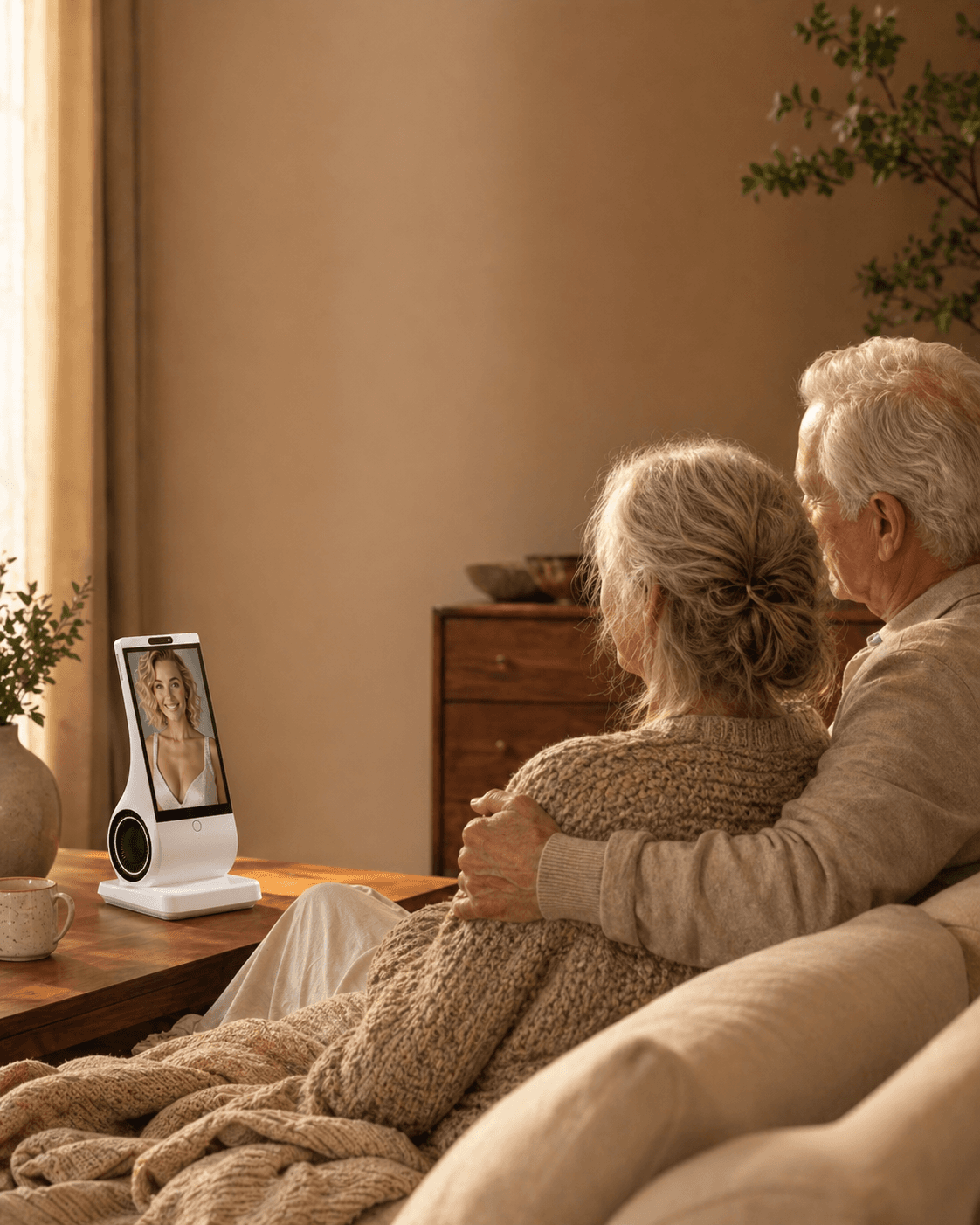
An AI companion can help an older parent find stories worth telling, but its long-term memory is not automatically a family archive. A durable record requires the parent’s permission, the original audio or video, a reviewed transcript, names and dates, exportable files, and backups the family controls. Use the companion to make conversation easier; use a separate, explicit oral-history process when the goal is to preserve a voice accurately for the next generation.
Reviewed and updated: August 21, 2026
The moment families usually notice too late
The conversation begins over an ordinary object. A daughter finds a dented biscuit tin in her father’s kitchen and asks why he keeps it. He laughs, then explains that his mother packed the same tin when the family left their first apartment. He remembers the train platform, the neighbor who carried their suitcase, and the tune his brother whistled because nobody wanted to admit they were frightened.
The daughter has never heard this story. Halfway through, she thinks: I should be recording this. Then she remembers the AI companion on the counter. It remembers that her father likes jazz and that he once worked nights. Perhaps, she assumes, it will remember the biscuit tin story too.
That assumption is where good intentions go wrong. A companion may retain a useful summary, discard the original conversation, mishear a name, or remember only what helps the next chat. Even a system with excellent conversational continuity may not produce an audio file, a faithful transcript, clear dates, an export, or anything the family can retrieve after the account closes. “It remembers Dad” and “we preserved Dad’s story” are different claims.
Families are asking this question now for understandable reasons. Recent public discussions include adult children who regret half-listening to repeated stories, people searching for a low-friction way to capture a parent’s voice, and families who bought structured memoir services only to discover that the prompts felt like homework. One recent discussion asked how to preserve a 90-year-old grandparent’s voice; another asked how to draw out the person a parent was before becoming “Mom” or “Dad.” These posts reveal demand and language, not proof that one tool works for everyone.
The useful buying question is narrower than “Can AI preserve memories?” Ask instead:
What do we want to have five or twenty years from now, who will control it, and has the parent freely agreed to that use?
Five things people call “memory” that are not interchangeable
Product pages often use memory as if it described one object. In practice, a family may be talking about five different things.
| What it is | What it is good for | What can go wrong | What to ask for |
|---|---|---|---|
| A conversation prompt | Helping a person begin or continue a story | The prompt may lead, stereotype, or tire the speaker | Can the person skip it, change topic, or stop? |
| Companion memory | Carrying selected context into later conversations | It may be compressed, selective, wrong, or unavailable outside the service | What is saved, for how long, and can the user view, correct, delete, or export it? |
| Transcript | Making speech searchable and readable | Speech recognition can alter names, accents, dates, dialect, and quiet words | Is the original recording retained, and can a human correct the text? |
| Audio or video recording | Preserving voice, timing, laughter, pauses, and expression | Recording without clear permission damages trust and may violate local law | Who consented, where is the original file, and who may hear or share it? |
| Family archive | Keeping reviewed source files, context, rights, and backups over time | Accounts close, formats age, relatives disagree, and unlabeled files become meaningless | Does the family control open files, metadata, access rules, and at least two copies? |
A companion can be excellent at the first job and useful at the second while doing none of the last three. A phone recorder can create an original audio file but offer no conversational help. A memoir service may supply prompts and a printed book yet leave the family uncertain about raw audio ownership. A human interview can be warm and flexible but still fail as preservation if nobody labels or backs up the recording.
The Smithsonian Institution Archives’ oral-history guidance treats oral history as a planned recorded interview that preserves a person’s recollections in their own words. Its practical advice is refreshingly unglamorous: explain the project and rights, let the narrator refuse questions, ask open-ended questions, retain the original recording, label files, and make copies. The Library of Congress family-history guide likewise starts with asking permission before recording an older relative.
These practices matter more than whether AI appears anywhere in the workflow.
Decide what “preserve” means in your family
Three siblings can use the same word while wanting incompatible outcomes.
One wants a few clips of their mother’s laugh. Another wants a factual family tree. A third wants a polished memoir for the grandchildren. Their mother may want none of these. She might enjoy telling stories but hate the idea that an intimate conversation will circulate after her death. Or she may want the recording kept private for ten years. She may be comfortable sharing childhood recipes but not a first marriage, a medical history, immigration details, political activity, or stories involving people who are still alive.
Before choosing a device, choose the artifact. Possibilities include:
- short private voice notes for immediate family;
- a set of recorded interviews with full audio and corrected transcripts;
- a small printed book with selected photographs;
- a family timeline that marks uncertain dates rather than inventing precision;
- a recipe collection in the parent’s own voice;
- stories meant only to enrich current conversations, with no permanent recording;
- no archive at all.
“No archive” is a valid choice. An older adult does not owe descendants complete access to a life. The purpose of consent is not to obtain a signature that makes the family comfortable. It is to let the narrator determine what happens.
The choice can also vary by story. A parent might approve a recording of school memories for every grandchild, restrict a wartime story to adults, and ask that a painful family dispute never be saved. A practical consent note should name the project, who can access it, whether editing is allowed, whether AI services may process it, where copies will be stored, whether it may be published, and how the parent can change their mind.
Do not hide recording behind the claim that “otherwise the conversation will not be natural.” A relaxed covert recording is still covert. If asking permission makes the moment stiff, begin with a short trial: “Would you be comfortable if I record ten minutes so we can hear how it feels? We can delete it together afterward.” The recording light should not become a trap.
Conversation is valuable even when it produces no archive
It is easy to turn a parent into a source of content. That changes the emotional center of the visit. Instead of listening because the story matters today, the family starts collecting material for tomorrow.
Conversation has value without a deliverable. The National Institute on Aging distinguishes loneliness—the distressing feeling of separation—from social isolation, which concerns the number and regularity of social contacts. A recording project might create more contact, or it might leave a parent performing alone for a microphone. A companion might make a quiet afternoon more engaging, or it might do nothing to add reciprocal human relationships.
Evidence about conversational technology is promising but unsettled. A 2025 systematic review of voice assistants found many studies reporting improvement in loneliness, while emphasizing small, uneven samples, varied measures, and the need for training and adaptation. A 2026 randomized-trial meta-analysis reached a more cautious conclusion: across eight trials, it found a small reduction in depressive symptoms but no statistically significant loneliness effect, with substantial variation between studies. Neither result justifies telling a buyer that a companion will cure loneliness.
Human conversation has its own evidence. An NIA-funded trial of scheduled video conversations reported preliminary cognitive benefits for socially isolated adults aged 75 and older. The conversations were guided by trained people; the screen was a channel, not the relationship. That distinction should shape a family-story project. Technology may lower friction, supply prompts, and keep materials organized. The attention still has to come from somewhere.
When a companion can make stories easier to tell
The strongest use is often not “record everything.” It is “help us arrive at a better conversation.”
A parent whose week feels repetitive may answer “nothing” when asked, “What did you do today?” A more specific prompt can open a door: “You mentioned the bakery on Pine Street. What did it smell like in the morning?” The companion can remember a preference for gardening and ask how tomatoes were tied before plastic clips existed. It can help a family member prepare follow-up questions or turn a broad subject into a manageable ten-minute chat.
This role is especially useful when relatives live far apart and calls have fallen into a predictable loop of weather, medication, appointments, and the date of the next visit. The goal is not to make the AI the main listener. It is to create material that travels back into human conversation.
A 2026 study of a dialogue agent that shared everyday family information offers an interesting, early example. In a ten-day experiment with 108 grandparent-grandchild pairs, the agent gathered information from both sides and used it to support later interaction; the authors reported stronger willingness to engage and increased psychological connection. That does not prove long-term benefit, and it raises obvious questions about permission, selective sharing, culture, and what happens when family members disclose different things. Still, it points toward a better design principle: use the agent as a bridge between people, not a destination that quietly replaces them.
Here are four bridge patterns a family can test:
The handoff question
The companion asks the parent about one bounded subject, such as a first job. With permission, the parent chooses one detail to share with family. The next human call begins there: “You said the foreman always wore a red tie. What was he like?” The family does not receive the whole private conversation.
The photo return
A relative sends one labeled photograph. The parent talks about it with a person or companion, then asks a question back: “Do you know who made the dress?” The next generation searches the family album or calls an aunt. The photograph becomes a two-way activity rather than a prompt dumped on the older adult.
The practical legacy
Instead of asking for a life summary, ask for knowledge someone may actually use: how to judge bread dough, calm a frightened child, repair a drawer, choose fish, host a holiday, or apologize after an argument. Practical questions invite texture and reduce the pressure to sound historically important.
The disagreement marker
When two accounts conflict, preserve the difference. “Dad remembers 1968; Aunt Leila thinks it was 1970.” An AI summary should not silently select one. Family memory is not a database waiting to be cleaned. Contradictions can reveal perspective, sequence, and emotion.
Verify that the family archive survives the conversation
With the storyteller's permission, make one small recording or text sample and retain the original separately from any AI summary. Label who spoke, when, what the file contains and any uncertainty that must not be silently corrected.
Export the sample, open it outside the companion service, and check that an agreed recipient can find and understand it. Decide who may copy, edit, share or delete it, and keep a backup appropriate to the family's needs. Do not assume chat memory is an exportable archive.
These are separate requirements, not points. A beautiful summary cannot replace a missing original, and a successful export cannot supply permission to reuse a person's voice. Stop collecting if the storyteller does not want a record.
A four-week trial that does not turn life into an interview
Buying a yearly service and announcing a “legacy project” can make a willing storyteller disappear. A smaller trial shows whether the process creates connection or obligation.
Week one: listen without collecting
Have two ordinary conversations. Notice where the parent becomes animated, where they change the subject, and how long their energy lasts. Ask what they would enjoy passing on and what they want left alone. Do not arrive with fifty prompts. Write a one-sentence purpose together, such as: “We want a few recordings of Granddad explaining the work and people he cared about, for close family only.”
Test the companion as a conversation aid, if one is already available. Can the parent start and stop comfortably? Does it hear their ordinary voice? Does it push when they give a short answer? Does it treat speculation as fact? Do not purchase a device solely for the trial if a phone call, voice memo, or in-person visit can answer the question.
Week two: make one ten-minute recording
Ask permission immediately before recording. State the date, people present, place, and intended audience at the beginning of the file. Choose an easy subject with a physical anchor: a photograph, recipe card, tool, song, uniform, piece of jewelry, or familiar route.
Ask one question at a time. “Tell me about your first day at the shop” is better than “Tell me about work, your friends, and how the town changed.” Follow the narrator’s emphasis. If they want to tell the favorite story again, repetition may bring a new detail. If they look tired or say “not today,” stop.
Play back a short section before ending. Some people like hearing their voice; others find it uncomfortable. Let that reaction guide the next step.
Week three: review one page, not a whole life
Create a short transcript from the recording, by hand or with software. Listen again while checking names, places, dates, and words the system marked uncertain. Keep the original audio. Do not smooth dialect, grammar, or emotion until the speaker sounds like a corporate biography.
Show the parent a manageable excerpt. Ask four questions:
- Is this what you meant?
- Is any part private or wrong?
- Who may see or hear it?
- What should we ask next, if anything?
If the parent corrects a date, retain a note rather than erasing the earlier version without explanation. If another relative disputes the story, add their account separately. Oral history preserves perspective; it does not certify every remembered detail.
Week four: prove the archive survives the app
Export the original recording and reviewed transcript. Use descriptive filenames, for example 2026-08-21_Mina-Rahman_first-tailoring-job_01.wav and a matching text or PDF file. Put a plain-language rights note beside them. Store a second copy in a different controlled location. Ask someone other than the project organizer to open both copies.
Then test the uncomfortable endings. What if the subscription lapses? What if the phone breaks? What if the service closes? What if the parent wants one story deleted? What if the organizer dies first? A preservation plan that works only while one person remembers a password is a temporary collection.
At the end of four weeks, choose among three honest outcomes: continue occasionally, keep conversation but stop recording, or stop the project. Success is not the number of files. It is a process the parent still wants.
Prompts that invite a person, not a performance
“Tell me your life story” is too broad. “What was on the kitchen table when you were ten?” gives the mind somewhere to stand. Specific prompts also make follow-up easier for relatives who fear they have nothing new to discuss.
Try questions tied to senses and decisions:
- What sound told you the day had started in your childhood home?
- Who taught you something you still do with your hands?
- What did a small luxury cost when you earned your first pay?
- Which family recipe changed because an ingredient was unavailable?
- Tell me about a journey that did not go to plan.
- What rule did your parents have that you refused to keep with your own children?
- Who made you laugh at a difficult time?
- What object in this room would need an explanation fifty years from now?
- When did you change your mind about something important?
- What would you like us to ask another relative while we still can?
Avoid questions that contain the preferred answer. “You must have been terrified when you immigrated, right?” puts an emotion in the narrator’s mouth. “What do you remember feeling on the journey?” leaves space for excitement, boredom, fear, relief, or no clear memory.
Do not make memory performance a test. Correcting every date mid-story can embarrass a speaker and interrupt the thread. Save factual review for later unless the person asks for help. On the other hand, do not publish uncertain details as verified history merely because the story was vivid. Warmth and accuracy are different qualities.
For a parent with cognitive impairment, communication advice should come from qualified sources and people who know the individual. The Alzheimer’s Society communication guide emphasizes patience, clear language, reducing distractions, and respecting the person’s pace. A familiar story can be comforting, but a recording project should never be used to test, confront, or repeatedly force someone to acknowledge loss. If conversations cause distress, seek guidance from the care team rather than asking an AI to manage the situation.
Editing: preserve meaning before polish
AI can remove filler words, reorder events, translate, summarize, and turn a transcript into a smooth narrative. Those capabilities are convenient and dangerous. A polished paragraph may combine events from different years, replace an unusual phrase, resolve an ambiguous pronoun incorrectly, or convert a family belief into a factual claim.
Keep three layers:
- Source layer: the untouched original recording plus basic metadata.
- Review layer: a transcript with corrections, uncertain words, translations, and notes linked to the source.
- Presentation layer: the excerpt, book, audio montage, or family website created for an audience.
Never overwrite the source layer with the presentation layer. If AI helps edit, record which service was used and what human review occurred. Where exact wording matters, link back to a timestamp in the recording. Where translation matters, retain the original-language audio and text beside the translation.
This separation also protects the narrator’s character. Pauses, code-switching, laughter, unfinished sentences, and regional words may carry more meaning than a perfectly grammatical summary. The family may produce a readable edition, but it should not pretend that the edition is the original voice.
Names, dates, and the temptation to “fix” uncertainty
Make a small authority list for recurring names and places. Ask the speaker to spell what they can. Compare documents, photographs, letters, maps, and other relatives’ accounts. Mark conclusions by confidence:
- Confirmed: supported by the recording and an independent record.
- Attributed: this is how the narrator remembers it.
- Approximate: the decade or sequence is known, not the exact date.
- Disputed: family members or records differ.
- Unidentified: a person, place, or word remains unknown.
An AI system may dislike empty fields and resolve them. Resist that urge. “Unidentified woman beside the bus, probably 1950s” is more useful than a confident invented name.
Privacy is about people who never bought the device too
A parent’s story contains other people. It can reveal a sibling’s adoption, a neighbor’s illness, a grandchild’s diagnosis, an old affair, immigration status, finances, political activity, or an allegation nobody else agreed to publish. The narrator owns their experience, but that does not make every detail harmless to distribute.
Choose access by audience rather than one blanket setting. Private family listening, a closed reunion screening, a printed book, and a public website create different risks. Redact account numbers, precise medical identifiers, addresses, security answers, and information that could enable fraud. Consider delaying sensitive material or restricting it to named people.
Voice itself can be sensitive. A clean recording can be copied, impersonated, or used in ways the speaker never expected. Do not upload it to a voice-cloning service merely because the file exists. If a family wants a familiar-voice experience, obtain specific permission for that purpose and explain that generated speech may say words the person never spoke. General permission to record a recipe is not permission to create a synthetic voice.
The FTC’s consumer guidance for voice assistants recommends understanding when the device listens, reviewing what is stored, securing the account, deleting unwanted recordings, and limiting connected services. Add family-level questions: Can guests tell when the device is active? Are children’s voices captured? Does a visiting caregiver know the policy? Who can review history? Is two-factor authentication available? What does deletion mean for backups and model training?
Legal rules for recording and inheritance differ by place. This article is not legal advice. If the project may be published, monetized, donated to an archive, used in a dispute, or include people who cannot provide informed consent, obtain local legal or professional guidance.
Common mistakes, with a more useful correction
“If it remembers the story tomorrow, it is preserved”
Tomorrow’s continuity proves only that the system retained or reconstructed enough context for another conversation. Ask for the original file, export, metadata, and deletion controls before calling it an archive.
“A transcript is safer and simpler than audio”
A transcript is easier to search but can lose pronunciation, emotion, timing, and uncertain words. Keep the source recording when permission allows, then treat the transcript as a reviewed access copy.
“We should collect everything before it is too late”
Urgency can bulldoze consent and exhaust the person. Ten willing minutes are more valuable than hours gathered under pressure. Prioritize stories the parent wants to tell, not a descendant’s completion anxiety.
“Repeated stories have no new value”
Repetition may add detail, show what matters, or simply be enjoyable. It can also signal fatigue or a communication problem. Listen for the person, not merely new facts. If repetition or memory change is concerning, discuss it with a qualified professional; do not diagnose from a recording.
“AI can fact-check family history for us”
AI can suggest records to examine, but it can also invent sources, merge people, and present probabilities as facts. Verify consequential claims against primary records and label personal recollection as personal recollection.
“Once the family has a copy, sharing within the family is harmless”
Families have conflict, estrangement, minors, and different ideas about privacy. A named audience and a way to revise access are better than an unlimited family group chat.
“A familiar synthetic voice keeps the person alive”
A generated voice is a simulation, not the person and not evidence of what they believed. It can comfort some people and disturb others. Never use it to deceive, obtain consent, settle an argument, or manufacture new “memories.”
When an AI companion is the wrong starting point
Choose another path when:
- the parent says no, appears uneasy, or cannot understand what will be recorded and shared;
- the family’s real need is emergency response, medication management, personal care, or clinical assessment;
- the parent wants human contact and the family is using a device to avoid feasible calls or visits;
- hearing, speech recognition, language, fatigue, or motor barriers make every interaction frustrating;
- the service cannot explain storage, export, deletion, account recovery, or what happens when it closes;
- family conflict makes access or consent unsafe;
- the project is driven mainly by pressure to produce a polished book;
- recording repeatedly triggers grief, fear, shame, confusion, or agitation;
- the only retained artifact is an AI summary;
- nobody is willing to review, label, export, and back up the material.
A simpler tool may be better. A phone’s voice-memo app, used openly, can preserve original sound. A scheduled call can be more reciprocal. A trained oral historian can handle complex testimony. A social worker, memory clinic, counselor, or community aging service may be appropriate when the underlying concern is isolation, cognitive change, depression, bereavement, safety, or caregiver strain.
If someone expresses hopelessness, self-harm, abuse, neglect, acute confusion, or immediate danger, stop the content project and contact local emergency or crisis services and a trusted person. An AI companion and a family archive are not crisis systems.
Where EUVOLA may fit—and the boundary that matters most
EUVOLA is a dedicated, voice-first AI companion device with an on-screen avatar, personalized voice options, and long-term memory intended to support continuity across conversations. It has no camera. Those characteristics may suit an older adult who prefers speaking to typing and wants a consistent conversational presence in a familiar room.
For a family-story project, the useful role is prompting and continuity: remembering that the parent worked in a bakery, asking a follow-up later, or helping an ordinary day contain a subject worth bringing to the next family call. The parent should still choose whether to use it and where it sits.
The official EUVOLA FAQ draws an important preservation boundary. Original conversation audio and text are deleted after model processing. Long-term memory may retain useful context, is user-deletable, and is not meant to be perfect permanent word-for-word storage. Long-term memory is not used for model training. Other eligible data may be used to improve models if the user has not opted out, so privacy-sensitive users should review the opt-out setting before use.
Therefore, do not buy EUVOLA on the assumption that it will automatically create, store, or export an oral-history recording. The currently confirmed product facts do not establish a family transcript, recording archive, inheritance workflow, or memory-export feature. If preserving original voice is the goal, run a separate, permission-based recording and backup process. EUVOLA can be the conversational table; it should not be mistaken for the archive room.
Core companion functions do not currently require an active subscription after the included Premium period, according to the official FAQ. That reduces one continuity concern, but it does not remove the need to ask about account recovery, future service changes, privacy settings, and whether the intended user can operate the device without constant help.
Five actions to take before the first recording
- Ask what the parent wants. Agree on one subject, audience, and stop rule; accept no.
- Name the artifact. Decide whether you want conversation, a summary, a transcript, original audio, or a family archive.
- Test ten minutes. Use one familiar object and one open question; play back the result together.
- Keep the source and review it. Correct names and dates without rewriting the speaker; mark uncertainty.
- Export, label, and copy. Put usable files, rights notes, and metadata in at least two controlled places, then test deletion and recovery.
Frequently asked questions
Can an AI companion automatically write my parent’s memoir?
It may help generate prompts, transcribe speech, organize themes, or draft prose, depending on the product. That output still needs the parent’s permission and human review. A memoir is an edited interpretation; retain the original recording and identify where AI helped. Never present invented transitions or merged events as the parent’s own words.
Is an AI companion’s long-term memory the same as a transcript?
No. Long-term memory is usually selected or compressed context used to improve later interaction. A transcript attempts to represent what was said in sequence. Either can contain errors, but only a transcript linked to source audio can be checked word by word.
Should I record a parent who repeats the same stories?
Only with permission. Repetition does not make a story worthless, and a later version may contain new details. Avoid showing irritation or turning the conversation into a memory test. If repetition is new or concerning, seek professional advice rather than relying on an AI explanation.
What file should we keep?
Keep the highest-quality original the recorder can reliably produce, plus an accessible copy and a reviewed transcript. Open, widely supported formats are safer than a file that opens only inside one app. The Smithsonian guide recommends protecting the original, using clear filenames, and making copies.
Can family members correct a story after the parent dies?
They can annotate it, but should not silently replace the narrator’s account. Add a dated note describing the conflicting document or recollection. Preserve both the source and the correction so future listeners understand who said what.
Is it okay to clone my parent’s voice from the recordings?
Only with specific, informed permission and a clear purpose. Recording permission is not automatically cloning permission. A synthetic voice can say new words and may create deception, grief, or fraud risks. Label generated audio unmistakably and never use it to impersonate the person.
What if my parent likes talking but does not want anything saved?
Honor that choice. Configure the product for the minimum retention compatible with use, review privacy and training controls, and do not build a shadow archive from summaries. A good conversation does not need to become property.
Can AI verify whether a family story is true?
Not by itself. It can suggest search terms or records, but it may hallucinate sources or confuse people with similar names. Verify dates and claims against documents, photographs, maps, newspapers, and other firsthand accounts. Label unverified recollection honestly.
Could preserving stories reduce loneliness?
The process can create meaningful conversation, but no archive guarantees less loneliness. Research on conversational agents is mixed and still developing. A project that increases reciprocal family contact may help connection; one that leaves the parent answering prompts alone may not. Track human contact and the parent’s experience, not just recording hours.
What happens if the service or companion company shuts down?
Assume access could end. Export original recordings, transcripts, metadata, and consent notes while the account works. Keep copies outside the service and test that ordinary software can open them. If export is impossible, the product is a poor sole repository for irreplaceable material.
How often should we revisit consent?
Before each recording or new use, and whenever the audience, technology, topic, or distribution changes. Permission to make a private recording today does not cover a public podcast, an AI voice model, or a memorial avatar later.
A better final question
Do not ask only, “Will the AI remember my parent?” Ask, “Will this process help us listen now, and will the parts we intentionally preserve remain understandable, controllable, and faithful later?”
If the parent enjoys the conversation, the family follows up, and a separate archive keeps original, consented material, AI may serve a modest and useful role. If the system merely produces fluent summaries inside an account nobody can control, it has created the feeling of preservation without the thing itself.
The most valuable result may be smaller than a digital immortality project: a labeled recording of one recipe, one train journey, one bad first job, one apology, or one laugh—kept because the person chose to share it, and heard because someone chose to listen.
Sources and further reading
- Library of Congress: Oral Histories—Family History Interviews
- Smithsonian Institution Archives: How to Do Oral History
- National Institute on Aging: Loneliness and Social Isolation—Tips for Staying Connected
- National Institute on Aging: Online Conversations Show Potential Cognitive Benefit
- Systematic Review: Voice Assistants’ Influence on Loneliness in Older Adults
- 2026 Systematic Review and Meta-analysis: AI Conversational and Socially Assistive Agents
- 2026 Study: Dialogue Agents That Share Family Information
- Alzheimer’s Society: Communicating and Dementia
- Federal Trade Commission: Secure Your Voice Assistant and Protect Your Privacy
- EUVOLA: Official Frequently Asked Questions