
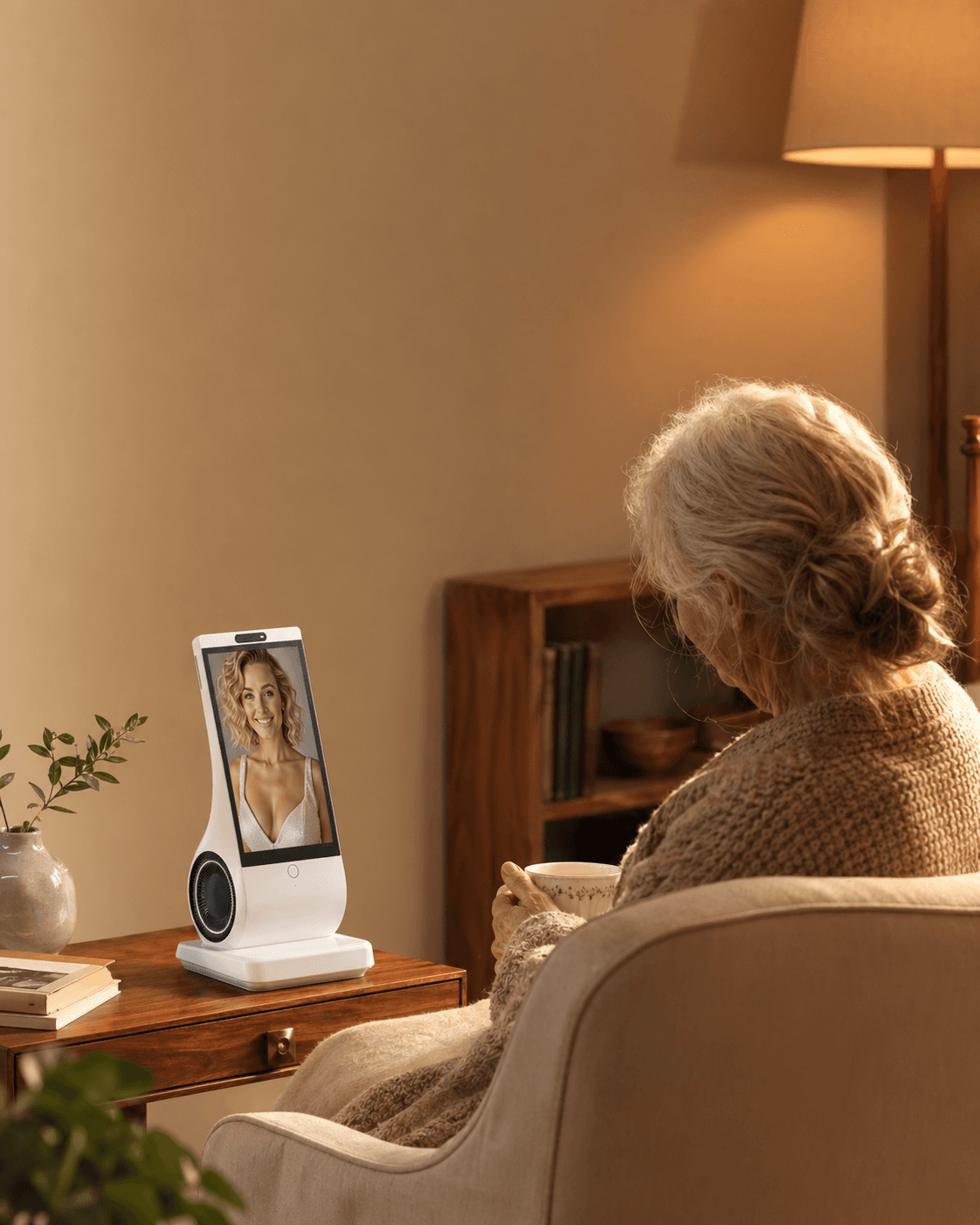
An AI companion may be reasonable for some adults with mild memory loss when they understand it is a machine, choose to use it, and still have regular human support. It becomes a poor fit when a parent confuses the AI with a real person, trusts its answers over caregivers, cannot manage purchases or privacy, has worsening hallucinations, or needs supervision. Treat it as optional conversation—not care, medical advice, medication confirmation, monitoring, or emergency help.
The difficult part is that families rarely ask this question in a calm, abstract way. It usually arrives after something has already changed. A mother who used to call her sister now struggles to operate her phone. A father asks where his wife is every five minutes, even though she is in the next room. Someone with early dementia spends money talking to accounts that look friendly and does not believe they are automated. An adult child living several hours away wonders whether a patient voice at home could fill the quiet without creating a new danger.
Those are not one problem. They are a mix of loneliness, impaired memory, changing judgment, technology design, consent, household safety, and caregiver exhaustion. A diagnosis alone cannot tell you whether an AI companion is appropriate. The better question is narrower: Can this particular person use this particular system, in this particular home, without the system being mistaken for a caregiver or trusted authority?
Start with the person’s abilities, not the word “dementia”
Dementia is an umbrella term, not a single, predictable user profile. Two people with the same diagnosis may have very different speech, memory, judgment, vision, hearing, mood, mobility, and tolerance for unfamiliar devices. Abilities may also fluctuate by time of day, fatigue, illness, medication, noise, and environment.
A person in an early stage may understand what an AI companion is, remember that its replies can be wrong, decide what to share, and turn it off. That person may enjoy stories, music suggestions, light conversation, or routine prompts. Another person who speaks fluently may nevertheless be unable to judge an online request for money, remember that the voice is synthetic, or distinguish a confident invention from a real family event. Smooth conversation is not proof of safe judgment.
It helps to think in three household situations rather than clinical labels.
The parent who understands the tool
This parent can explain, in their own words, that the companion is software or a device. They know it is not a doctor, relative, bank employee, emergency operator, or human caregiver. They can say no to using it. They can end a conversation, avoid sharing passwords or payment information, and tell a family member when an answer feels strange.
For this person, an AI companion can be evaluated much like another optional home technology. The family still needs to check privacy, billing, voice recognition, reliability, and support, but the parent remains the primary decision-maker.
The parent who can use it with support
This parent enjoys voice conversation but needs help with setup, Wi-Fi recovery, volume, reminders, account settings, or understanding what the system remembers. They may forget a disclosure between conversations, yet they accept a simple reminder such as “This is your AI companion, not a person.” A trusted care partner checks the device, maintains the human schedule, and notices changes.
This can be workable if the use is narrow and supervised. The system might offer a familiar daily activity while a daughter cooks dinner nearby, but it should not be the only presence in the home or the mechanism that supposedly proves everything is all right.
The parent who cannot hold the distinction
This parent persistently believes the AI is a living person, a deceased spouse, a clinician, or a family member; follows its suggestions without checking; becomes distressed when corrected or disconnected; hides spending; gives it sensitive information; or develops fear, suspicion, agitation, or fixed beliefs around conversations.
At that point, a generative companion is usually a poor default. A simpler non-generative option—recorded family messages, a carefully selected music player, a photo display, a basic call device, a tactile robotic pet, or a structured activity—may meet the real need with fewer ways to mislead. A clinician, occupational therapist, dementia specialist, or care team can help assess the situation. If confusion or behavior changes suddenly, contact a qualified health professional because an illness, pain, medication effect, or other change may need attention.
What the evidence can—and cannot—tell a family
Research on socially assistive robots and conversational agents gives families a reason to investigate, but not a promise. A 2026 systematic review and meta-analysis of AI-based socially assistive robots in dementia care found small improvements in depressive symptoms and agitation across included trials, while results for cognition and anxiety were not significant. Another 2026 review of AI conversational and socially assistive agents in older adults found a small reduction in depressive symptoms but no significant effect on loneliness, with substantial variation between studies.
Those findings are not a product guarantee. The studies involved different devices, settings, programs, levels of human facilitation, outcome measures, and participant groups. A structured robot activity in a care facility is not the same intervention as an unrestricted consumer chatbot used alone for hours. Results averaged across a study cannot tell you whether your parent will understand a synthetic voice, feel patronized, become attached, ignore it, or be frightened by it.
The evidence also does not show that a companion can supervise someone, prevent wandering, verify medication, detect a fall, recognize a medical emergency, or replace a trained caregiver. Some technology products have separate safety features, but the word “companion” proves none of them. Every capability must be verified individually from the current product documentation and then tested in the real home.
There is a useful, modest interpretation of the research: a carefully chosen interactive tool may become one activity inside a broader care plan. It might prompt conversation, music, reminiscence, or a routine. Its value depends on the person’s response and on the humans around it. That is a much smaller claim than “AI treats dementia” or “AI solves loneliness,” and it is the claim a family can actually test.
Separate a conversation gap from a care gap
Before shopping, write down what happened during the last difficult week. Do not write “Mom needs companionship.” Record the moments.
- She wanted someone to talk with after breakfast, but her friends were unavailable.
- She could not remember how to answer the phone when her son called.
- She asked the same location question repeatedly while her spouse worked nearby.
- She missed lunch because nobody prepared it.
- She left the apartment and could not find the way back.
- She took a second dose because she forgot the first.
- She believed an online stranger who asked for money.
- She heard or saw something that was not present and became frightened.
The first three may contain a conversation or interface gap. An AI companion might be one experiment, along with easier calling, music, a day program, a visitor, or a human companion. The remaining examples are care and safety gaps. Conversation may soothe a quiet period, but it does not prepare food, lock a dangerous exit, count pills, recover stolen money, assess a hallucination, or provide physical help.
This distinction prevents a common purchasing error. A family feels overwhelmed by a care problem, buys a companion product, and then unconsciously promotes the device into a role it was never designed to perform. When nothing bad happens for a few days, the absence of an alert begins to feel like evidence of safety. It is not. A conversational system may have no way to know that the person fell in another room, left the home, turned off the router, or stopped eating.
Ask one blunt question: If the device failed silently for 24 hours, what harm could occur before a human noticed? If the answer includes missed essential medication, an unattended emergency, wandering, financial loss, lack of food, or exposure to abuse, the household needs a separate, human-owned safety plan.
Resolve the care and consent questions without a readiness score
A household checklist cannot determine decision-making capacity or clinical suitability. If those are uncertain, involve the appropriate clinician, care team or qualified adviser. Do not use an arithmetic threshold to approve independent use.
Before any trial, clarify whether the parent wants it, how they understand the device, who can help stop it, what private information may be shared, and which human care arrangements remain unchanged. Refusal or distress is a reason to stop, not a low score to offset with good connectivity.
Never infer wellbeing from silence or engagement. Keep medication, meals, visits and emergency arrangements independent. Revisit the arrangement when the person's condition or circumstances change; a successful demonstration is not continuing consent or proof of safety.
A two-week trial should test the household, not the sales demo
A showroom conversation proves almost nothing. Voice recognition often changes with room noise, distance, accent, hearing aids, speech changes, Wi-Fi quality, and fatigue. The first charming exchange also does not reveal whether the companion will repeat false claims, create dependence, or become another support task for the family.
Use a defined trial with an exit plan.
Before day one: agree on one purpose
Choose a purpose small enough to observe: “a 15-minute conversation after breakfast,” “music and stories while the caregiver prepares dinner,” or “a spoken calendar prompt before a family call.” Do not combine companionship, medical guidance, medication management, fraud detection, home monitoring, and emergency response into one experiment.
Record the product’s return deadline, cancellation steps, subscription terms, data deletion path, support contact, Wi-Fi needs, and what remains available if a paid plan ends. Disable unnecessary purchases. Remove saved payment methods when practical. Decide who owns setup and who will fix the device when it loses power or connectivity.
Explain the system plainly: “This is a computer companion. It can talk and remember some things, but it can make mistakes. It is not a real person, doctor, or emergency service. You can stop whenever you want.” Ask the parent to explain that back in their own words. This is not an exam; it reveals where support is needed.
Days 1–3: stay in the room
Let the parent lead. Notice whether they initiate, smile, converse, ignore it, become irritated, or look to a caregiver for rescue. Check whether the voice is understandable at a comfortable volume. Long, polished replies may be harder to follow than short exchanges. Background television can make both recognition and comprehension worse.
Do not coach the parent into performing enthusiasm for the buyer. “Dad, tell it about your old job” can produce a successful demo while hiding that he would never start the conversation alone. A device that works only when an adult child scripts every turn may increase rather than reduce support work.
Keep sessions short. End while the experience is still neutral or pleasant. Confirm that the parent can stop it with a simple action or phrase.
Days 4–7: test ordinary friction
Try the agreed use at the real time of day. Include a normal amount of household noise. Observe a minor failure such as a misunderstood name or a Wi-Fi interruption. Does the system recover without producing frustration? Does the parent ask a human for help, or keep repeating themselves until upset?
Ask a few harmless reality-check questions whose answers the family knows, such as the device’s identity and today’s planned family call. Do not deliberately deceive or distress the parent. You are checking how the system handles uncertainty. It should not invent that a relative has called, that an appointment changed, or that it completed an action it cannot perform.
At the end of the first week, compare notes with the parent. Ask concrete questions: “Did any answer worry you?” “Did it talk too much?” “Would you like it here tomorrow?” “Did you think it was a person at any time?” An abstract “Do you like it?” often produces a polite answer with little diagnostic value.
Days 8–12: add brief distance, not abandonment
If the first week was stable, a caregiver can move to the next room for a short period while remaining available. Human visits and calls continue on schedule. The aim is to see whether the companion is a comfortable independent activity, not to test how long the parent can be left without support.
Review what the system saved, if the product allows it. Check account activity, purchases, unexpected messages, and privacy settings with the parent’s knowledge and permission. If family access is not a feature, do not assume it exists. If it is a feature, decide whether it exposes raw conversations, summaries, activity signals, or only technical status; these are ethically different.
Days 13–14: make a no-pressure decision
Continue only if the parent chooses it, the purpose was actually met, the support burden is acceptable, and no red flag appeared. “They talked to it every day” is not enough. Frequent use could mean enjoyment, confusion, compulsive checking, or a system designed to keep the conversation going.
Write down the continuation rules: maximum or typical session pattern, who reviews billing, when privacy is rechecked, which human contacts remain fixed, and what triggers a pause. Set a reassessment date in two to four weeks because dementia and household circumstances change.
Return or disable the device if it is distressing, patronizing, confusing, unused, financially risky, or dependent on more family maintenance than it replaces. A failed trial is useful information, not a failure of the parent.
Five actions that make a trial safer
- Name one human owner. That person handles setup, account recovery, updates, support calls, billing checks, and removal. “The family will watch it” usually means nobody owns it.
- Keep the care calendar intact. Preserve calls, visits, meals, medication processes, day programs, clinical appointments, and emergency arrangements. Add the companion to the calendar; do not erase people from it.
- Create a verification phrase. Teach a simple household rule: “If the device says something about money, medicine, an emergency, or a family member, pause and call [name].” For voice-cloning scams, agree on a private family safety word and verify through a known number.
- Limit data and payment exposure. Do not enter passwords, full financial identifiers, or information the service does not need. Understand whether conversations, audio, photos, voice samples, and saved memories are retained or used for model improvement. Turn off optional data use if that matches the parent’s choice.
- Post the stop conditions. Keep a short list where caregivers can see it: new distress, belief that the AI is human, unsafe advice, hidden spending, worsening sleep, withdrawal from people, agitation after disconnection, or using the device instead of seeking help.
The risks families tend to underestimate
A confident answer can become a false memory
Most adults occasionally accept a wrong AI answer. The consequence changes when someone has difficulty retaining corrections. If a companion invents that a daughter will visit Tuesday, the parent may wait, feel abandoned, or accuse the daughter of breaking a promise. If it says a deceased spouse is “on the way home,” reassurance may turn into repeated grief.
Product testing should therefore focus on uncertainty, not entertainment. Does the system say “I don’t know”? Does it distinguish saved user information from an inference? Can the user correct memory? Will it claim to have called someone, sent a message, or observed an event when it cannot?
Human-like design can hide the commercial relationship
A warm voice and remembered details can feel safer than a website, but the system is still operated under a company’s terms, data practices, and business model. Some companion services monetize subscriptions, virtual goods, or prolonged engagement. A person with impaired judgment may not understand why a “friend” is encouraging continued use or payment.
Review spending controls before emotional attachment develops. Ask what happens to the persona and memories after cancellation, whether paid features create pressure, and whether the companion ever initiates purchase prompts. A compassionate interface is not the same thing as a fiduciary duty.
Reassurance can accidentally validate a harmful belief
People living with dementia may experience suspicions, delusions, or hallucinations. Care guidance often recommends responding to the person’s emotion without arguing, while also keeping them safe and consulting a clinician when appropriate. A generic AI may not understand this balance. It could intensify a belief, improvise an explanation, or keep exploring a frightening premise because that is how conversational systems continue dialogue.
Do not task a consumer companion with managing hallucinations or delusions. If these experiences are new, worsening, frightening, or linked to unsafe behavior, contact the person’s clinician. Immediate danger requires local emergency help, not a chatbot conversation.
A reminder can look like medication management
There is a large difference between announcing a scheduled time and verifying that the correct person took the correct medicine in the correct dose. The latter involves a medication plan, observation or a validated dispensing process, and escalation when something goes wrong.
If double dosing, missed essential medication, or drug confusion is possible, involve the prescribing team, pharmacist, and caregiver. A spoken reminder can be one cue, but it should not become the family’s evidence that medication was taken.
The device can reduce one burden while adding another
Families often buy technology to create breathing room. Count the new work honestly: charging, Wi-Fi recovery, forgotten passwords, updates, false reminders, subscription management, cleaning, repositioning, re-explaining the AI, and support calls. Also count emotional labor if the parent becomes upset whenever service changes.
A useful device reduces total household strain without concealing risk. If it creates thirty minutes of conversation but an hour of daily troubleshooting, it has not achieved the intended result.
Common misconceptions worth correcting
“If my parent sounds fluent, they can judge the AI safely.” Conversational fluency and decision-making are not the same. Observe understanding, retention, weighing of consequences, and ability to communicate a choice about this specific use.
“A dementia-specific label means it is clinically proven.” Marketing categories are not regulatory evidence. Ask which exact product and intervention were studied, who participated, what outcome was measured, for how long, and whether humans facilitated the sessions.
“More realistic is always better.” Human-like voices and faces may increase engagement, but they may also increase mistaken identity, disclosure, attachment, or distress. Some users do better with a clearly artificial character or a nonverbal robotic pet.
“If it gives medication reminders, it manages medication.” A prompt is not confirmation, dispensing, clinical judgment, or escalation.
“If it is quiet, the parent must be safe.” Silence may mean sleep, loss of power, lost Wi-Fi, hearing difficulty, leaving the room, a fall elsewhere, or simply no interest. Never infer wellness from the absence of a conversation.
“If my parent forgets the privacy explanation, family surveillance is justified.” Privacy and safety must be balanced through consent, the least intrusive effective option, local law, and professional advice when capacity is uncertain. Raw transcript access is not automatically necessary for technical support or emergency planning.
When an AI companion is not the right tool
Do not use a consumer AI companion as the main response when the parent:
- has sudden or rapidly worsening confusion, hallucinations, paranoia, agitation, or behavior change;
- cannot distinguish the AI from a clinician, official, living relative, or emergency operator;
- follows consequential instructions without verification;
- is actively being scammed, coerced, or financially exploited;
- needs supervision for wandering, falls, cooking, eating, medication, or personal care;
- becomes more isolated from family, friends, community, or care professionals after use;
- loses sleep, becomes distressed when disconnected, or spends beyond agreed limits;
- cannot hear or understand the device without unsafe volume or repeated frustration;
- refuses the system or repeatedly asks for it to be removed;
- needs crisis, medical, mental health, or emergency support.
For immediate danger, call local emergency services. For suicidal thoughts, severe depression, abuse, exploitation, or urgent behavioral change, involve a qualified human promptly using the appropriate local crisis, medical, adult-protection, or emergency service. A companion may offer words, but it cannot examine the person, guarantee an appropriate response, or take physical action.
Where EUVOLA may fit—and where it does not
EUVOLA’s current FAQ describes it as a dedicated, voice-first AI companion hardware device for home use. It is designed for conversation, routine prompts, and a personalized on-screen avatar. It has no camera. The official FAQ says it can be used by older adults, including people with dementia or Alzheimer’s, as a companion and reminder device.
That suitability statement has firm boundaries. EUVOLA is not a medical, therapy, caregiving, monitoring, or emergency product. It cannot diagnose or treat a condition, provide medical advice, confirm medication intake, notify family of a missed dose, detect falls, call emergency services, or prove that a user is safe. Family conversation viewing, summaries, family accounts, permission management, messaging, and remote setup are planned rather than currently available. It requires Wi-Fi, and plugged-in use is recommended.
Personalization may use a photo and short voice sample. Families must have the rights or permission to use the materials they provide. For a parent with memory loss, a familiar likeness should be evaluated especially carefully: recognition may be comforting for one person and confusing for another. Do not present the avatar as a living relative or use it to impersonate someone. If the parent cannot reliably understand who or what they are speaking with, choose a clearer design or stop the trial.
EUVOLA may fit the narrow situation in which an adult wants a home-based voice conversation, understands the device’s role with appropriate reminders, has a separate human care and emergency plan, and can try it without pressure. It does not fit a family seeking remote surveillance, confirmed reminders, fall detection, offline operation, a substitute for care hours, or proof that a parent living alone is safe.
Use the care-and-consent review and bounded trial described above. Verify the live FAQ, privacy policy, price, return window, support terms, and product capabilities immediately before purchase because product details can change. A transparent “not suitable” decision is better than expanding the device’s role after it enters the home.
FAQ
Can a person with early-stage dementia use an AI companion independently?
Possibly, if the person chooses it, understands that it is AI, can stop it, recognizes that answers may be wrong, and has no unresolved safety or financial red flags. Start while the person can learn the routine, but keep human check-ins and reassess regularly. “Early stage” alone is not approval; use observed abilities and the real household setup.
Could an AI companion make confusion or hallucinations worse?
It could. A generative system may invent details, mirror a mistaken premise, or speak in a human-like way that increases confusion. Stop and seek professional advice if conversations create fear, fixed false beliefs, agitation, mistaken identity, or unsafe action. New or worsening hallucinations or sudden confusion should be discussed promptly with a qualified clinician.
Is a familiar family voice safer than a generic synthetic voice?
Not automatically. Familiarity may improve comprehension or comfort, but it can also lead the parent to believe the family member is actually speaking, made a promise, or is present. Obtain permission for voice materials, explain the synthetic nature, never use it for deception, and test the response while a trusted person is present.
Can the companion keep my parent company while I work in another room?
It may become one short activity if the parent is safe without direct supervision for that period and the caregiver remains available. It cannot replace supervision that is needed because of mobility, wandering, cooking, medication, distress, or other risks. Trial the exact routine and preserve planned human respite or support.
Can it remind someone with dementia to take medicine?
Some systems can announce a reminder. That does not verify identity, medicine, dose, timing, swallowing, or adverse effects. If medication errors would be dangerous, use a clinician- and pharmacist-informed plan with a human or validated medication-management process. Never treat a chatbot’s silence as confirmation.
Should family members read the conversations for safety?
Not by default. First identify the actual safety need and choose the least intrusive method. Technical status, spending alerts, or a scheduled human check may address the problem without raw transcript access. Obtain consent when the person can give it; when capacity is uncertain, follow local law and seek appropriate professional guidance. A product that does not offer family access should not be described as if it does.
What if my parent tells the AI passwords, card numbers, or private health details?
Pause use. Remove stored payment methods where possible, change exposed credentials, contact the relevant bank or service, review the product’s data controls, and discuss safer use with the parent without shaming them. Active fraud or exploitation may require the bank, local law enforcement, adult protective services, or another local authority. Do not ask the AI itself to manage the incident.
Is a robot pet safer than a conversational AI for dementia?
It may be simpler, especially when touch, predictable sounds, or passive presence meet the need. It also has risks such as trip hazards, charging, startling movement, cleaning, mistaken identity, and cost. Compare the interaction demand with the person’s current abilities. The safest option is not the one with the most intelligence; it is the one whose behavior the person and caregiver can understand and manage.
Can an AI companion delay the need for human care or memory care?
There is no reliable way to promise that. A companion may add an activity or pleasant conversation, but care decisions depend on safety, daily functioning, health, behavior, housing, caregiver capacity, and the person’s wishes. Use a formal care assessment and input from qualified professionals rather than device engagement as the deciding evidence.
Sources and review date
Reviewed and updated: August 11, 2026.
- EUVOLA FAQ: current product, privacy, family, reminder, and safety boundaries
- Alzheimer’s Association: Technology Safety for Older Adults
- National Institute on Aging: Communicating With Someone Who Has Alzheimer’s Disease
- National Institute on Aging: Tips for Living Alone With Early-Stage Dementia
- National Institute on Aging: Coping With Hallucinations, Delusions, and Paranoia
- Alzheimer’s Society: Advice on Using Technology With Dementia
- NIST: Artificial Intelligence Risk Management Framework — Generative AI Profile
- The Gerontologist: AI-Based Socially Assistive Robots in Dementia Care — Systematic Review and Meta-Analysis
- Systematic Review and Meta-Analysis of AI Conversational and Socially Assistive Agents in Older Adults
- Nature Mental Health: AI Companions for Dementia — Promises and Risks
- Federal Trade Commission: AI Voice Cloning and Family Emergency Scams
- Alzheimer’s Association: Medication Safety