
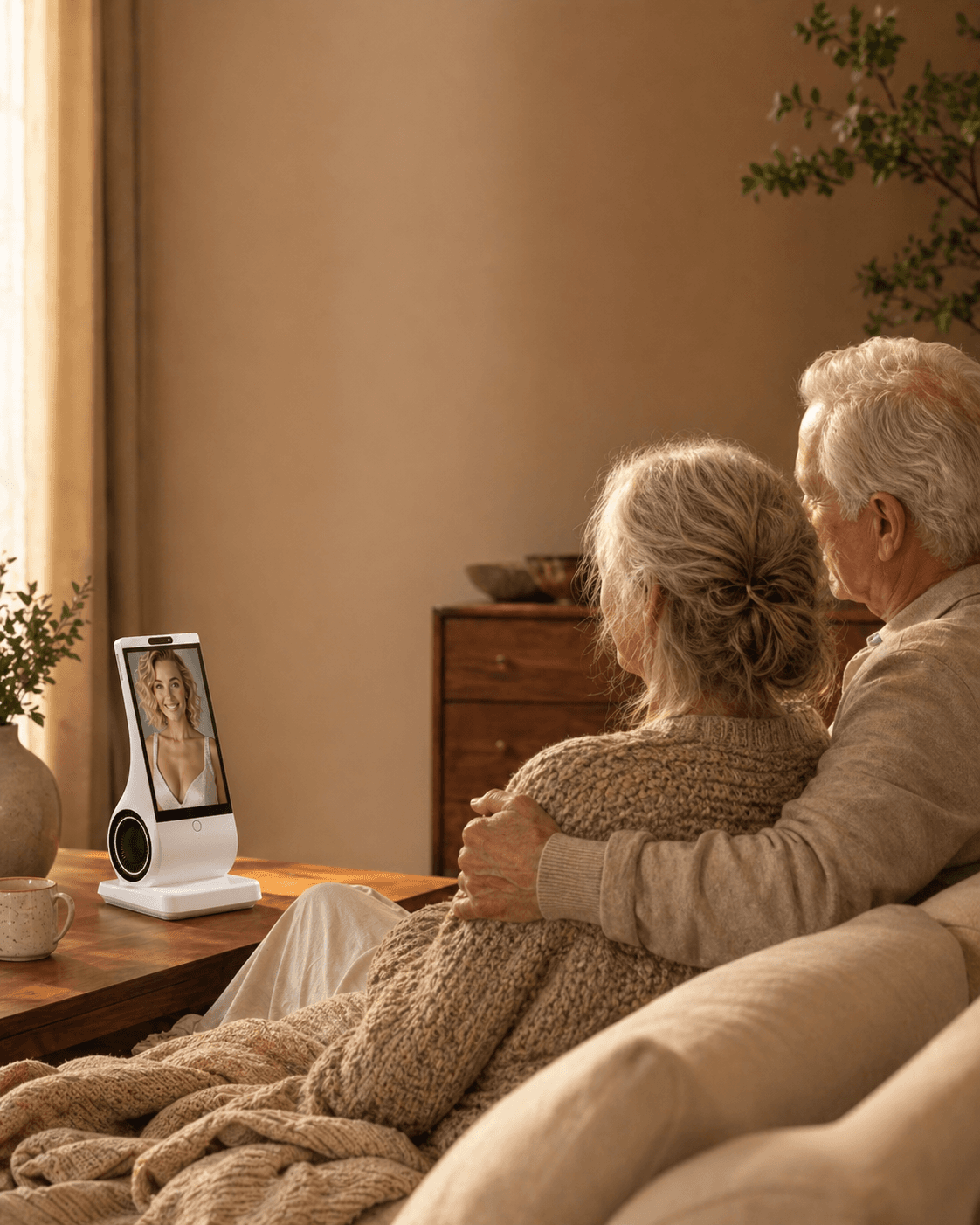
An AI companion can make some hours at home less empty after an older parent stops driving, and it can help them prepare questions, plans, and conversation for the next real outing. It cannot restore mobility, drive them anywhere, assess driving safety, or replace friends, family, transport services, clinicians, or emergency help. The useful test is simple: does the device support a wider life outside the home, or make a shrinking life easier to ignore?
Reviewed and updated: August 28, 2026
The loss is larger than the car
On Thursday mornings, Martin used to leave home without telling anyone. He bought two tomatoes, argued cheerfully with the fishmonger, stopped at the library, and sometimes drank coffee with a man whose surname he never learned. After a minor crash and a difficult conversation with his doctor, he stopped driving. His daughter arranged grocery delivery and promised rides to every appointment. She believed the practical problem was solved.
Three weeks later, the refrigerator was full and Martin had missed nothing medical. Yet he had spoken face to face with only his daughter and a delivery driver. The library book stayed on the hall table. Coffee became something he drank alone. When his daughter asked what he wanted to do on Saturday, he said, “Don’t make a special trip for me.” What disappeared was not only transportation. It was spontaneity, privacy, ordinary acquaintances, and the right to leave without asking for a favor.
That is why families now ask whether an AI companion could help. They are not always looking for a robot friend in the abstract. They are trying to fill the long intervals created when driving, walking distance, public transport, health, and family schedules no longer line up. Recent public discussions in AgingParents, CaregiverSupport, eldercare, TechForAgingParents, and AgingCare repeatedly describe parents who stop driving, refuse to ask anyone except one adult child for a ride, live where taxis are expensive or buses are absent, and slowly stop going out. Other posts describe a widowed parent who wants a nightly call because evenings feel empty, or a family that organizes activities which the parent will not attend without familiar people. These discussions are demand signals, not proof that every non-driver is lonely or that AI fixes the problem.
The buying question should therefore be more exact than “Will a companion keep Dad company?” Ask:
Can it make home time better while helping Dad retain choice, transport, human relationships, and reasons to leave home?
Driving retirement creates four different gaps
Families often treat every consequence of stopping driving as loneliness. That hides the work that actually needs doing.
| Gap after driving stops | What it feels like at home | What may help | What an AI companion cannot supply |
|---|---|---|---|
| Mobility gap | “I cannot get where I choose, when I choose.” | Family rides, accessible transit, volunteer drivers, taxis, paratransit, community transport | A vehicle, physical assistance, door-through-door support, safe transfer, money for fares |
| Participation gap | “My club still exists, but reaching it is too hard.” | A recurring ride tied to a valued activity, an escort, a nearby alternative | The shared room, worship service, class, shop, park, or meal itself |
| Conversation gap | “There is nobody here for the small things.” | Family and friend contact, neighbors, visitors, group calls, a companion for optional in-between talk | Mutual obligation, touch, history shared by another person, community membership |
| Control gap | “Every outing now requires permission and gratitude.” | A personal mobility budget, choices among drivers and times, private booking help, advance planning | Legal autonomy, money, transport capacity, or consent from another human |
An AI companion can address only part of the conversation gap. It may also help with planning: rehearsing how to ask for a ride, listing questions for a transport provider, or remembering that Tuesday is the day to choose Friday’s outing. But planning is not mobility. A polished conversation about the library does not put Martin inside the library.
The distinction matters because substitution can look successful in a dashboard. A parent may talk to the device every day while leaving home less often. The family may hear fewer complaints while the transport and participation gaps deepen. “More companion use” is not an outcome worth celebrating by itself.
What research supports—and what it does not
The CDC MyMobility Plan treats mobility as something to prepare for before a crisis. Its three-part approach looks at the person, the home, and the community. CDC explicitly notes that stopping driving can reduce health, social interaction, and the ability to get around. That is a stronger frame than choosing a gadget after the car keys are gone: protect mobility and participation, not only safety inside the house.
The National Institute on Aging’s older-driver guidance explains why “giving up the keys” can feel like losing freedom, errands, activities, and social contact. It recommends identifying transportation needs and local alternatives before the driving conversation. Options vary by place: public transit, reduced-fare services, taxis, rideshare, scheduled community trips, volunteer drivers, delivery services, and help from an Area Agency on Aging may all be relevant. None is universally available or suitable.
A systematic review of 16 studies found driving cessation associated with declines in general, physical, social, and cognitive health and with greater depressive symptoms. The pooled estimate from five observational studies was nearly twice the odds of greater depressive symptoms among former drivers. That result deserves care. It does not prove that stopping driving alone caused depression in each person; declining health can lead both to driving cessation and poorer outcomes, measures varied, and most data came from older cohorts in a limited set of countries. It does show why a family should not treat transport loss as a minor administrative change.
A separate systematic review of driving cessation and social participation found that six of seven included US studies linked stopping driving with at least one participation domain, such as leisure, volunteering, work, or frequency of contact. Measures were inconsistent, and the review did not establish a single remedy. A newer review of transition interventions and strategies found surprisingly little controlled evidence for programs designed to support driving retirement. In other words, the problem is well recognized, but families should be suspicious of any product promising a proven, complete solution.
Research on conversational agents for older adults is also mixed. Some studies report engagement or reduced loneliness, while sample sizes, duration, measures, and products differ. A companion may be pleasant, may help a routine, or may be ignored. It should not be marketed as diagnosing or treating loneliness, depression, grief, or social isolation. If a parent shows persistent sadness, hopelessness, marked withdrawal, sleep or appetite changes, self-neglect, confusion, or thoughts of self-harm, involve a qualified clinician or local crisis service. A chat is not an assessment.
The question to ask before buying: what trip disappeared?
“Dad needs company” is too broad to guide a purchase. Start with the trip that vanished.
Was it the Tuesday card game, the early worship service, a dawn walk at the mall, a volunteer shift, lunch with a sibling, the barber, a particular grocery aisle, or the freedom to drive nowhere in particular? The answer reveals whether the loss is primarily social, practical, sensory, spiritual, or about control. Grocery delivery replaces bags of food, not choosing a peach, greeting the cashier, or changing plans on the way home.
Write down seven days of former trips and current substitutes. Include trips that seem trivial. A short drive to buy a newspaper may have supplied fresh air, movement, familiar faces, and private time. A medical ride may be technically available but too inflexible for a friend’s birthday. A daughter’s Saturday errand run may complete every task while making the parent feel like cargo.
Then separate destinations into four groups:
- Essential and time-sensitive: medical care, prescriptions, food, banking, legal appointments.
- Identity-bearing: worship, volunteering, clubs, work, caregiving for someone else, cultural or language community.
- Relationship-bearing: visiting friends, family meals, a regular café, grief group, neighborly errands.
- Pleasure and spontaneity: parks, shops, library browsing, a drive to see the weather change, choosing an outing on the same day.
A transport plan that covers only the first group keeps a body supplied while allowing a life to contract. An AI companion might make waiting less dull, but it cannot turn an essentials-only schedule into participation. Give identity and pleasure a budget, a driver, and a place on the calendar.
Build the mobility plan before the companion plan
In the United States, the Eldercare Locator, a public service of the Administration for Community Living, connects older adults and families with local services through its website and 1-800-677-1116. The NIA guide to services for older adults living at home also points families toward transportation, meals, personal care, and community support. Outside the United States, begin with the municipal aging office, social services, health system, disability organization, transit authority, or a trusted local nonprofit. Availability, eligibility, booking windows, accessibility, escort rules, and prices differ sharply.
Do not hand a parent a list of phone numbers and call the job done. Test the full trip. Can someone answer the phone? How far ahead must a ride be booked? Does the driver wait at the curb or enter the building? Can the service handle a walker, wheelchair, hearing difficulty, or a person who needs an escort? What happens when an appointment runs late? Is the return ride guaranteed? Can a trusted person book on the parent’s behalf without taking over every decision? Is the fare affordable twice a week, not merely once?
Create at least two routes for essential destinations and one route for a chosen social destination. A plan depending on one adult child is fragile. So is a plan depending on an app the parent cannot use, a volunteer service that operates only weekdays, or a taxi company that does not serve the rural road after dark.
The companion belongs after those questions. It can help the parent practice the booking script, compare tomorrow’s options, remember which questions remain unanswered, and talk through reluctance. It should never invent a booking confirmation, imply a vehicle is coming, or become the only place where plans are stored.
Keep a transport plan separate from a conversation plan
Write down one trip the parent misses, its purpose, an available route, the person or service responsible, the cost and a backup. Include a chosen social or enjoyable trip, not only deliveries and medical appointments. Confirm arrangements with the people expected to provide them.
Then ask what, if anything, a companion would add between those real activities. It cannot supply transport or determine fitness to drive. Do not use a device purchase as evidence that lost mobility has been addressed.
Review the parent's actual choices and outings, not a total score. If no workable route exists, keep that gap visible and seek appropriate local transport or community help rather than describing conversation as a replacement.
A two-week trial based on life, not screen time
Do not start with an annual commitment and a speech about loneliness. Borrow, use a return window, or make the smallest reversible purchase available. Keep the first trial separate from any decision about driving fitness; clinicians, licensing authorities, and qualified driving evaluators handle that question.
Days 1–2: map silence and movement
Ask the parent which parts of the day feel quiet and which lost trips matter. Do not assume every solitary hour is painful. Some people enjoy privacy after decades of obligations. Record current human contacts, planned outings, transport failures, and who provides rides. The parent should describe what they want more of, not merely what the family fears.
Days 3–4: test one real route
Book or rehearse one nonmedical trip the parent chooses. Try the whole chain: preparation, pickup, entry, payment, waiting, return, and contingency. If the route fails, fix it before presenting the companion as help. A device cannot compensate for a driver who never arrives.
Days 5–7: introduce optional conversation
Place the companion where the parent chooses, explain when it listens and how to stop, and test ordinary speech at ordinary volume. Use it for ten or fifteen minutes, not all day. Try a subject connected to an outing: questions for the gardening club, a list for the library, or a story to tell a friend. Notice misunderstanding, fatigue, unwanted interruption, privacy discomfort, and whether the parent reaches for it without prompting.
Days 8–10: make a bridge
With permission, bring one item from the companion conversation into a human call or visit. The parent might ask a grandchild which book to reserve, choose a café for Friday, or rehearse how to tell a friend that rides are now harder. Do not send raw transcripts or summaries to family unless the parent knowingly chooses that sharing.
Days 11–13: test a bad day
Turn off Wi-Fi briefly, move the device, lower the volume, or simulate the helper being unavailable. Can the parent recover without panic? Can they still find transport numbers and family contacts on paper or another reliable channel? Does the device clearly admit when it cannot act? Never simulate an emergency.
Day 14: decide with evidence
Count chosen outings, canceled trips, human contacts, times the parent initiated use, frustrations, and support minutes. Ask three blunt questions: “Did this make home better?” “Did it help you do anything with another person?” “Would you spend your own money and space on it?” A no is a valid result.
Five actions that matter more than the unboxing
- Replace destinations, not just errands. Restore one place tied to identity or pleasure, not only medical and grocery trips.
- Create two transport paths. Combine family, community, public, volunteer, taxi, or rideshare options so one failure does not isolate the parent.
- Let the parent own the calendar. Offer choices of destination, time, driver, and frequency; do not make every ride a favor to negotiate.
- Use AI as a bridge. Prepare questions, conversation, or plans for a real person and outing; keep private dialogue private unless the parent chooses otherwise.
- Review after two weeks and six weeks. Check mobility, contact, cost, burden, consent, and actual preference—not novelty or login counts.
Common mistakes and better corrections
“Grocery delivery means independence is handled”
Delivery solves access to goods. It may also remove a weekly walk, conversation, choice, and reason to dress. Keep delivery where it reduces strain, then deliberately replace the social and movement value of the trip.
“If Mom is talking to the companion, she is not isolated”
Conversation with software and participation in a community are different. Ask who knows her, who would notice her absence, where she contributes, and when she sees another person by choice.
“Dad refuses rides, so the device is the only realistic option”
Refusing may reflect embarrassment, loss of control, fear of strangers, cost, unreliable pickup, or not wanting a child to sacrifice work. Offer a budget, several drivers, reciprocal ways to contribute, and a trial trip with a trusted person. Do not translate “no to this ride” into “yes to staying home.”
“A reminder will make him go”
Remembering is not the same as wanting, preparing, walking to the curb, or trusting the driver. Find the failed step. If pain, fatigue, anxiety, hearing, continence, mobility, or cognition is involved, seek appropriate professional support.
“The AI can watch for depression after driving stops”
A consumer companion should not be treated as a diagnostic monitor. Fluent language can create false confidence, and silence can have many meanings. Concerning change belongs with the parent, trusted people, and qualified professionals.
“More calls prove the plan works”
The adult child may be receiving more urgent requests because the transport system is failing. Track whether responsibility is distributed and predictable. A sustainable two-call schedule plus reliable outings may be healthier than constant crisis contact.
“We can install it as a surprise gift”
A companion that listens, remembers, or occupies a prominent room is not a neutral ornament. Show the parent what it does, discuss privacy and cost, and accept refusal. Surprise can work for chocolates; it is a poor consent model for conversational technology.
When a companion is the wrong tool
Do not use an AI companion as the primary response when the parent needs:
- a driving-safety assessment, licensing decision, vehicle adaptation, or rehabilitation;
- reliable transport to food, medical care, medication, legal services, or essential appointments;
- physical assistance entering a vehicle, navigating stairs, transferring, or carrying mobility equipment;
- emergency response, fall detection, wandering support, overnight supervision, or wellness checks;
- diagnosis or treatment for depression, anxiety, grief, cognitive change, substance use, or another health concern;
- protection from abuse, neglect, exploitation, or self-neglect;
- a human visitor, counselor, caregiver, interpreter, faith leader, or peer group;
- technology they have declined or cannot operate without distress;
- privacy that the product and household cannot provide.
If the parent cannot obtain food, medication, urgent care, or safe shelter; becomes acutely confused; expresses hopelessness or self-harm; is missing; or faces immediate danger, contact local emergency, crisis, adult-protection, medical, or social services. Do not ask a companion to manage the situation.
Where EUVOLA may fit, with a narrow job description
EUVOLA is a dedicated, voice-first AI companion device with an on-screen avatar, personalized voice options, and long-term memory for continuity across conversations. It has no camera. Those facts may make it easier for an older adult who prefers speaking to typing and wants an optional conversational presence in a familiar room.
After driving stops, a sensible EUVOLA role is modest: help the parent talk through tomorrow’s choices, remember a topic they want to raise with a friend, rehearse questions for a transport provider, or make a quiet hour more engaging. It can support the bridge from “I have nowhere to go” to “I want to ask Nora about the Wednesday class.” It does not book, guarantee, or provide the ride unless a separate, verified service explicitly does so; no such transport capability should be inferred from companionship.
The official EUVOLA FAQ explains important privacy boundaries. Original conversation audio and text are deleted after model processing. Long-term memory may retain useful context, is not perfect word-for-word storage, and can be deleted by the user. EUVOLA has no camera. Families should still review listening, memory, training opt-out, account, network, support, and placement choices with the person who will use it.
Do not position EUVOLA as a medical alert system, driving evaluator, depression detector, caregiver, transport dispatcher, or substitute for family contact. If a two-week trial increases pleasant conversation but outings continue to disappear, the product may be doing its narrow job while the family plan is still failing.
Questions to ask any vendor
Ask for direct answers, not lifestyle language:
- What does the device do when the internet fails?
- How does the user stop a conversation, mute listening, view or delete memory, and close the account?
- Are raw audio, transcripts, or summaries stored, for how long, and for what purposes?
- Can family members access conversations, summaries, usage, or location? Is each permission optional and visible to the user?
- Does the product claim to contact rides, family, clinicians, or emergency services? What exact confirmation proves the action happened?
- Can the user choose quiet hours, volume, language, voice, and placement?
- What happens after cancellation, device replacement, company closure, or loss of the supporting phone?
- Who handles setup and recovery when the usual adult child is away?
- Is there a return period long enough to test ordinary and difficult days?
- Which claims are supported by independent evidence for this product and this population?
The FTC’s voice-assistant privacy guidance recommends reviewing privacy settings, deleting stored interactions where available, securing accounts and networks, and considering where a listening device is placed. A shared living room, a home-care visit, and a confidential medical call create different privacy conditions.
Calculate the six-week cost of the whole plan
The device price is only one line. For six weeks, estimate transport fares, family mileage, parking, escort time, subscription charges, internet changes, setup, troubleshooting, and any paid support. Then list the value the parent receives: essential trips completed, chosen social trips completed, cancellations avoided, support hours saved, and activities they would genuinely miss without the plan.
Do not convert conversation minutes into a medical or financial benefit. Instead, compare two complete options. Option A might combine grocery delivery, one volunteer-driver trip, one paid taxi, two scheduled family calls, and no companion. Option B might use the same mobility plan plus a companion the parent wants. If Option B removes a real human outing to stay within budget, the apparent technology saving is a participation loss. If it makes home time better without cutting transport or contact, the extra cost may be reasonable.
Include failure costs. Who travels over when the network drops? What happens if the parent cannot reset a password, a taxi cancels, or the only family driver becomes ill? A plan that looks inexpensive because one daughter supplies unlimited unpaid labor is not inexpensive; the cost has merely been hidden. Review the calculation with the parent, not around them.
Frequently asked questions
Can an AI companion replace the social life an older parent loses after driving?
No. It may add optional conversation at home, but it cannot recreate mutual relationships, community membership, touch, spontaneous encounters, or the ability to contribute in person. Use it alongside a transport and contact plan, not instead of one.
Could it help a parent who refuses to ask for rides?
It can help them rehearse a request or compare choices, but the reason for refusal matters. Cost, shame, safety, unreliable pickup, and fear of burdening family need different solutions. Give the parent a defined ride budget and multiple options so every trip does not feel like a personal debt.
Should we buy the companion before the parent stops driving?
Only if the parent wants it for companionship on its own merits. Mobility planning should begin early, but a companion is not a mobility plan. Test transport routes before a crisis, following resources such as CDC’s MyMobility Plan.
Can it tell us whether Dad is safe to drive?
No. A companion conversation is not a validated driving assessment. Discuss concerns with a clinician, licensing authority, occupational therapist, certified driving rehabilitation specialist, or other qualified local service. Immediate unsafe driving requires direct action under local law and professional guidance.
Is talking to AI better than watching television alone?
That depends on the person and the use. Conversation can be more active than passive viewing, but frustration, repetition, privacy discomfort, or overuse may make it worse. The relevant comparison includes calling someone, radio, audiobooks, hobbies, a visitor, a class, and rest—not only television.
What if my parent says they are not lonely?
Believe the statement unless there is concrete reason to revisit it. Solitude is not automatically loneliness. Ask about missed places, choice, transport, and preferred contact without imposing a diagnosis. They may need rides and autonomy without wanting more conversation.
Can a companion reduce caregiver guilt?
It may make some intervals feel less empty, but it cannot certify that the parent is safe, socially connected, or content. Guilt often signals impossible expectations or an unreliable care plan. Share responsibility, set sustainable contact, and seek caregiver support rather than using device activity as reassurance.
How much human contact is enough?
There is no universal number. Quality, preference, reciprocity, culture, health, and existing relationships matter. Look for chosen contact, someone who would notice change, opportunities to contribute, and the parent’s own report. Persistent concern deserves discussion with a qualified professional.
What should we measure during a trial?
Track chosen outings, successful rides, cancellations, human contacts, parent-initiated companion use, frustrations, support time, privacy concerns, and the parent’s wish to continue. Do not use conversation minutes alone.
Can two parents share one device?
They may share a room but still need separate consent, privacy, preferences, and memory boundaries. Ask the vendor how speakers and accounts are separated. Never assume one spouse agreed on behalf of the other.
What if transportation simply does not exist where they live?
That is a structural limit, not a motivation problem. Contact local aging, disability, health, transit, faith, and volunteer organizations; examine paid drivers, neighbor agreements, delivery, relocation, or changes in the frequency and location of activities. An AI companion may make home time better, but it cannot erase geographic isolation.
A better result than “they use it every day”
Six weeks after Martin stopped driving, his daughter stopped asking whether he felt lonely. She asked which trip he missed. He chose the library, not the supermarket. They found a volunteer driver for alternate Thursdays, kept grocery delivery, and put taxi money in an envelope he controlled for one unplanned outing a month. A neighbor agreed to join him for coffee when schedules matched.
Martin tried a voice companion too. He used it to make a list of books, practice the name of a new transport service, and talk about fish recipes when the kitchen was quiet. Some days he ignored it. His daughter did not count that as failure. The device had a narrow place; the library, coffee, choices, and people carried the larger load.
That is the standard worth using. The best companion plan does not make staying home look complete. It helps an older parent keep authorship of a life that still reaches beyond the front door.
Sources and further reading
- CDC: MyMobility Plan
- CDC: Older Adult Drivers
- National Institute on Aging: Safe Driving for Older Adults
- National Institute on Aging: Services for Older Adults Living at Home
- Administration for Community Living: Eldercare Locator
- Systematic Review: Driving Cessation and Health Outcomes in Older Adults
- Systematic Review: Driving Cessation and Social Participation in Late Life
- Systematic Review: Supporting the Transition From Driving
- National Institute on Aging: Social Isolation and Loneliness in Older People
- Federal Trade Commission: Secure Your Voice Assistant and Protect Your Privacy
- EUVOLA: Official Frequently Asked Questions