
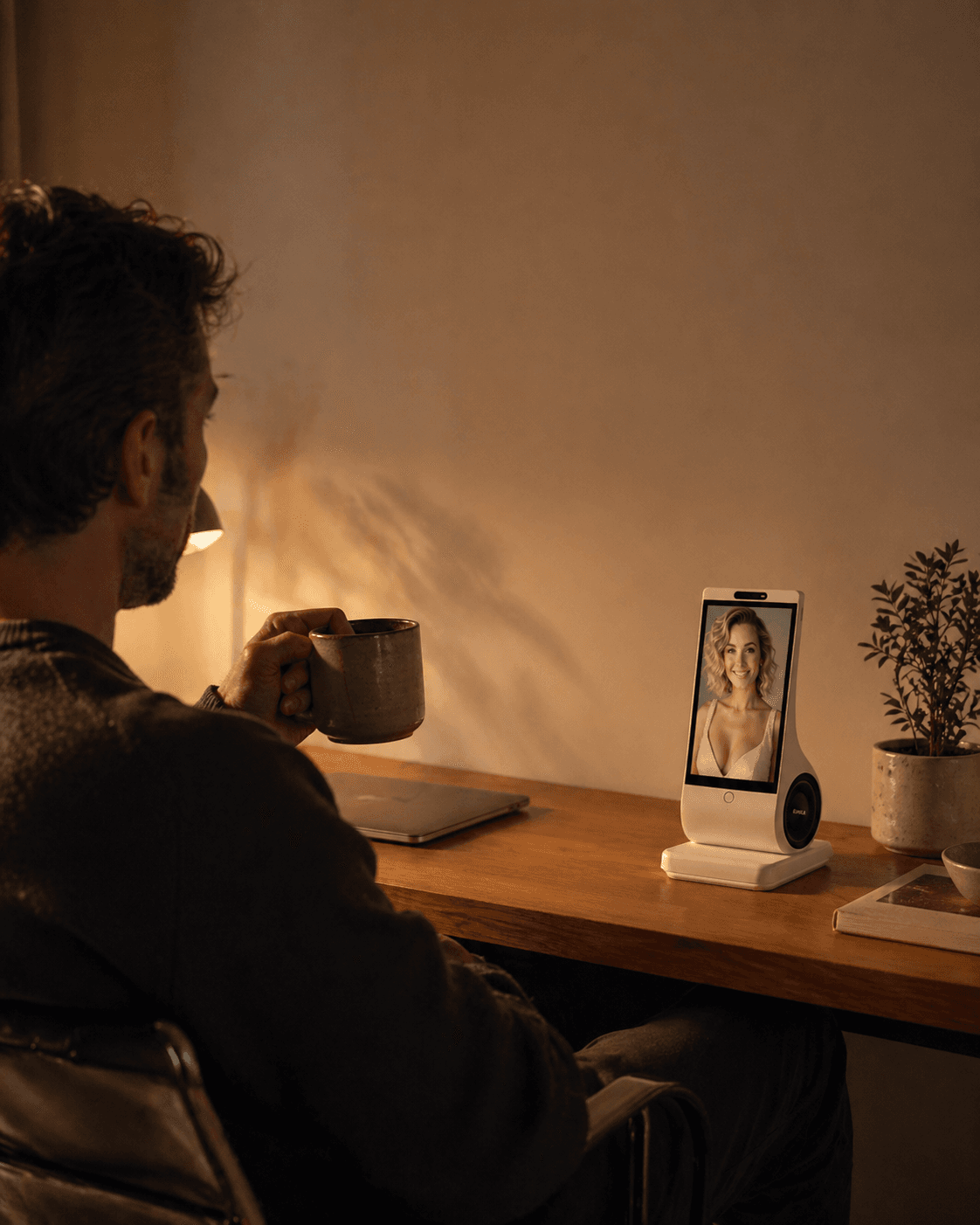
An AI companion can provide extra conversation practice if it supports your target language and lets you finish your thoughts. Use it to rehearse a specific everyday exchange, then check important corrections against a reliable learning resource or a teacher. A friendly conversation, a correctly understood request and a higher language level are three different outcomes.
This guide is for adults choosing how to practise speaking between lessons or human conversations. It does not establish that EUVOLA or another companion improves proficiency. EUVOLA, which sells a home companion device, publishes it; the examples and practice record below are editorial suggestions, not results from learner testing.
Decide whether you need conversation, instruction or assessment
Start with the job you want to do. “Talk about my weekend in French” requires an understandable exchange. “Explain why this French sentence is wrong” requires accurate instruction. “Tell me whether I am ready for a B2 exam” requires assessment against the actual examination criteria. One product may attempt all three, but success at the first does not verify the other two.
For conversation, look for replies you can understand, relevant follow-up questions and enough time to answer. For instruction, you also need corrections that preserve your intended meaning, explain the relevant rule and distinguish an error from a different but acceptable expression. For assessment, use the exam provider's requirements and an appropriate teacher or official test; do not treat a chatbot's encouraging level label as a qualification.
The British Council's discussion of AI and language learning, published on 12 March 2026, recommends questioning AI outputs and keeping human teaching central. It is educational guidance, not a trial proving that a particular companion improves speaking.
Choose one task you want to do with a person
Choose something you could genuinely need: describe a hobby, ask about a train connection, explain a simple problem or ask a follow-up question. Use an invented situation when the real one would involve private information. If you are a beginner, start with familiar words from your course rather than asking the companion to invent an entire curriculum.
The Council of Europe's CEFR self-assessment grid separates listening, spoken interaction and spoken production. Use that distinction to make your goal concrete: understanding a reply is different from producing your own explanation. The grid is a reference framework; a successful chat does not certify a level.
For example, a learner might aim to explain what they enjoy about gardening and ask the other person about their hobby. The useful outcome is completing that exchange with their own words. Producing a polished paragraph for the AI to read aloud would accomplish a different task.
Agree on feedback before starting
Try a request such as:
“Practise a short conversation with me in French about a hobby. Ask one question at a time. Keep replies short. Let me finish before correcting me. After the exchange, identify one phrase that made my meaning unclear, explain a possible correction and tell me if you are uncertain.”
This is an example request, not a guaranteed setting or a claim that any companion follows it. If the product has documented controls for reply speed, turn-taking or language, use them. A spoken promise to wait is not proof that the voice interface has changed.
Choose when you want feedback. Corrections after the exchange may suit a conversation goal; immediate feedback may suit a focused grammar exercise. There is no single schedule prescribed here. If constant corrections prevent you from finishing, simplify the task or use a different practice method.
Separate recognition errors from language errors
If a reply seems unrelated, first check what the system understood. A transcript, when available, can help identify a misheard word. Do not assume every companion exposes transcripts, or that a transcript preserves the sound accurately.
If you said one word and the system heard another, repeating the sentence more clearly may repair the exchange. It does not prove your original grammar was wrong. Likewise, a correctly written transcript does not establish that your pronunciation is comfortable for a human listener.
Practise at your normal pace, including thinking pauses. If the system repeatedly takes over while you search for a word, record that as an interface obstacle. Try a documented turn control if available, or switch to text or another tool. Do not force yourself to speak faster just to satisfy the device. The home voice-interaction guide covers room noise and placement; this learning task also needs space to hesitate.
Verify a correction before turning it into a habit
Ask the companion to show your original expression, its proposed revision and the reason for the change. Check that the revision still says what you meant. “I would like to…” should not quietly become “I must…” just because the second sentence sounds smoother.
Then check a correction you intend to reuse against your course material, a reputable dictionary with examples, or a teacher. Ask about the setting: Is it formal, casual or regional? If two answers conflict and you cannot resolve them, mark the phrase uncertain and avoid teaching it to yourself as a rule.
For pronunciation, separate “the system understood me” from “a listener can follow me comfortably.” Use published audio examples and, when possible, feedback from a teacher or willing language partner. Do not let an unverified accent score decide that a regional accent or your identity needs fixing.
UNESCO's guidance on generative AI in education, first published in 2023, calls for human oversight and pedagogical validation. It does not validate a companion's correction feature.
Keep a small record, then try a related human exchange
A useful record captures what you tried and what still needs checking. It is not a proficiency score.
| Record | Example entry |
|---|---|
| Task and conditions | Describe a hobby; voice; target language; date and product/plan |
| What I managed myself | Explained why I enjoy it and asked a follow-up |
| Help or interruption | Needed a word prompt; AI answered before I finished |
| Correction to verify | Original phrase, revision, reason and checking source |
| Next human use | Try a related topic with a willing partner or teacher |
These entries are illustrative, not observations from a customer. Keep only the detail you need; avoid a shared log of private voice recordings.
On another occasion, try a related exchange without copying the earlier answer. When feasible, use it with a person who agrees to practise. Notice whether you can explain, ask and repair a misunderstanding without the companion supplying every sentence. A single successful exchange is a useful observation, not evidence of lasting improvement. There is no promised practice duration or proficiency gain here.
Check EUVOLA's actual role before buying for learning
According to the current EUVOLA FAQ, EUVOLA is a home device for voice conversation, supports multiple languages and requires Wi-Fi. Recognition can vary by language, accent, voice and environment. Those statements do not establish a language curriculum, validated pronunciation scoring, examination assessment or learning results; this guide has not verified those capabilities.
If you are considering EUVOLA for casual practice, ask support about the exact target language and required interaction, and test them under the current purchase and return terms. Do not buy for a teaching feature that you hope it will acquire later. For a broader shortlist, use the product comparison record.
Review the privacy policy and documented data controls before speaking. Use fictional travel details or a harmless hobby rather than a passport number, employer document or another person's private story. A language exercise does not require uploading someone else's photo or voice.
Keep real conversations and teaching in your learning plan. An AI companion cannot replace human relationships, clinical judgment, caregiving or crisis and emergency services. If the practice tool cannot let you finish, gives corrections you cannot verify, or becomes your only source of the language, change the arrangement rather than treating more chatting as proof of progress.