
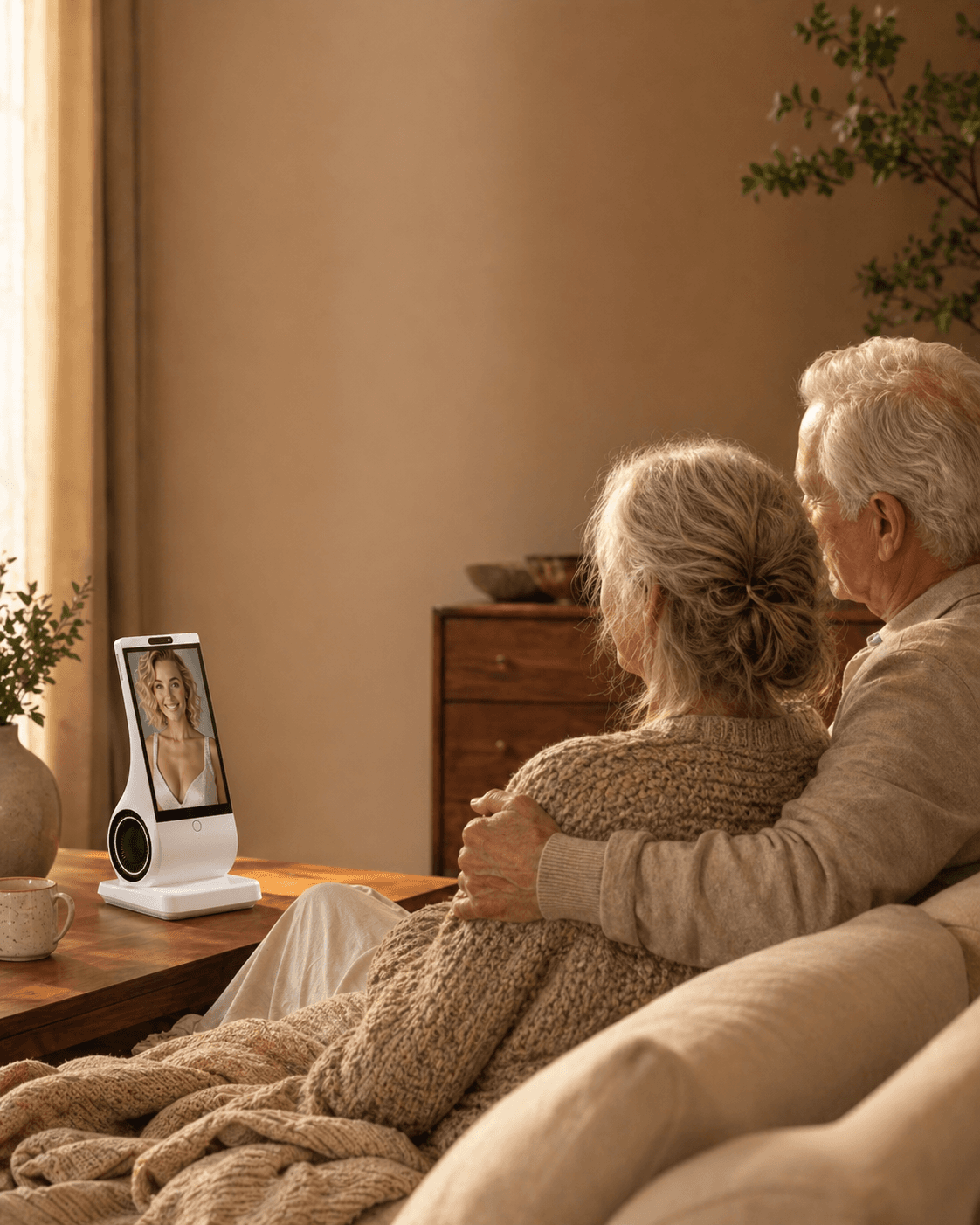
An AI companion may offer a welcome conversation during a widowed parent's quiet evening, if they want it and understand what it is. It cannot replace the person who died, treat grief, protect someone overnight, or take over family contact. A sensible trial gives it one modest role before bedtime, preserves human plans, and stops if conversations leave your parent more distressed, less rested, or less connected to other people.
Reviewed and updated: September 4, 2026. Written by the EUVOLA Editorial Team. The household examples below are illustrative, not customer testimonials or clinical case histories.
The difficult hour may begin after everyone else goes home
Imagine a parent who manages shopping, meets a friend for lunch, and sounds cheerful during an afternoon call. At eight that evening, the washing up is finished. The chair beside theirs is empty. A television supplies voices, but nobody answers when they comment on the programme. An adult child hears another lonely phone call and wonders why the day's visit was not enough.
That visit did not fail. It simply did not recreate the ordinary presence of a spouse: someone who knew which neighbour was being discussed, remembered the joke from breakfast, or noticed that the room had become cold. Buying more entertainment may miss the wish for a response. Buying a conversational device may answer part of that wish, while leaving the loss itself untouched.
Before comparing products, ask about the particular evening. “When does the house feel hardest to be in?” is more useful than “Would a robot make you less lonely?” Your parent might name the meal, the moment the television goes off, a weekend without plans, or waking in the dark. Those answers lead to different arrangements. An earlier shared supper, an evening telephone group, and a sleep assessment are not interchangeable purchases.
A parent can also want solitude. Sitting quietly with a photograph is not automatically a problem to solve. The aim is to offer choice where quiet feels unwanted, without turning every moment alone into a family surveillance project. An adult child may feel relieved by a device's presence while the parent feels watched, managed, or politely obliged to use an expensive gift.
Separate conversation, bereavement, sleep, and safety
An AI companion is an interactive system that generates replies and may maintain a persona or remembered context across conversations. A radio supplies sound; a video call connects two actual people; a companion generates a response. That responsiveness can be appealing, but it does not give the system a shared marriage, personal concern, or a human obligation to check what happens next.
Bereavement is a response to loss. Loneliness describes an unwanted gap in connection; social isolation concerns the amount of contact available. A parent can have visitors and still miss one particular person. They can also enjoy a chatbot while lacking transport, practical help, or friends. Feeling better during one conversation is different from having reliable people in their life.
The NHS guidance on grief, reviewed in July 2026, explains that grief affects people differently and does not follow a compulsory sequence. Do not set a deadline by which your parent should stop missing their partner. Equally, worsening distress or difficulty managing daily life deserves human support, not an automatic assumption that another device session will help.
Sleep needs separate attention. A parent who wants company at seven may appreciate a brief conversation. A parent regularly awake and exhausted at three in the morning needs a conversation with a healthcare professional about the sleep problem. A general companion is not a sleep treatment, and its willingness to continue replying is not a reason to keep talking until dawn.
Safety is another separate arrangement. Fear of being alone after a fall, an alarming symptom, or a threatening message requires a real contact and response plan. A voice coming from a screen does not mean anyone is watching over the house. If the buying question is actually “Who will know if something happens tonight?”, resolve that before shopping for companionship.
What the research allows us to say
Research gives a reason to explore conversational comfort, with considerable limits. De Freitas and colleagues' AI Companions Reduce Loneliness reports short-term reductions in self-reported loneliness in its studies, including a week-long component. This does not establish treatment for bereavement or lasting benefits for widowed older adults using a particular home device.
A separate four-week study of 981 participants by Fang and colleagues, revised in October 2025, found no significant effects of its assigned interaction conditions. Greater voluntary use was associated with poorer psychosocial outcomes. That association does not establish that extra chatbot use caused the outcomes; people already struggling may use a chatbot more. Neither paper tested EUVOLA as a grief intervention.
These findings cannot be compressed into “AI cures loneliness” or “talking to AI is always harmful.” For a household, a more useful question is whether this particular arrangement adds a comfortable option without pushing aside rest, meals, relationships, or needed support. A parent who enjoys ten minutes of wordplay before calling a friend is having a different experience from someone who cancels calls to remain in an absorbing conversation.
A short home trial cannot prove a medical benefit. It can reveal practical fit: whether the parent initiates voluntarily, understands the responses, can stop comfortably, and still wants the other parts of their evening. Treat those observations as purchasing information. Do not administer a homemade grief score or use a shopping checklist to decide whether professional help is necessary.
Match the option to the missing part of the evening
Consider the following comparisons as a decision framework rather than a ranking. Availability, cost, accessibility, and local services vary. None of these options is a universal answer, and several can work together.
When the room is too silent
A familiar radio programme, an audiobook, music, or a recorded message may be enough when your parent wants sound without effort. These can be easier to start and stop than a conversation. An existing device may already do the job. Ask whether they want a voice replying to them or simply something pleasant to hear while they cook or read.
Recorded messages have a different meaning from generated speech. A saved greeting really came from its sender; an AI response is newly generated. Keep that distinction visible, particularly if the recording features the person who died. Ask before replaying intimate material, and keep a family-controlled copy of recordings that matter rather than assuming a companion's memory preserves them.
When they want to tell someone about the day
A friend, neighbour, relative, volunteer befriending service, or small telephone group can provide a real relationship. A regular slot may be easier than repeatedly deciding whether it is acceptable to call. Check service hours and eligibility directly; a community calling programme is not necessarily an overnight service or an emergency response line.
An AI companion can be an additional place for ordinary talk when nobody is available. It may help someone rehearse how to invite a neighbour for tea or find words for a message they will send themselves. The meaningful outcome is the contact that follows, not an elegant invitation that remains inside the device. Confirm any real venue, time, or telephone number independently.
When they miss someone who understands the loss
A bereavement group, trained support volunteer, counsellor, faith community, or trusted friend with a similar experience may meet a need that cheerful small talk cannot. Cruse's guidance on grief and loneliness describes how loss can change social connections. The right support need not involve talking to a large group on the first day.
Ask what makes an option uncomfortable. It may be transport after dark, fear of being expected to speak, language, a religious mismatch, or the thought that attending means admitting defeat. A smaller first step could be asking an organiser what a session is like. An AI can help draft that question; it cannot establish the organiser's qualifications or replace the answer.
When the difficulty is being alone with practical tasks
Meals, transport, shopping, household paperwork, or an evening care visit can matter more than conversational novelty. A parent who says “I hate evenings” may mean that cooking for one feels pointless or that getting ready for bed is physically difficult. Ask without assuming that every need is emotional. A companion cannot prepare dinner, support a transfer, or make the home physically safe.
If funds are limited, compare the cost of the complete arrangement. A device plus connectivity, setup visits, and troubleshooting may compete with transport to a weekly supper. Write down what each purchase actually provides. Do not compare a one-time hardware price with an entire year of human care and conclude that the hardware is a substitute.
When company is welcome but a full conversation is tiring
A tactile robotic pet or another familiar object may suit someone who enjoys a presence without maintaining dialogue. Capabilities differ widely. Some devices make simple movements or sounds; others need accounts, Wi-Fi, updates, and charging. Check the actual product rather than assuming every robot provides conversation or every soft companion has medical evidence behind it.
The parent should be able to decline all of these options. “I would rather my friend come for supper” is a useful answer. So is “I like the radio and do not want a machine asking me questions.” A successful comparison sometimes ends without a technology purchase.
Design one ordinary evening before you buy anything
Start with a piece of paper and the actual hours your parent finds difficult. Write the beginning and end of that period, the activities already there, and the part they would like to change. Avoid filling every blank. A timetable that requires constant stimulation can become another burden, especially on a day when grief or tiredness makes ordinary tasks harder.
For example, a parent might choose a meal at six, a neighbour's call twice a week, a short optional conversation after clearing the table, and familiar music before bed. This is an illustration, not a recommended schedule or a proven treatment. The useful feature is that the AI has a defined place among other choices and a clear ending.
The parent chooses an ending they can carry out: closing the session, using a demonstrated control, or switching to another activity. Do not assume a product supports a sleep timer, automatic quiet hours, microphone mute, or a particular spoken stop command. Demonstrate the exact controls on the version you would buy. If stopping requires a distant child to navigate an app, that is a material buying problem.
Consider the morning as well. Did the evening leave your parent rested enough for breakfast, a planned outing, or a call? A lively session is not necessarily a good fit if it displaces sleep. The NHS insomnia guidance recommends a consistent waking time and relaxation before bed. Our practical buying judgment is to test conversation before the wind-down period, rather than position an endlessly responsive device as a bedside sleep solution.
A missed session should have no penalty. There should be no family disappointment to manage and no suggestion that the parent is neglecting the AI. If the parent wants to spend the evening with a friend, the device has lost nothing. The household arrangement should make that choice easy.
Budget for the evening you actually want
A useful cost comparison starts with the same period and the same job. Over the next three months, list hardware, any service charge, connectivity that must be added, and the travel or time needed for setup. Beside that, list the specific human or non-interactive alternative your parent would choose. Use actual local quotes. An estimate for a taxi to a weekly gathering should include the return journey; a befriending service may have no fee but limited availability.
Keep money and emotional permission separate. If you pay, explain whether it is a gift and who handles future charges. Your parent should not have to keep using something because you spent money on it. A sibling who contributes financially does not acquire a right to its account, remembered information, or conversations. Agree on those boundaries before a payment creates an expectation.
Continuity also has a cost. Ask what happens if the device breaks, an account is lost, a service changes, or the support person becomes unavailable. Do not assume that exported chats recreate a companion elsewhere, or that a replacement device automatically restores everything. Obtain current answers from the vendor. Preserve irreplaceable family recordings independently, and retain at least one evening option that does not depend on the same account or connection.
Keep memories separate from an imitation of a spouse
The wish to hear a familiar voice is understandable. It still deserves its own decision. Buying a conversational companion does not require making it look or sound like the person who died. A clearly artificial persona may avoid some of the ambiguity, although it cannot guarantee comfort or prevent attachment. Ask your parent before setting up any face, name, or voice.
A photograph album, authentic voice message, and interactive simulation offer different experiences. The album and recording preserve existing material. A simulation produces new replies that may sound convincing without reflecting the deceased person's thoughts, wishes, or values. It should never be presented as a channel for obtaining their permission, forgiveness, financial advice, or instructions about the family.
Suppose a parent asks a generated likeness, “Would you be upset if I moved?” Even a warm reply could acquire an authority that it does not deserve. That is a cue to pause and involve a trusted person, not to improve the prompt until the answer feels right. Housing, money, care, and relationship decisions belong with the living people and qualified advisers responsible for them.
Consent is not settled because an adult child owns a photograph. Consider the rights to the source material, the deceased person's known wishes, and the surviving parent's willingness to encounter the result. Family disagreement should not be resolved by secretly building a simulation and seeing whether it works. The separate guide to recreating a deceased loved one addresses that boundary in more detail.
Memory errors need plain correction. If a companion invents an anniversary detail, treat it as an incorrect generated statement. Consult photographs, documents, or people who were there if accuracy matters. Do not gradually replace the family's uncertain but authentic recollections with confident synthetic versions. A pleasant conversation is not an archive.
A trial with five decisions, not a grief score
Use these five questions before purchase or during a return period. They are an editorial checklist, not a validated clinical assessment. A “no” means fix that practical issue or choose a different arrangement; it does not describe your parent's health.
- Is the parent choosing it? They can describe what interests them, understand that replies are generated, and can decline without an argument. Interest expressed to please a gift-giver is not enough.
- Can they operate and end it? Try normal evening lighting, their usual speaking voice, and the actual chair or table. They should not need to strain, shout, or repeatedly ask someone else to recover the session.
- Does it leave room for sleep and people? Keep an existing human plan and a preferred bedtime routine. Ask the parent whether using the device makes those easier, harder, or no different.
- Is the privacy arrangement acceptable? Read the current data policy together, check relevant settings, and decide where visitors can talk privately. Agreement to use a device does not give family members permission to read intimate conversations.
- Can the household stop or return it? Know the purchase deadline, cost, support contact, account ownership, and data-deletion route. Have a familiar alternative available if Wi-Fi, the product, or interest disappears.
Before day one, write down one modest aim in the parent's words: “I would like someone to answer when I talk about the gardening programme.” Do not replace it with “reduce loneliness by fifty percent.” The first can guide a decision without pretending that a small household experiment measures a clinical outcome.
During the first few evenings, keep setup unhurried and separate from a difficult anniversary or other emotionally loaded event. Use ordinary subjects first. Help should be available, but it should not become an audience grading the parent's performance. After demonstrating a feature, let them show what they would do themselves. A reassuring nod does not prove that the controls make sense.
Over the next week, ask brief, non-intrusive questions: “Was it pleasant?”, “Did you finish when you wanted?”, and “Would you choose it again?” A parent can keep private notes if they want. Nobody needs transcripts. Also notice agreed practical outcomes such as keeping a supper date or feeling comfortable turning the device off. Avoid interpreting every sad evening as a failed product trial or every cheerful one as recovery.
Near the return deadline, decide while returning is still possible. Keep it if the parent wants it, can control it, and finds the cost worthwhile. Adjust timing or placement if the problem is practical. Return or pause it if it is unwanted, confusing, intrusive, or pulling the evening away from rest and real relationships. Review again after an update or a change in the parent's circumstances.
The household details that matter after dark
An attractive demonstration in a bright shop may say little about an evening at home. Try the device with the television at its usual volume. Ask your parent to use their ordinary accent and pace. Recognition that works only when an adult child speaks clearly into the microphone is not evidence that it fits the person who will use it.
Check the screen, indicators, sounds, and cable route from the parent's usual seat. A light that seems small in daylight may be distracting at night. A charging cable must not cross a walking route. If hearing aids are removed before bed, do not assume speech that was comfortable earlier remains accessible. These are placement and usability questions to test, not promises about a device's capabilities.
Name someone who will handle updates or connection problems, with the parent's agreement. “My daughter will sort it out” is incomplete if she cannot visit for three weeks and remote setup is unavailable. Ask the seller what can be recovered locally, what needs an account login, and how support works. Do not leave account ownership or billing attached to an email nobody can access.
Plan an ordinary outage: a telephone, familiar audio, a book, or a prearranged person to call. This does not mean deliberately frightening the parent with a simulated emergency. Explain that connected products can become unavailable and show the alternative while everyone is comfortable. The fallback is part of making a purchase reversible, not a prediction that the service will fail.
Privacy becomes especially tangible in the evening. A relative may telephone about a family dispute while the device sits nearby. A visiting friend may not know a microphone is present. The FTC's voice-assistant guidance recommends understanding listening behaviour, data handling, and account security. Ask the particular seller what controls exist; do not assume features described for other voice assistants exist on this one.
When to pause the technology and involve people
Pause if generated replies repeatedly upset your parent, if they think the device is actually the deceased person, or if they use its statements as authority for consequential decisions. Also revisit the arrangement if use crowds out meals, sleep, appointments, or relationships, or if the parent feels unable to stop because the AI might be hurt. These observations do not diagnose a disorder; they tell the family that the present setup is not serving its modest purpose.
Listen before taking action. A parent may value a conversation that others find unusual, and sadness after remembering a spouse is not by itself proof of harm. Ask what happened and what they want. When there is no immediate danger, a supported pause, another source of company, and appropriate professional advice can be more respectful than secretly deleting an account or abruptly removing a valued object.
Seek healthcare or bereavement support when distress is worsening, daily life is becoming difficult to manage, or sleep problems persist. Do not wait for a return period to finish. A companion cannot distinguish all the possible causes of withdrawal, confusion, sleeplessness, or distress. New or sudden concerning symptoms require human assessment rather than a family theory based on chat content.
If a parent talks about suicide, cannot stay safe, or faces immediate danger, contact local emergency or crisis services and a trusted person who can help directly. In the United States, 988 offers crisis support and guidance for helping someone else; use local services elsewhere. Do not leave a chatbot in charge of assessing risk, providing supervision, or deciding whether help is necessary.
A need for overnight supervision, hands-on care, fall response, medication confirmation, or emergency calling makes a general companion the wrong purchase for that job. It might still have a separate recreational role under an appropriate care plan. That is different from using it to justify leaving a person alone when the actual support need has not been met.
Where EUVOLA could fit in this particular evening
EUVOLA is the publisher of this guide. The fit described here is deliberately limited to an optional home conversation, not a claim of bereavement or sleep benefits. According to the current official FAQ, it is dedicated voice-first hardware with an on-screen avatar and no camera. It needs Wi-Fi and has no offline mode. Those facts make home connectivity and the parent's comfort with spoken interaction relevant buying checks.
The same FAQ says family conversation viewing and summaries are unavailable, and remote setup is planned rather than currently provided. It also states that EUVOLA cannot detect falls, handle emergencies, confirm medication intake, or notify family about missed medication. A purchaser should therefore arrange setup and human safety support separately instead of assuming that a companion doubles as a remote caregiver.
For this use, ask your parent to try an ordinary, clearly identified AI persona before considering a familiar likeness. This is our editorial suggestion, not evidence that a particular persona is safer or therapeutically effective. Test the exact stopping, sound, and screen controls available on the device. If those controls cannot support the parent's preferred evening, a different option may fit better.
Check current privacy choices, complete costs, and return conditions before paying. Avoid buying because a demonstration feels moving or because a relative hopes the device will reduce guilt. The practical test remains whether your parent freely wants this additional conversation and can keep the rest of their evening intact.
Common mistakes that change the buying decision
“Another lonely call means the visit did not help.” A visit can matter greatly without eliminating the empty hours that follow. Ask about timing and the specific need instead of treating loneliness as an accusation. A revised call arrangement or another local relationship may help more than adding a product to an unchanged week.
“If the voice sounds comforting, it should sound like the spouse.” Familiarity is not permission, and generated words are not the deceased person's words. Keep authentic recordings and interactive personas distinct. Do not make a likeness the default gift setting, especially when your parent has not asked for it.
“More conversation time means better results.” Time is a usage measure. It does not reveal whether sleep, relationships, or daily functioning improved. A parent choosing a short enjoyable exchange and then turning the device off may be getting exactly what they wanted. There is no need to increase the session length to justify the purchase.
“No camera means no privacy decision.” Spoken information and remembered context still matter. Check what is processed, retained, used for improvement, and deletable under the current policy. Respect visitors too. Moving a device out of a private conversation is sometimes simpler than asking everyone to adapt to it.
“They stopped complaining, so everything is fine.” A parent may avoid mentioning loneliness because they do not want to disappoint the gift-giver. Ask whether they would choose to keep the device even if it could be returned with no hurt feelings. Give the answer room to be “no,” and continue ordinary contact whichever choice they make.
Questions families ask before trying it
Is it too soon after a death to offer an AI companion?
There is no universal waiting period. Ask whether the parent wants to see it, and avoid making a surprise purchase during a highly emotional moment. Early practical help, company, or bereavement support may be more welcome. The parent should be able to say “not now” without that becoming a permanent judgment about technology or their ability to cope.
Could it help years after the spouse died?
It might offer a pleasant activity if wanted; elapsed time alone does not establish suitability. An anniversary or quiet evening can still be difficult years later. Do not present the purchase as a way to finish grieving. Review the current need, existing relationships, practical support, and any worsening distress, rather than using the calendar as evidence that a parent should have moved on.
Should it stay beside the bed all night?
Do not assume that bedside access improves sleep. Test an earlier evening slot first and protect the parent's chosen wind-down routine. If ongoing wakefulness is the issue, discuss it with a healthcare professional. Sound, lights, engagement, and cable placement all matter. A general companion should not be positioned as overnight supervision or an emergency device.
What if my parent would rather talk to AI than to me?
Ask what feels easier about it without demanding transcripts. They may dislike being questioned about symptoms, finances, or chores on every family call. Make some contact about ordinary interests again. If device use steadily replaces wanted relationships or the parent is struggling to stop, revisit the arrangement and seek suitable human support. Do not turn the comparison into a loyalty test.
Is talking about a deceased partner with AI the same as simulating them?
No. A person can discuss a memory with a clearly identified artificial companion without asking it to impersonate anyone. Even then, the system may invent details or offer unhelpful interpretations. Keep the parent in control of the topic and check factual memories elsewhere. A simulation adds a separate likeness, consent, and emotional-boundary decision.
Can the family use conversation records to see whether it is helping?
Do not assume records exist or that access is appropriate. In EUVOLA's current offering, family conversation viewing and summaries are unavailable. For any product, voluntary discussion of comfort, control, sleep, and human plans is a better starting point than demanding intimate content. A need for care monitoring should be addressed through an appropriate, consent-based care arrangement.
What should we do if a reply is cruel, misleading, or upsetting?
End the conversation and support the parent directly. Explain that the response was generated and does not establish anything about their worth or the deceased person's feelings. Check the product's reporting or support route and decide whether a supported pause or return is appropriate. Do not keep testing distressing prompts with the parent to see whether the system eventually gives a better answer.
Is a two-week trial long enough to know?
It can answer practical purchase questions, not establish lasting emotional effects. Use the actual return deadline rather than assuming every seller offers two weeks. If the device stays, check again after the novelty fades, after updates, and when health, routines, or support change. Your parent remains free to stop using it without having to prove that it was a mistake.
A worthwhile outcome might be quite small: an enjoyable exchange after dinner, a message sent to a friend, and an evening that ends when the parent wants. It need not erase sadness to be welcome. It must leave the parent with choices, human connections, and a clear understanding of what the device can and cannot provide.
Sources and further reading
- NHS: Grief after bereavement or loss, reviewed July 14, 2026
- NHS: Insomnia and sleep habits
- Cruse Bereavement Support: Grief and loneliness
- De Freitas and colleagues: AI Companions Reduce Loneliness, research manuscript
- Fang and colleagues: Extended Chatbot Use, revised research manuscript, October 2025
- Federal Trade Commission: Voice-assistant privacy and security
- 988 Lifeline: Help Someone Else, United States
- EUVOLA: Official FAQ and current product boundaries