
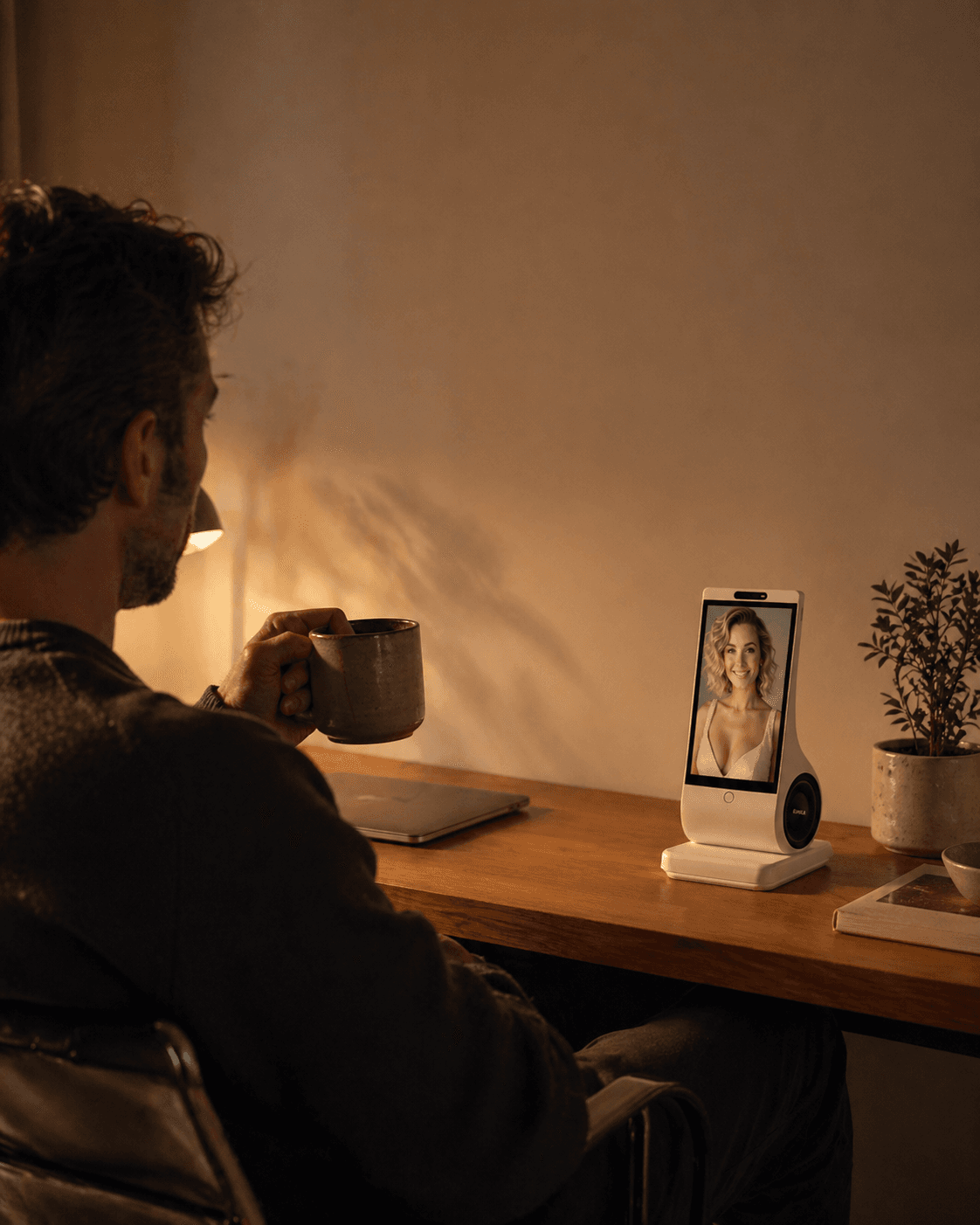
You can use an AI companion to explore your own reactions to a book, but you cannot assume that asking for “no spoilers” prevents disclosures or invented details. For an unfinished book, choose between discussing only what you describe and asking the system for book facts. If even a small hint would spoil the experience, keep factual questions out of the AI conversation until you finish.
This guide is for adult readers who want a conversation between reading sessions or before a book-club meeting. EUVOLA, which sells a home companion device, publishes it. The requests and reading note below are editorial suggestions, not a tested spoiler filter or evidence of improved reading comprehension.
Choose what the conversation is allowed to do
A discussion of your reaction needs no knowledge of the ending. You can say that a character's decision surprised you and explore why. A request to explain a character's identity, trace a mystery or summarize earlier chapters asks for facts about the work. Those facts need checking, and a response may draw on material beyond your reading position.
For a strict no-spoiler preference, use your own short description without naming the book: “Two friends disagree about whether to keep a promise. Ask me about what I found convincing in their choices.” This reduces how much book-specific information you invite into the exchange; it does not create a technical guarantee. Avoid adding the full plot, private annotations or an entire book simply to get a conversation started.
If you want factual help while still reading, consider a willing reader who knows your stopping point or an edition's notes you have checked for scope. A publisher's discussion guide may cover the ending, so save it until finishing unless its coverage is clear. Choosing to wait is a reasonable way to protect an experience that cannot be restored after a reveal.
Set a precise stopping point, then ask a bounded question
“Halfway through” is ambiguous. Record the title, author, edition or translation, and last completed chapter or named section. If you use pages, include the edition; page numbers alone may not identify the same passage. For an audiobook, note the chapter and the last event you have already heard, rather than expecting a timestamp to identify every edition.
Here is an illustrative request:
“I have finished chapter 4 of this edition and have not started chapter 5. Discuss only the events I describe here. Do not summarize later events, hint at future importance, confirm or reject my predictions, or invent quotations. Ask one question about my reaction. If answering needs information outside my description, say that you cannot answer within this boundary.”
Use the request only if you are comfortable with the remaining risk. It is an instruction, not proof that a service has restricted its access to later chapters. Even “you will understand that later” can reveal that a detail matters. Ask for questions about what you already noticed rather than confirmation of your theory.
For voice conversation, agree on short replies and how to stop using the product's documented controls. A spoken assurance that it will wait or avoid spoilers is not a verified setting. If a reveal starts, stop the exchange; do not ask the companion to explain the significance of the spoiler.
Check an alleged fact or quotation against your copy
Generative AI can confidently produce false content, as NIST's July 2024 generative AI risk profile explains. That warning is not a measured error rate for book discussion or EUVOLA.
Treat a quoted sentence as unverified until you can find it in your own copy within the part you have read. Ask for a chapter or passage location, but do not assume a supplied location is correct. If it cannot be found, mark it unverified and remove it from your discussion notes. Do not search an unrestricted plot summary to check it if avoiding spoilers is your priority.
Distinguish three things: wording you can locate, your interpretation of that wording, and an AI-generated possibility. Different interpretations can be interesting without becoming facts about the author or story. Ask “What in my description supports that reading?” rather than “What did the author secretly mean?” A plausible account of intention still needs evidence.
In translation, verify wording in the edition you are reading. Do not put a generated paraphrase in quotation marks or assume wording from another translation appears in yours. If you need a citation for an essay or public post, return to the text and the applicable citation requirements.
Keep your own reading note between sessions
A companion remembering the book title is not proof that it remembers your stopping point. Keep a short note outside the conversation and check it before restarting. The memory reliability guide covers remembering and correcting information more broadly; here the crucial detail is which material you have actually read.
A useful note can contain:
- Work and edition: title, author and translation if relevant.
- Boundary: last completed chapter or section, with nothing from later material.
- My reaction: one idea in your own words.
- Text to revisit: a location you found in your copy.
- Still uncertain: an interpretation or alleged fact you have not verified.
- Next conversation: a question for yourself or a willing reader, with the same stopping point.
This is a blank editorial record, not a customer diary or a score. Use as much or as little of it as helps. When restarting, restate the boundary rather than asking the AI to reconstruct it. Read its first reply cautiously; a successful previous session does not establish that the next one will stay within scope.
Use the chat to prepare for a conversation with a reader
Ask for one open question about a scene you have already described, then decide whether it represents your own curiosity. ALA's library facilitation guide, revised in September 2020, recommends welcoming questions grounded in participants' perspectives. It addresses human discussions, not AI effectiveness.
An original example is: “Which part of this decision felt understandable to you, and which part did not?” You can ask a friend or reading group the same question after agreeing on the reading boundary. Do not repeat a generated analysis as if it were your reading, or share another group member's comments with an AI without permission. An AI's encouraging response is also not evidence that everyone in the group will agree.
What should you verify before choosing EUVOLA for this?
The current EUVOLA FAQ describes a Wi-Fi-dependent home voice companion. This guide has not verified a book library, reading-position integration, edition-aware quotations or a spoiler filter for EUVOLA. Ask support about the exact interaction you need; do not purchase on the assumption that those features exist or will arrive.
A text tool may suit checking exact wording better if it provides usable source locations; that still needs verification. A voice device may suit discussing your own reaction if its controls work for you. The app-versus-device guide explains that format decision. Check the actual privacy policy and return terms before sharing material or buying.
Keep the conversation optional. A companion cannot replace human relationships, caregiving, clinical judgment, crisis support or emergency services. For reading, the immediate decision is simpler: if you require certainty that nothing beyond your stopping point will be revealed, finish the book first or use a trusted human arrangement rather than relying on the chatbot's promise.