
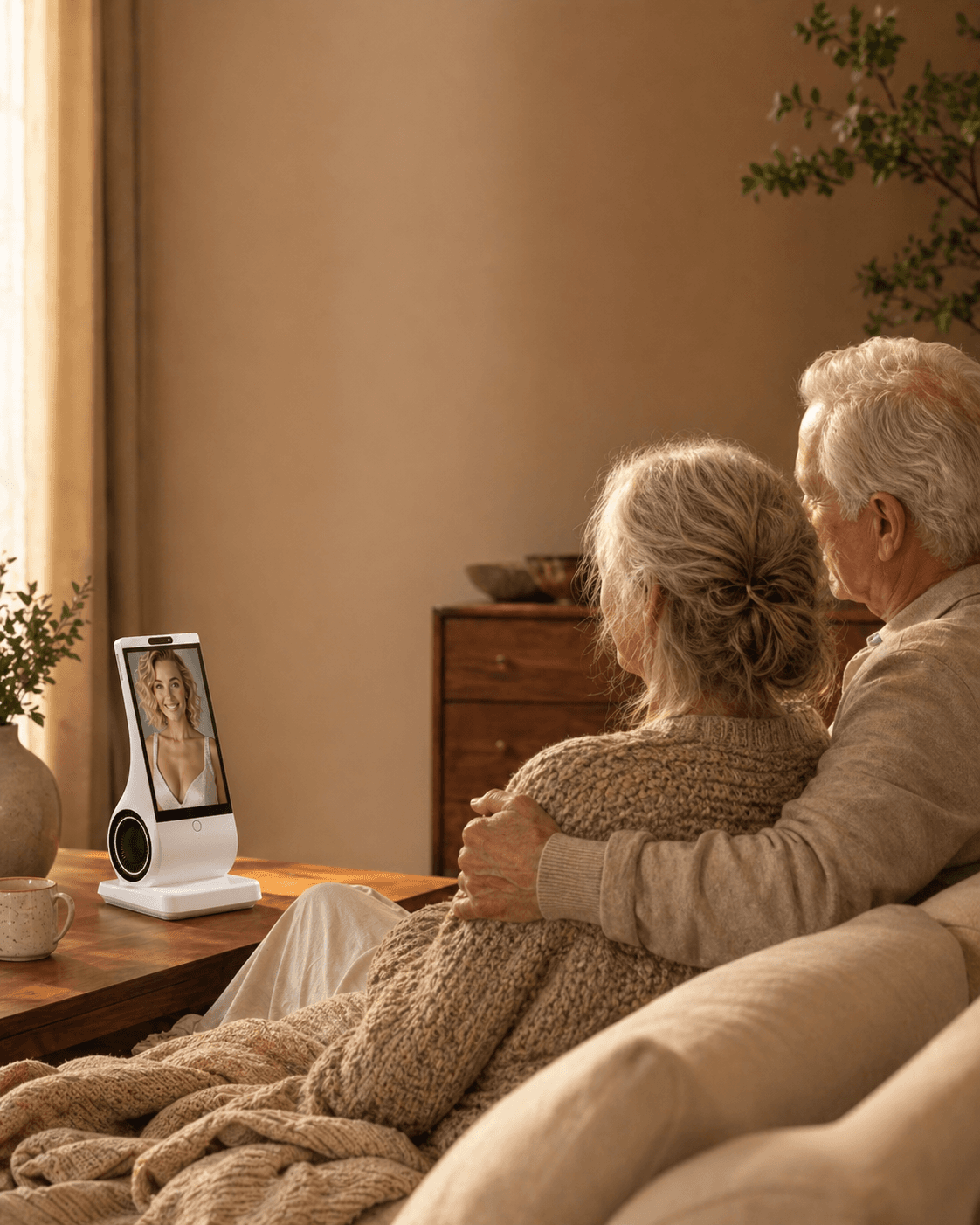
Keep health questions, but give them a boundary. Ask first whether anything practical needs attention, agree when to discuss it, then spend part of the call on the ordinary life you still share: a neighbour's dog, a recipe, a family decision, a match on television, or a plan for next week. The goal is not to avoid illness. It is to keep your parent a whole person and your relationship more than a care report.
Reviewed and updated: September 8, 2026. Written by the EUVOLA Editorial Team. The family scenes are illustrative, not customer testimonials or clinical case histories.
When a daughter becomes the family help desk
Picture a Sunday call that begins warmly and narrows within two minutes. Did the prescription arrive? What did the doctor say? Is the ankle still swollen? Has the boiler engineer called? Your parent answers, then adds a complaint about the pharmacy and a list of appointments. You open your calendar. Twenty-five minutes later, both of you have been responsible and neither of you has really visited.
Nothing in that call was trivial. Medication, pain, transport, bills, and a broken appliance matter. Avoiding them can leave a parent unsupported. Yet when every conversation follows the same route, the adult child becomes a coordinator and the parent becomes a bundle of needs. The two people who once argued about music, exchanged work stories, or planned a holiday disappear behind the checklist.
An adult child may miss being asked about their own life. A parent may notice that every caller sounds like a nurse. Some parents then conceal problems because they are tired of being assessed; others lead with problems because practical updates reliably hold the caller's attention. A longer call does not automatically repair either pattern.
The World Health Organization's explanation of social connection is useful here because it separates structure, function, and quality. Structure includes how many relationships and interactions a person has. Function is the support exchanged. Quality is whether those interactions feel positive, satisfying, strained, or harmful. A family can improve function by handling every appointment while watching the quality of the relationship decline. It can also have frequent contact without giving a parent the kind of connection they want.
This is why “call more often” is sometimes the wrong first instruction. The better first question is: what job has the call been forced to do, and which human part has been crowded out?
Give care administration its own lane
Separating care talk from ordinary talk does not mean pretending everything is fine. It means naming two legitimate lanes instead of letting one consume the other.
The care lane holds information that needs a decision, handoff, record, or safety follow-up: symptoms the parent wants help raising with a clinician, transport, prescriptions, paperwork, home repairs, bills, and agreed safety plans. It needs a place to land: a shared note, calendar, planning call, or the person who owns the next action. Repeating one worry on five family calls is not a reliable care system.
The relationship lane holds the conversation that would still matter if nobody needed managing. It may be funny, uneventful, opinionated, repetitive, quiet, or affectionate: what each person ate, a local change, consented family news, a television plot, a photograph, or a small decision. It is not filler before the serious part. It is the relationship.
Ask your parent how they want the lanes arranged. One person may want urgent practical business first so it stops hanging over the call. Another may need ten relaxed minutes before discussing a letter from the hospital. A third may want a separate Tuesday care call with one family member and ordinary calls with everyone else. Do not impose an artificial ban on health. Some people genuinely want to describe an illness, and being heard can be part of closeness. The distinction is choice, not topic purity.
A simple opening can be enough: “I want to hear how you are, and I also miss talking about ordinary things with you. Is there anything we need to sort today, or shall we keep this one as a normal call?” If something does need action, ask, “Do you want listening, help deciding, or for me to do a task?” Those three answers prevent many conversations from turning into unwanted advice.
Do not use the two lanes to dodge necessary care. Sudden confusion, new difficulty breathing, severe pain, signs of a stroke, a fall, threats of self-harm, abuse, or immediate danger are not conversation-design problems. Use local emergency, clinical, safeguarding, or crisis services. In the United States, 988 Lifeline's guidance for helping someone else explains how to reach crisis support; other countries have their own services.
Ask what kind of company they want today
“How are you?” is not a bad question. It is simply too broad to carry every call. A parent living with pain may hear it as a request for a medical report. A parent who dislikes discussing health may reply “fine” and close the subject. A person near the end of life may know that the honest answer will frighten the caller. Changing the question changes the invitation.
Offer a small menu rather than an interrogation:
- “Would you rather tell me what happened today, hear something from my day, or choose something we can do together?”
- “Do you want to talk about the appointment, or would you like a break from it?”
- “Would company help, even if neither of us has much news?”
- “Is there something you want my opinion on, or shall I ask for yours?”
- “Do you have energy for ten minutes, or would tomorrow be better?”
These questions return control without requiring the parent to invent a subject. They also allow “not today” to be a valid answer. A parent may want silence, rest, a programme, or somebody else. Respecting that preference is not abandonment.
Choice matters particularly when caregiving has changed the balance of power. A child may control transport, online accounts, or access to professionals. Even kindly phrased questions can feel like supervision when saying no has consequences. The systematic review of community-based person-centred care in BMC Geriatrics found recurring emphasis on older people's values, preferences, communication, and shared decision-making. It also notes the practical limits and tensions in implementing those ideals. A useful family translation is modest: ask before taking over, make the next action visible, and notice whether the parent can disagree safely.
There is no obligation to make every conversation profound. Ten minutes discussing supermarket strawberries can be more reciprocal than an hour of advice. Ordinary detail says, “You still belong in my everyday life.”
Build topics from now, then, next, and opinion
Many people freeze because they think a worthwhile conversation requires news. It does not. A dependable topic bank is built from four directions, each with a different emotional load.
Now: one specific thing from today
Avoid “What did you do?” when the likely answer is “nothing.” Bring a detail small enough to hold. “The café changed its chairs and everyone looks uncomfortable.” “A magpie stole the dog's biscuit.” “I tried the soup you recommended and added too much salt.” Then invite a response: “What would you have done?” Specific detail is easier to answer than a demand for an interesting life.
You can ask equally concrete questions: Which room is warmest this afternoon? What did you think of the radio interview? Did the market still have good tomatoes? Which neighbour puts out the blue flowers? The purpose is not covert monitoring. If you are actually checking whether the heating works or food is available, say so and move that question to the care lane.
Then: a memory with a reason for asking
“Tell me about your childhood” can feel like homework or a final interview. Anchor the memory in something present. “I passed a school sports day and remembered you hated running. What did you prefer?” “I am making your rice dish on Friday. When did you start adding lemon?” A photograph, object, song, or current family decision can supply the hook.
Let uncertainty remain. A parent can remember an event differently from a sibling. Conversation is not a court transcript. If the purpose is to preserve a family record, obtain consent, keep the original recording or document, mark uncertainty, and use a proper archive. An AI companion's remembered context is not automatically a transcript or family archive; the separate EUVOLA guide to preserving a parent's stories and voice explains that boundary.
Next: a real choice within reach
Future talk need not mean another medical appointment. Ask which cake to bring, which match to watch together, where to put a plant, whether to call Saturday morning or afternoon, or which photo a grandchild should use for a school project. The choice must be genuine. Asking “Would you like to go out?” when transport, accessibility, and timing are already impossible only advertises lost control.
A tiny plan gives the next conversation a bridge. “I will send two soup recipes; choose the stranger one.” “You watch the first half, I will watch the second, and we will compare notes.” The parent contributes to what happens next rather than waiting to be checked.
Opinion: ask for judgment, not just history
Care can quietly recast a competent adult as a recipient. Ask for expertise that is real: how to negotiate with a tradesperson, rescue a plant, phrase a difficult message, season a dish, choose between two coats, understand a family custom, or judge a local decision. Do not manufacture dependence by pretending you cannot do something. Say why their perspective matters.
Opinion also creates room for disagreement. A relationship in which the parent is allowed only to be grateful is not reciprocal. You can disagree without turning the call back into a capacity test. “I see it differently, but I wanted to know how you read it” preserves adulthood better than correcting every conclusion.
Keep a short private list of hooks for yourself, not a dossier on your parent. Four or five prompts are enough. Delete intimate material you do not need. A conversation bank should reduce pressure, not turn family life into data collection.
A twenty-minute example, not a prescription
Suppose you have twenty minutes and both people know the limit. A possible split is five minutes for care administration and fifteen for ordinary connection:
- Minutes 0-2: arrive. Say where you are, ask whether it is a good time, and listen to the first answer without opening another app.
- Minutes 2-5: triage the practical lane. Ask whether anything needs action before the next planned care check. Record an action once, with an owner and a date. If the issue needs a longer decision, schedule it rather than rushing.
- Minutes 5-11: exchange one ordinary detail each. Do not require equal speaking time, but make room for both lives.
- Minutes 11-17: use one hook. Ask an opinion, look at the same photograph, compare a programme, plan food, or continue yesterday's story.
- Minutes 17-20: close clearly. Say what will happen next: who is calling, when, and what practical action is pending.
The arithmetic is transparent: 5 care minutes + 15 relationship minutes = 20 minutes. It is not a therapeutic dose, a research result, or a rule for every family. On a difficult day, the care issue may need all twenty minutes. During a comfortable shared activity, the call may last an hour. The value of a split is that you can notice when practical work consumes every contact for weeks.
Ask your parent to change the ratio. One may choose 10 + 10. Another may prefer a dedicated 30-minute care call on Monday and no care agenda on Thursday. A person who tires easily might choose 2 + 8. Write down the arrangement only if it helps both people.
Do not score the call by how entertaining it was. Ask instead: Did an urgent task get an owner? Could the parent choose or refuse a topic? Did both people exist in the conversation? Did it end on time? Is another human contact planned? Those questions expose a failing process without grading anyone's personality.
The SAME Page pilot trial, reported in the Journal of General Internal Medicine, tested a checklist for older patients, family companions, and clinicians before primary-care visits. In 93 dyads, it changed some measures of patient-centred communication and the balance of topics in some settings, but not every outcome or clinic. That study is not proof for a family-phone formula. It provides a narrower lesson: when medical priorities need attention, agreeing the agenda can keep roles and concerns from remaining implicit.
When the conversation is one-sided
A parent who speaks for forty minutes without asking a question may be lonely. They may also be anxious, hard of hearing, excited, used to a family pattern, afraid that silence will end the call, living with cognitive change, or simply poor at reciprocal conversation. Do not diagnose the cause from a phone habit.
Start by making your limit predictable before resentment peaks: “I can talk until quarter past. I want to hear your news, and I have one thing I would like to tell you too.” When the boundary arrives, do not introduce a new excuse that can be negotiated. “I need to stop now. I will call Sunday after lunch.” Warmth and finality can coexist.
If interruptions are the problem, name the turn rather than attacking the person: “Hold that thought; I want to finish this sentence, then I am listening.” If you are never asked about your life, volunteer one bounded story and ask whether they have space to hear it. Some parents do not know what adult children want to share. Others may be unable or unwilling to offer the relationship you hope for. A topic system cannot fix contempt, coercion, abuse, or decades of emotional absence.
Daily calls are not a moral minimum. The right rhythm depends on consent, relationship history, need, time zones, other contacts, and the care plan. The existing guide to AI companionship between family calls argues for three separate calendars: human contact, companion use, and actual care or safety. Do not collapse all three into the most available adult child's phone.
If every call leaves you panicked, sleepless, financially pressured, or unable to function, the next step may be a family meeting, caregiver support, counselling, social-work advice, legal or financial guidance, or less contact. A conversational device should not be used to make an unsafe relationship easier for others to ignore.
Adapt the conditions before blaming the relationship
What sounds like disinterest or repetition may partly be a bad channel. Check the setting and the person's needs before deciding that better topics failed.
Hearing changes
The National Institute on Deafness and Other Communication Disorders notes that age-related hearing loss can make conversation with family and friends difficult and contribute to isolation. It recommends practical measures such as facing the person, speaking clearly without shouting, and reducing background noise. On a video call, good light and a stable camera can help a person see expressions and lip movement. On a voice call, turn off the television, use the device the parent hears best, and ask whether the pace is comfortable.
Do not respond to missed words by using a childish tone or speaking about the parent as if they are absent. A hearing assessment and appropriate hearing support are different interventions from buying a louder companion device. Sudden hearing change or other symptoms warrant professional advice.
Dementia or cognitive change
Dementia is not ordinary ageing, and not every repeated story indicates dementia. When a person is living with dementia, adapt to them rather than applying generic conversation tricks. Alzheimer's Society guidance recommends a calm, well-lit environment, reducing distractions, allowing time to process and respond, avoiding interruption, and including the person rather than talking around them. It emphasizes that every person's experience is different.
Use one idea at a time. Offer limited, meaningful choices. A photograph, familiar music, folding towels, watering a plant, or sitting together may carry more connection than repeated questions. Do not test memory or correct every detail. Coordinate important medical or safety information through the agreed care system, not by secretly interrogating a casual conversation.
An AI companion can make factual errors, misunderstand speech, or continue a confused premise. It is not supervision. For a fuller decision framework, read whether an AI companion is safe for a parent with dementia or memory loss.
Serious illness, fatigue, and the end of life
A seriously ill parent may want to discuss symptoms, death, ordinary gossip, or none of them. Ask: “Do you want to talk about what is happening, or would another subject be a relief?” Follow their lead without making them protect you from every feeling. Silence, reading aloud, music, a hand massage with permission, or describing the view can be genuine contact.
Health and palliative-care decisions belong with the person and their clinical team. An AI companion should not interpret symptoms, alter medication, deliver a prognosis, or substitute for hospice, palliative care, spiritual care, counselling, or family presence. If the parent is too tired to talk, do not turn companion use into another task they must perform to reassure the family.
Where an AI companion might fit
An AI companion is a system designed for repeated personal interaction, often through text or voice and sometimes with a stable persona or remembered context. Its plausible role here is narrow: it may give a willing parent another place for ordinary conversation between human contacts. A parent might talk about the garden, practise telling a story, ask for ideas for Friday's family call, or continue a topic when relatives are asleep in another time zone.
That possibility is not the same as evidence that the device will improve family conversation. A short research manuscript by De Freitas and colleagues reports reductions in loneliness in several studies, including a one-week longitudinal design, and highlights feeling heard. The settings, products, participants, and short time horizon limit what a family can infer. A separate four-week experiment by Fang and colleagues detected no significant effects from assigned conversation or modality conditions; heavier voluntary use was associated with worse psychosocial outcomes. That association does not prove heavy use caused harm. Together, the studies justify a cautious trial and observation, not a promise.
A useful test asks whether companion talk creates bridges outward. Does the parent bring a new question to a daughter? Decide to call a friend about a shared interest? Remember a programme they want to watch together? Or does the family start calling less because “the device has company covered”? The first pattern may complement a relationship. The second is substitution, even if total minutes of conversation increase.
Never use an AI companion as a covert reporter. If the family needs health updates, obtain them through consented human and clinical arrangements. Do not mine conversations for mood, infer a diagnosis, or demand transcripts. Connected conversation can contain intimate information about the parent and people who never agreed to use the product. Current ICO guidance for consumer connected products emphasizes transparency, limiting data to what is necessary, and meaningful user controls. Read the product's actual privacy and deletion terms before installation.
A transparent EUVOLA fit check
EUVOLA publishes this guide and sells an AI companion, so the relevant product facts and the conflict of interest should be explicit. According to the EUVOLA FAQ, EUVOLA is a dedicated, voice-first home device with a personalized on-screen avatar. It has no camera. It requires Wi-Fi and does not currently work offline.
For this use case, voice interaction may suit a parent who prefers speaking to typing, but “voice-first” does not guarantee easy recognition. Accent, language, hearing, room noise, and the person's voice all matter. Test it in the actual chair, at the actual time of day, with the television and household sounds that normally exist.
EUVOLA is not a family communication or monitoring portal. Its current FAQ says that family messaging, photo sending, conversation viewing, summaries, family accounts, and permission management are not available. Remote setup is planned, not currently available. Do not buy it expecting to read what a parent said or receive a digest of their health.
It is also not a medical, therapy, caregiving, or emergency product. It cannot diagnose or treat a condition, give medical advice, confirm medication intake, notify family about missed medication, detect falls, call emergency services, or handle a crisis. It may create reminders, but a reminder is not confirmation or supervision.
The fit question is therefore specific: does the parent voluntarily want a voice conversation at home, understand that the replies are generated, accept the data practices, have reliable Wi-Fi and setup support, and retain human contact? If any answer is no, a phone schedule, shared activity, hearing support, community programme, or another non-AI option may fit better.
Run a fourteen-day bridge test
Do not measure success by device minutes or by whether the adult child feels less guilty. Before day one, keep the existing human-call schedule. Agree one modest job, such as “a place to talk about the day's small events before our Wednesday call.” Write down return, cancellation, deletion, and support deadlines.
During days one to three, let the parent choose when to use it. Verify volume, recognition, charging, Wi-Fi, and how to stop. Do not coach them to produce a positive demonstration. A device used only while the buyer is watching has not passed a home-use test.
During days four to seven, look for one outward bridge. The parent might save a question for a sibling, choose a programme to discuss, or decide to phone a friend. They do not need to disclose the content of private companion conversations. “Did anything give you an idea for another conversation?” is less intrusive than “What exactly did you tell it?”
During the second week, test an ordinary failure: a misunderstood phrase, a weak Wi-Fi period, an unwanted reply, or a day when the parent does not feel like using it. Can they stop, recover, and get help without panic? Does the family keep its promised contact? Has anyone quietly started assuming the device covers loneliness, care, or safety?
At day fourteen, the parent has the deciding vote unless capacity or immediate safety creates a separate legal and care question. Continue only if use is voluntary, the practical burden is tolerable, privacy is understood, human contact remains intact, and the device adds a kind of conversation the parent actually values. Return, pause, or delete it without treating the purchase price as a reason to persist.
Five actions before the next call
- Ask which lane is needed. Say, “Do we need to sort anything practical, or would you like a normal chat today?” Do not disguise monitoring as casual interest.
- Bring one real detail and one real question. A small event from your day plus a request for the parent's opinion is enough. Avoid firing a list of prompts.
- Give the call a kind, honest boundary. State the available time near the beginning and name the next contact before ending.
- Move actions out of the conversation. Put each care task in the agreed calendar or note with one owner and date so it does not occupy every call.
- Protect another human bridge. Plan a friend, relative, neighbour, group, shared programme, or visit. If testing an AI companion, do not cancel that bridge to make room for it.
The checklist is deliberately small. A family should be able to use it without turning affection into a project plan.
Common mistakes and a more useful correction
“If I do not ask about health, I am neglecting them”
Health questions can be necessary. Neglect comes from leaving needs without a safe response, not from spending ten minutes on football or bread. Put essential follow-up in a reliable care lane; then ordinary conversation no longer has to carry hidden surveillance.
“More prompts will make the conversation better”
A rapid series of questions feels like an interview. Offer one hook, listen to the answer, and contribute something of your own. Shared attention is different from extracting content.
“Talking about the past always works”
Memories can delight, bore, confuse, hurt, or feel like preparation for death. Ask permission and connect the memory to a present reason. Do not force life review on a parent who wants to discuss this morning's match.
“A lonely parent should accept any company offered”
Loneliness does not erase taste, privacy, or the right to refuse. A parent may dislike a device, a group, a volunteer caller, or a particular relative. The WHO definition treats loneliness as a gap between the connection a person has and the connection they want; unwanted contact can add structure without adding quality.
“A device can take the repetitive part off the family's plate”
That sentence centers the buyer's relief. Repetition may be harmless storytelling, a sign of hearing difficulty, anxiety, cognitive change, or an unmet need. Investigate respectfully. Never assign an AI companion as a containment strategy for a person other people find tiring.
“If the companion remembers, the next family call will be better”
AI memory can omit, distort, or surface details at the wrong moment. Family members should not rely on it to preserve care instructions or relationship history. Use normal care records for tasks and an agreed archive for material the parent wants preserved.
“A warm call means there is no serious problem”
Pleasant conversation is not a safety assessment. A parent can enjoy a joke while needing medical, financial, safeguarding, or practical help. Keep the systems separate so neither is falsely reassuring.
When this approach is not enough
Conversation design cannot resolve untreated pain, delirium, major hearing loss, medication problems, food insecurity, unsafe housing, abuse, coercion, financial exploitation, severe depression, caregiver collapse, or an emergency. It cannot make a historically abusive relationship reciprocal. It cannot grant decision-making capacity, settle a power of attorney dispute, or replace professional assessment.
If a parent abruptly changes how they communicate, seems newly confused, cannot follow a familiar exchange, or shows other concerning symptoms, seek appropriate medical advice rather than assuming ageing or loneliness. If the parent expresses a wish to die, self-harm, or immediate danger, respond as a real safety issue and contact local crisis or emergency services. Do not leave an AI system to manage it.
The adult child's wellbeing also matters. Resentment, dread, and exhaustion do not make somebody unloving. They may show that one person is carrying an impossible combination of emotional companionship, administration, money, transport, and clinical coordination. A caregiver group, therapist, social worker, ageing-services organization, faith or community leader, or another family member may help redistribute the work. An AI companion is not a substitute for that redistribution.
Sometimes the honest outcome is a shorter call, a different topic, or less contact. A respectful boundary can preserve more relationship than a daily conversation conducted under obligation.
Questions families ask
Should I stop asking “How are you?” altogether?
No. Ask it when you are ready to hear the answer and the parent wants the question. You can make it more precise: “How is your energy today?” “Is anything different since we spoke?” or “Do you want to talk about health, or take a break from it?” Precision reduces the pressure to recite every problem. If you need specific care information, explain why and what will happen with it. Then ask an ordinary question without implying that health has been dismissed.
What if my parent wants to talk only about illness?
Listen first and ask what they need: company, validation, a decision, or an action. If the same issue recurs without a clear next step, move it into a scheduled care conversation or professional channel. You can also say, “I have ten minutes for this now, then I would like to tell you something from my week.” A parent facing serious illness may reasonably choose illness as the subject. The aim is not to force cheerfulness; it is to make the choice explicit and protect both people from an endless, undefined role.
What if my parent says there is nothing to talk about?
Supply one small, specific detail rather than another broad question. Describe something you saw, ask for an opinion, listen to the same short piece of music, or look at one photograph. Silence is also allowed. If the parent consistently does not want calls, ask what contact they would prefer. Do not assume reluctance proves depression, cognitive decline, or rejection. A marked change combined with other symptoms is a reason to seek appropriate professional advice.
Is it disrespectful to set a time limit?
No, if the limit is honest, predictable, and not used to punish. Say it early: “I have twenty minutes and I want to spend them with you.” Give a brief warning near the end and name the next contact. Do not claim an emergency every time or remain on the call while becoming increasingly angry. If a practical issue cannot fit, schedule a separate decision. A reliable short call can feel safer than an unlimited call that ends abruptly.
Can an AI companion suggest topics for our family calls?
It may generate ideas or help a willing parent rehearse something they want to discuss, but verify whether the specific product supports the interaction and memory you expect. Generated prompts can be generic, intrusive, or wrong. Do not upload private family material without consent. The useful outcome is not a polished script; it is a bridge into a real conversation chosen by the parent. Keep family contact unchanged during a trial so the device does not become an excuse to call less.
Can I read the companion's conversations to know what my parent needs?
Do not assume that right. Private conversation remains private unless the parent knowingly chooses to share it and the product provides an appropriate control. EUVOLA's current FAQ says family conversation viewing and summaries are not available. Even where another product offers access, consider other household members and people mentioned in the conversation. Health, safety, and care reporting should use explicit, consented channels rather than covert monitoring or AI mood inference.
What changes if my parent has dementia?
Start with the individual, their stage and pattern of dementia, hearing and vision, preferred language, and care plan. Reduce distractions, allow more response time, use one idea at a time, and include rather than test them. Familiar music or shared activity may work better than questions. AI can misunderstand, reinforce an error, or create distress, so it requires closer assessment and support and is never supervision. Consult the person's care professionals for communication changes or safety concerns.
How will we know whether the new approach is working?
Do not look for a mood score or a perfect 50-50 speaking split. After two weeks, ask whether urgent tasks have clearer owners, whether the parent can choose or refuse topics, whether both people share something of ordinary life, whether calls end as promised, and whether other human connections remain. Ask the parent directly what feels better or worse. If the change mainly makes the adult child feel less guilty while the parent loses contact, it is not a successful bridge.
What if conversations stay painful despite all of this?
Stop treating topic selection as the only cause. The relationship may carry grief, conflict, abuse, cognitive change, untreated symptoms, or unequal caregiving work. Choose support suited to the cause: a clinician, hearing professional, palliative-care team, social worker, caregiver group, therapist, mediator, safeguarding service, or crisis service. You are not required to expose yourself to harm to prove love. A device cannot repair a relationship that is unsafe or fundamentally one-sided.
The question to carry into the next call
Do not ask only, “Did I check on my parent?” Ask, “Did my parent have room to be a person, and did I have room to be one too?” A good care system catches actions that matter. A good relationship still contains opinion, boredom, disagreement, humour, memory, plans, and the freedom to stop.
An AI companion may add another conversational moment for someone who wants it. It should not inherit the family's care obligations, private access, or emotional conscience. Keep the practical lane reliable, keep ordinary life alive, and let the parent help decide what the next conversation is for.
Sources and further reading
- World Health Organization: Social connection, 30 June 2025
- NIDCD: Age-Related Hearing Loss
- Alzheimer's Society: How to communicate with a person with dementia
- BMC Geriatrics: Person-centered care for community-dwelling older people
- BMC Geriatrics: Communication factors in residential and community aged care
- Journal of General Internal Medicine: SAME Page pilot trial
- ICO: Guidance for consumer Internet of Things products and services
- De Freitas and colleagues: AI Companions Reduce Loneliness, research manuscript
- Fang and colleagues: Extended chatbot use, research manuscript version 2
- 988 Lifeline: Help Someone Else, United States
- EUVOLA: Official FAQ and current product boundaries